
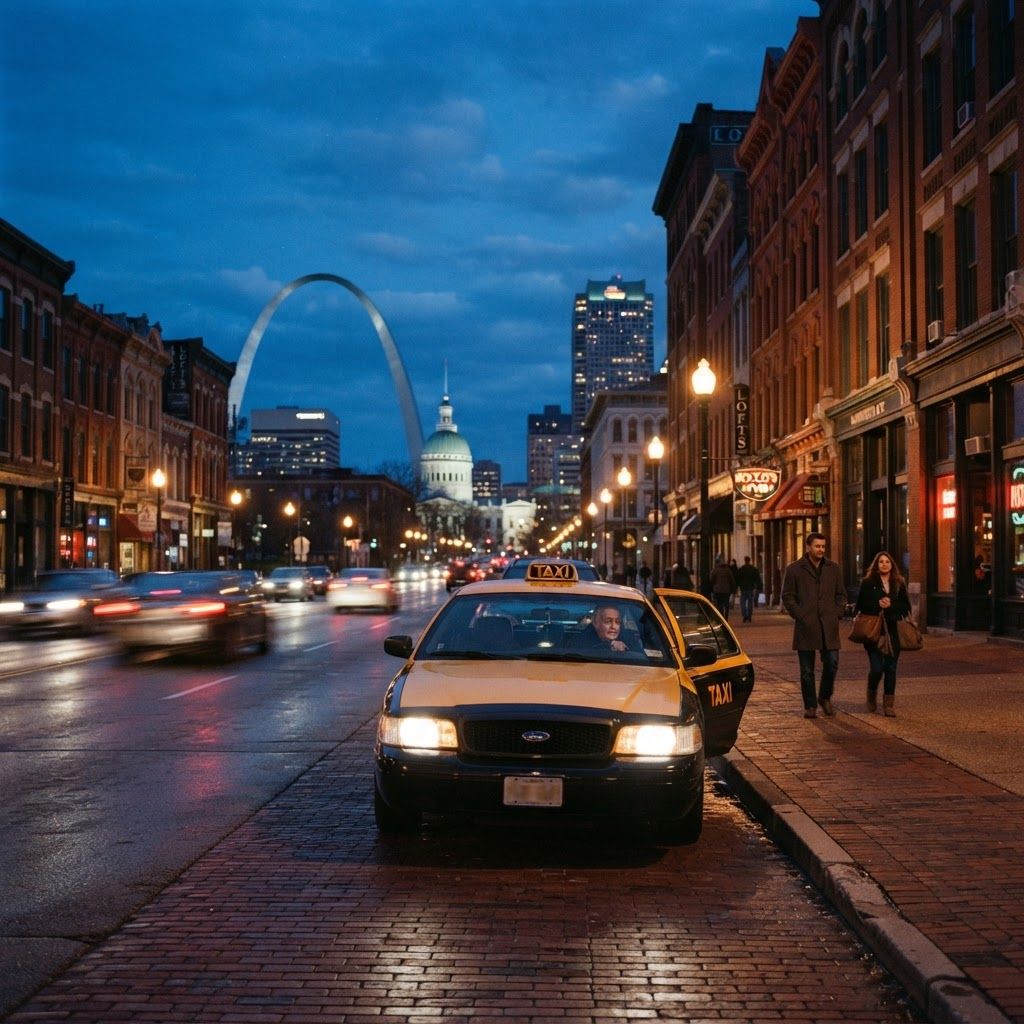
How Ground Transportation Works in St. Louis
St. Louis occupies an unusual middle ground in urban transportation. It is large enough to sustain a real for-hire vehicle industry but spread out enough that walking and transit rarely cover a full itinerary. The result is a market where traditional dispatched taxis, app-based rideshare, black car services and specialty transport all coexist and each holds meaningful share.
Geography drives a lot of this. Lambert International Airport sits northwest of the city core, roughly fifteen to twenty-five minutes from downtown depending on traffic on I-70. The entertainment districts, Washington Avenue, the Grove, Soulard, the Delmar Loop and the Central West End, are scattered rather than concentrated, which means night-out transportation often involves multiple hops. Major venues including Busch Stadium, Enterprise Center, CITYPARK and the Fox Theatre create sharp, predictable demand spikes that overwhelm supply at exactly the same moments every week.
Traditional Taxi Versus App-Based Service
The distinction still matters here. Dispatched taxi companies operate metered, regulated vehicles with fixed or capped airport rates, accept street hails and phone bookings, and can be reserved in advance with genuine reliability. That advance-booking dependability is their enduring advantage: a 4:30 a.m. airport pickup arranged the night before is more reliable through a dispatched company than through an app that depends on a driver happening to be awake and nearby.
App-based services win on convenience, transparency and short-notice availability, particularly in the urban core during daytime and evening hours. Their weakness is surge pricing during exactly the high-demand moments when you most need a ride, and thinner coverage in outlying municipalities late at night.
The Ten Best Taxi and Ride Services in St. Louis
1. St. Louis County Cab and Yellow Cab
The region's largest and longest-established taxi operation remains the benchmark for dispatched service. Its fleet size means it can absorb demand that smaller operators cannot, and it maintains a consistent presence at airport queues, hotels and convention venues. Advance reservations for early morning airport departures are its strongest use case, and its metered pricing offers predictability when apps are surging. Wheelchair-accessible vehicles are available through dispatch with advance notice.
2. Uber
Uber has the deepest driver network in the metro and consequently the shortest average wait times in the urban core and inner suburbs. Its tiered products cover everything from shared economy rides to premium sedans and larger vehicles for groups. Designated pickup zones at Lambert are clearly marked and well organized. The service is the practical default for most routine trips; the caveat is that fares during game egress or severe weather can multiply.
3. Lyft
Lyft operates a comparable model with a driver base that overlaps heavily with Uber's, and running both apps side by side is the single most effective way to control cost, since surge conditions rarely hit both platforms identically. Lyft's scheduled ride feature has improved considerably and is a reasonable option for airport departures, and its partnership programs with local employers and health systems are well established in the region.
4. Laclede Cab Company
Laclede is a long-standing local operator with a reputation built on driver knowledge rather than technology. Its drivers tend to know the region's neighborhoods, one-way streets and event traffic patterns in a way that app-based part-time drivers often do not. For visitors who value a driver who can actually navigate around a stadium letout, this local expertise has real value.
5. Harris Cab Company
Harris serves both city and county with a focus on reliability for recurring customers. Its business is heavily weighted toward scheduled service, including medical appointments, standing corporate accounts and regular airport runs. Customers who need the same trip every week generally find the consistency here preferable to app-based variability.
6. Gateway Black Car and Executive Sedan Services
The executive car segment serves business travel, client transport and premium airport service with pre-arranged pricing, professional chauffeurs and higher-end vehicles. For anyone arriving for a business meeting in Clayton or hosting visiting executives, a black car booked in advance with meet-and-greet service at baggage claim eliminates variability entirely. Cost is higher, but pricing is fixed and known before the trip.
7. Midwest Limousine and Party Bus Operators
Group transportation for weddings, bachelor and bachelorette parties, winery tours through Augusta and Hermann, and corporate outings is a substantial local segment. Operators here offer stretch vehicles, sprinter vans and larger coaches with hourly minimums. The safety value is real: for a group planning a day of wine tasting, hired transportation is materially better than designating a driver and hoping.
8. Medical Transportation Providers
Non-emergency medical transportation is an underappreciated but essential part of the market, particularly given the concentration of major hospital systems in the Central West End, Clayton and across the county. Providers in this segment offer wheelchair-accessible vehicles, stretcher transport, trained attendants and coordination with insurance and Medicaid transportation benefits. For dialysis, oncology and post-surgical appointment travel, these specialized operators are the correct choice rather than general rideshare.
9. Airport Shuttle and Hotel Transfer Services
Shared-ride shuttles and hotel courtesy vans serve the price-sensitive airport traveler well. Many downtown and airport-adjacent hotels operate complimentary shuttles, and shared shuttles running fixed routes to hotel clusters cost substantially less than a private ride. The trade-off is time, since shared routing means waiting for other passengers and multiple stops.
10. Metro Call-A-Ride
The regional transit agency's paratransit service provides curb-to-curb transportation for riders whose disabilities prevent use of fixed-route bus and light rail. It operates on advance reservation with fares far below commercial rates and is a genuinely important accessibility resource across the service area. Eligibility certification is required, and booking windows should be respected, but for qualifying riders it is the most affordable reliable option available.
Trends Reshaping the Market
Several developments are worth noting. Cashless payment has become near-universal, including at traditional taxi companies that once resisted it. Fleet electrification is beginning to appear in the premium and rideshare segments, driven by fuel economics as much as environmental commitment. Health system partnerships have expanded, with hospitals increasingly arranging patient transportation directly to reduce missed appointments. And integration between transit and rideshare, using an app-based ride to reach a MetroLink station rather than driving the full distance, is growing among commuters.
Practical Advice for Riders
Book airport departures in advance rather than relying on morning availability, especially for flights before 7 a.m. Compare both major apps before accepting a fare during peak periods. Walk two or three blocks away from a stadium exit before requesting a ride to escape the worst surge zone. Confirm the vehicle and driver against the app before entering. For group travel or wine country trips, hire a vehicle rather than improvising. And for medical appointments, use providers built for that purpose rather than general services.
Final Thoughts
St. Louis is well served across the transportation spectrum. Uber and Lyft handle the everyday, established taxi companies deliver the scheduled reliability apps struggle with, executive services cover professional needs, and specialized medical and paratransit providers serve riders with specific requirements. Match the service to the trip and the market works well in your favor.