
What Makes Chula Vista's Grocery Market Distinct
Grocery retail in Chula Vista is more varied than in most American cities of comparable size, and the reason is demographic rather than economic. A majority-Latino population, close proximity to the international border and a large share of multi-generational households produce genuine demand for specialty produce, fresh masa, whole cuts of meat, Mexican dairy products and bulk staples that mainstream national assortments handle inconsistently.
The result is a two-tier market. National and regional chains compete on price, convenience and pharmacy or fuel integration, while Hispanic-focused supermarkets compete on produce variety, in-house butchery, tortillerias and prepared foods. Households commonly shop both, buying packaged goods and household supplies at one and fresh produce and meat at another. Understanding that split is the key to shopping the city efficiently.
Hispanic and Specialty Supermarkets
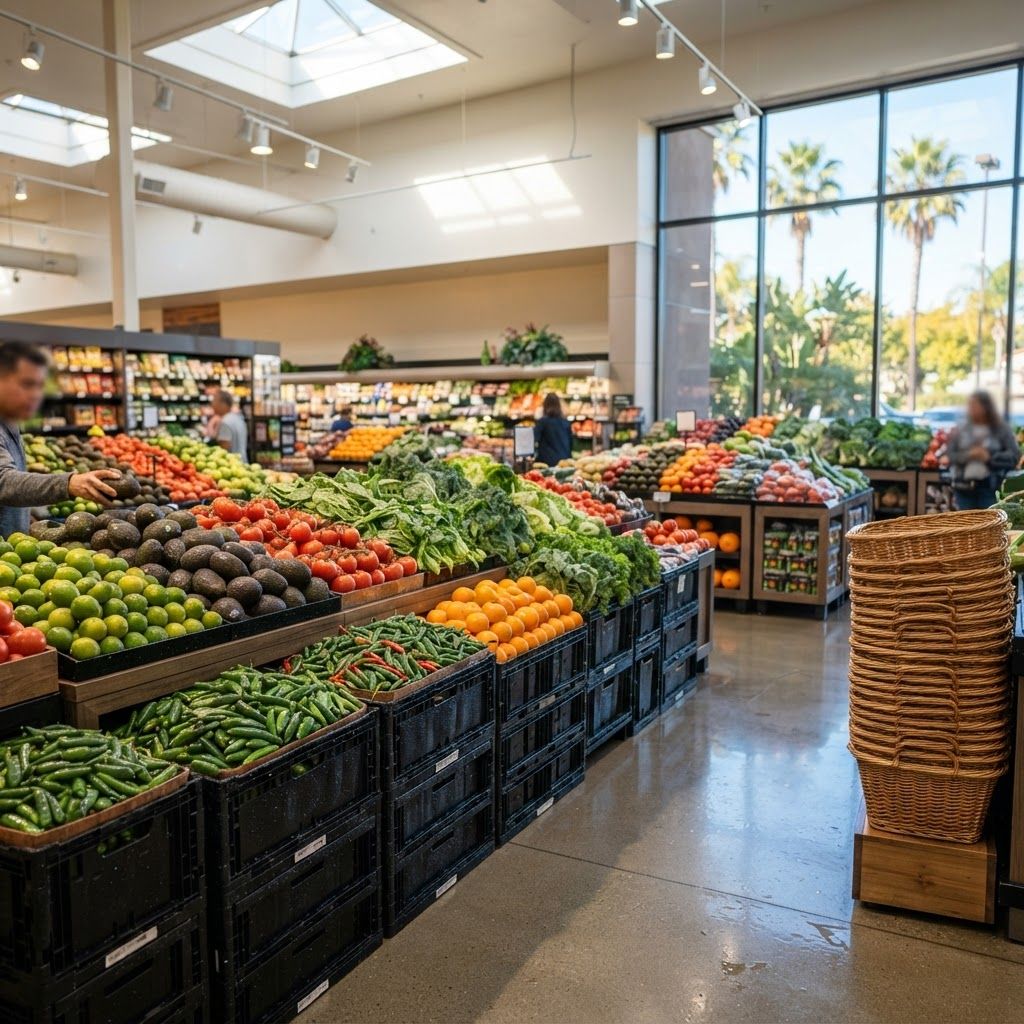
Northgate González Market is one of the strongest grocery operations in the South Bay, and its advantages are concrete rather than atmospheric. Its produce departments carry a far wider range of chiles, tropical fruit, cactus, herbs and root vegetables than mainstream competitors, with faster turnover and correspondingly better freshness. Its full-service carnicería handles cuts prepared to order, and its in-store tortilleria produces fresh corn and flour tortillas daily. Prepared food counters, bakeries and juice bars make it a destination rather than a stop.
Vallarta Supermarkets follows a similar model with comparable strengths in meat and produce, competitive pricing on staples, and hot food service that draws consistent lunchtime traffic. For households buying whole chickens, larger cuts of beef and pork, and produce in quantity, per-pound pricing is frequently the best available locally.
Cardenas Markets rounds out this segment, with particularly strong dry goods and spice selections alongside its fresh departments. Its bulk dried chiles, beans and rice pricing is notably competitive, and its bakery output is substantial.
Conventional and Regional Chains
Vons remains a widely used conventional supermarket in the city, valued for pharmacy integration, broad packaged-goods selection and digital coupon programs that produce real savings for shoppers who use them consistently. Its fuel rewards partnership adds meaningful value for commuting households. Base pricing on center-store items runs higher than value-focused competitors, and the loyalty pricing is where the actual value sits.
Albertsons operates comparably, with similar pharmacy and rewards infrastructure. Both chains have invested heavily in delivery and pickup fulfillment, which matters for households where time is the constraint rather than budget.
Ralphs offers a similar conventional assortment with strong private-label depth. Its store brands across dairy, canned goods and frozen categories deliver quality close to national brands at meaningfully lower prices, which is the most reliable way to reduce a grocery bill without changing what you cook.
Value-Focused Grocers
Food 4 Less competes squarely on price, using a warehouse-style presentation and bag-your-own model to reduce operating costs. For households buying in volume on a tight budget, its per-unit pricing on staples is among the lowest in the city. Presentation and service levels are lower, which is the explicit exchange.
Grocery Outlet operates an opportunistic buying model, purchasing closeout and overstock inventory and passing substantial discounts through. Selection is genuinely unpredictable, which makes it unsuitable for planned list shopping but excellent for flexible shoppers willing to build meals around what is available. Its natural and organic closeouts often sell far below conventional organic pricing.
Aldi has expanded its California presence with a deliberately limited assortment centered on private label. The model works because narrow selection reduces cost across the supply chain, and quality on core items is consistently good. Shoppers should expect to be unable to complete a full list there, and to supplement elsewhere.
Specialty and Wholesale Formats
Trader Joe's serves a distinct purpose in the local market. Its assortment is small and almost entirely private label, but its prepared foods, frozen items, snacks and wine represent strong value, and its produce pricing on core items is competitive. It functions as a supplementary rather than primary grocery destination for most households.
Costco closes the list, and for large households in Chula Vista it frequently anchors the monthly grocery budget. Its per-unit pricing on meat, produce in bulk, dairy, pantry staples and household supplies is difficult to beat, and its pharmacy, optical and fuel operations extend the value of membership well beyond food. The constraints are quantity and storage: bulk purchasing saves money only when the food is actually consumed before spoiling, and waste erases the savings quickly.
Practical Strategies for Local Shoppers
The single highest-return habit in this market is splitting shopping between a Hispanic supermarket for fresh produce and meat and a conventional or value chain for packaged goods. The price and quality gaps in both directions are large enough to justify two stops, and for many households the produce savings alone exceed the added time cost.
Use loyalty programs deliberately at conventional chains, where the gap between shelf and member pricing is widest. Digital coupon clipping before shopping takes a few minutes and routinely reduces a large basket by a noticeable margin. At value chains, focus instead on private label and per-unit comparison, since promotional pricing plays a smaller role.
Shop produce by season. Southern California's growing calendar means local citrus, avocados, strawberries and stone fruit all have windows where quality peaks and pricing drops significantly. Buying against the season means paying import premiums for lesser product.
Trends Affecting Grocery in the City
Three developments are reshaping local grocery. Online ordering with curbside pickup has moved from convenience to habit for a substantial share of households, and fulfillment quality now differentiates chains as much as in-store experience. Prepared and semi-prepared meal offerings have expanded across nearly every format as households cook less from scratch on weeknights. And private label has improved markedly in quality, narrowing the perceived gap with national brands and shifting share accordingly.
Price transparency has also improved. Unit pricing displayed on shelf tags allows genuine comparison across package sizes, and shoppers who read unit price rather than package price consistently spend less. It is the simplest available tool and the most widely ignored.
Final Thoughts
Chula Vista's grocery market is a real advantage for residents, offering depth in fresh produce and meat that most American cities lack alongside the full range of national and value formats. The households that shop it best treat it as a portfolio rather than a single destination: fresh departments at Hispanic supermarkets, bulk staples at wholesale clubs, packaged goods at value chains, and conventional supermarkets for pharmacy, convenience and loyalty pricing. That approach consistently produces better food at lower cost than loyalty to any single store.