
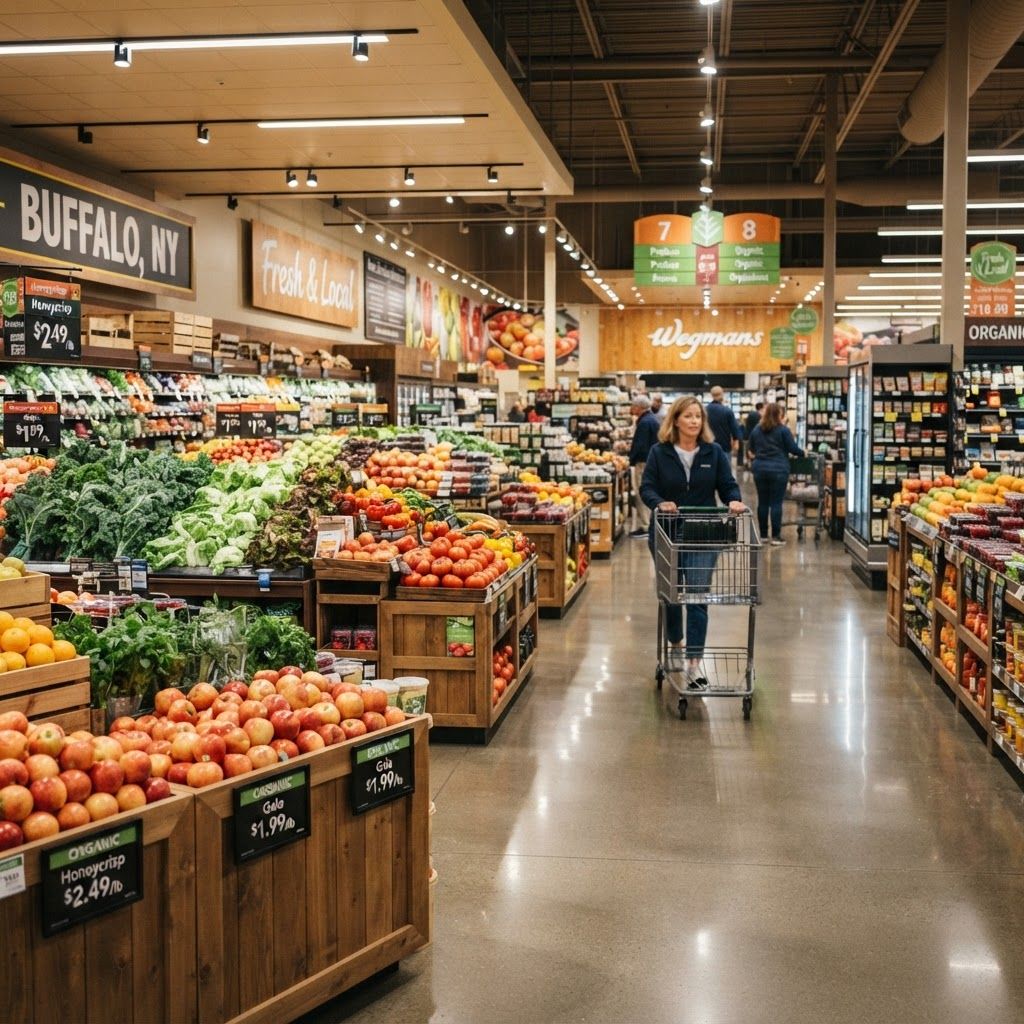
Why Buffalo Is a Grocery Shopper's Market
Buffalo has long punched above its weight when it comes to grocery retail. The city sits at the crossroads of Great Lakes agriculture, Niagara County orchards, and a dense network of family-run food businesses that stretch back generations. That combination has produced a market where national chains cannot simply coast on brand recognition. They have to compete with regional operators who know exactly what a Western New York shopper wants in February versus August.
The result is genuinely good news for residents. Price competition in the Buffalo metro remains sharper than in many comparable mid-sized cities, and the variety of formats means a shopper can choose between a full-service destination store, a lean discount format, or a specialty market depending on the week. Understanding who does what best is the difference between a frustrating grocery run and a satisfying one.
1. Wegmans
No conversation about supermarkets in Western New York starts anywhere else. The Rochester-based chain has built a reputation on scale combined with genuine merchandising care, and its Buffalo-area locations reflect that. Expansive produce departments, a cheese selection that rivals dedicated specialty shops, prepared foods that function as a legitimate dinner solution, and a store-brand line that consistently outperforms its price point. The stores are large, which means they reward a planned trip more than a quick errand.
2. Tops Friendly Markets
Tops is the most deeply embedded grocery name in Buffalo, with a store footprint that reaches neighborhoods larger competitors have skipped. Headquartered in Williamsville, the chain leans into convenience and accessibility. Its loyalty program and fuel-points partnerships create real savings for regular shoppers, and its commitment to keeping stores in urban and rural locations alike has made it a practical necessity for many households rather than merely an option.
3. Aldi
The German discounter has reshaped price expectations across the Buffalo market. Aldi's model strips out the variables that inflate grocery costs: a tightly curated assortment, predominantly private-label products, cart deposits, and customer-supplied bags. For shoppers focused primarily on staples, the savings are substantial and immediate. The trade-off is selection, which means many Buffalo families treat Aldi as a first stop rather than a single destination.
4. Dash's Market
Dash's occupies a distinctly Buffalo niche: a locally owned chain that competes on quality and service rather than square footage. Its stores emphasize butcher-counter meat, fresh seafood, and specialty and international items that larger chains stock inconsistently. Shoppers preparing for a holiday meal or a specific recipe frequently find Dash's to be the store that actually has the item in stock.
5. Lexington Cooperative Market
The Lexington Co-op represents a different model entirely: member-owned, mission-driven, and explicitly focused on local and organic sourcing. With locations serving the Elmwood Village and Hertel Avenue corridors, the co-op prioritizes relationships with regional farms and producers. Prices on some categories run higher than conventional supermarkets, but for shoppers who weigh sourcing transparency and community ownership, that calculation makes sense.
6. Price Rite Marketplace
Price Rite serves the value-focused end of the market with a warehouse-influenced format. Bulk pricing, a strong emphasis on fresh produce at low margins, and a notably broad international and Latin foods selection make it a valuable resource for large households and for shoppers seeking ingredients that mainstream chains treat as afterthoughts.
7. Save A Lot
Save A Lot operates on a compact, efficient premise: smaller stores, curated assortment, aggressive pricing on essentials. Its Buffalo locations function as genuine neighborhood grocers in areas where access to fresh food would otherwise require a longer trip. For weekly staples and pantry restocking, the format is difficult to beat on cost per trip.
8. Guercio and Sons
A Grant Street institution, Guercio and Sons has served Buffalo's Italian community and now its broader West Side for decades. The store is a specialty destination in the truest sense, with imported Italian goods, bulk olives and cheeses, house-made sausage, and produce sourced with an eye toward cooks rather than casual shoppers. It is not a one-stop store and does not try to be.
9. Niagara Produce
Located to the north of the city, Niagara Produce built its reputation on exactly what its name promises. The store's produce turnover and pricing reflect direct relationships with regional growers, particularly during Western New York's summer and fall harvest windows. Shoppers who cook seasonally treat it as a genuine competitive advantage.
10. Broadway Market
Broadway Market is technically a public market rather than a chain, but omitting it from any serious discussion of Buffalo grocery shopping would be a mistake. Its collection of independent vendors covers meat, baked goods, produce, and Polish specialties that are woven into the city's culinary identity, particularly in the weeks before Easter. It offers something no chain can replicate: direct contact with the people producing and selling the food.
Trends Shaping Buffalo Grocery Retail
Several forces are actively reshaping how these retailers compete. Online ordering and curbside pickup, once a differentiator, have become table stakes across nearly every chain on this list. Private-label expansion continues aggressively as retailers protect margins while offering shoppers lower price points. Local sourcing has moved from marketing language to operational reality, with even large chains dedicating shelf space and signage to Western New York producers.
Meanwhile, format fragmentation is accelerating. The assumption that a household does all its shopping at one store is increasingly outdated in Buffalo. Many residents now build a routine around two or three retailers: a discounter for staples, a full-service store for produce and meat, and a specialty market for particular ingredients.
Choosing the Right Store for Your Household
The best supermarket in Buffalo depends entirely on what you are optimizing for. Shoppers prioritizing selection and prepared foods gravitate toward the large-format destination stores. Those optimizing purely for cost find the discount formats deliver measurably lower totals. Households that cook ambitiously often find the specialty and cooperative markets carry the ingredients that make a recipe work as intended.
What is clear is that Buffalo residents are not short on options. The density and diversity of grocery retail across the metro area is a genuine quality-of-life advantage, and the competition between these ten operators keeps all of them sharper than they would otherwise be.