
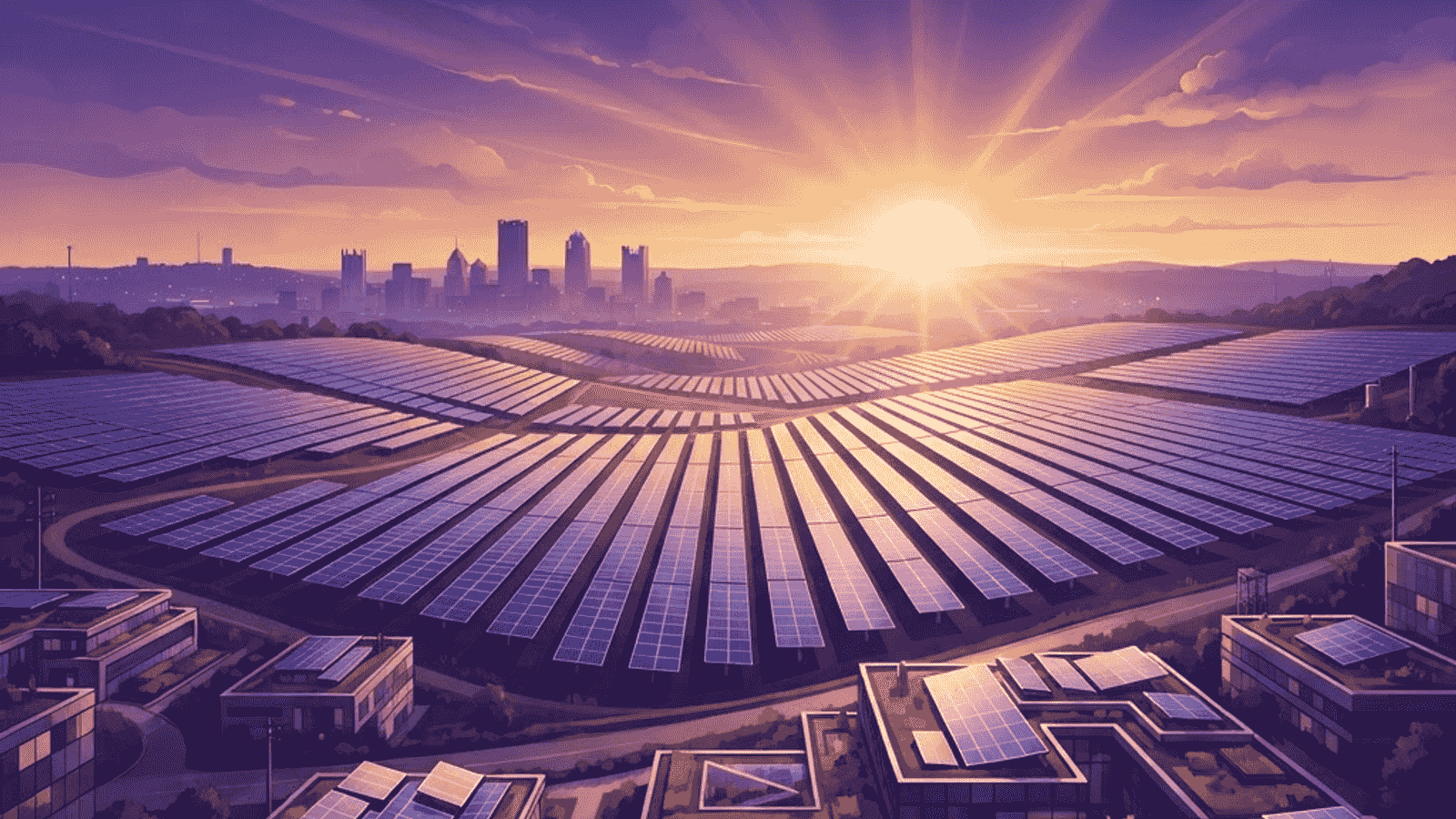
Solar in a City Known for Cloudy Days
Pittsburgh averages roughly 160 sunny days a year, which is fewer than the national average and considerably fewer than the sunbelt markets that dominate solar advertising. Prospective customers reasonably ask whether solar makes sense here at all. It does, for reasons that have little to do with raw sunshine hours. Photovoltaic panels are semiconductor devices, and they convert light rather than heat. They actually operate more efficiently at cooler temperatures, which means a crisp October afternoon in Pittsburgh can produce better instantaneous output than a scorching July day in Arizona. Germany built a substantial solar industry at a latitude and cloud cover comparable to western Pennsylvania.
What matters more than sunshine is economics, and here Pittsburgh is favorable. Pennsylvania offers net metering at full retail rate for properly sized systems, operates a market for solar renewable energy credits, and sits in a deregulated retail electricity market where rates have trended upward. Combine that with federal tax incentives and the payback math works out reasonably across most of Allegheny County. The real constraints in Pittsburgh are physical: mature tree canopy, dense rowhouse roofs, north-facing slopes on the city's hillsides, and older roof structures that sometimes need replacement first.
Ten Solar Companies Serving Pittsburgh
1. Scalo Solar Solutions — Backed by decades of local construction experience, Scalo approaches solar as a building project rather than an electrical accessory. That perspective shows in flashing details, load calculations, and a willingness to turn down roofs that should not carry an array yet.
2. EIS Solar — A Pittsburgh engineering-led installer covering residential, commercial, and agricultural work. EIS is frequently recommended for its blunt site assessments and for handling the interconnection and permitting sequence across the region's many small municipalities without drama.
3. Energy Independent Solutions — Particularly strong with schools, churches, and nonprofits, this firm understands how tax-exempt organizations can still capture incentive value through ownership structures and grant programs that most residential installers never touch.
4. Vox Energy Solutions — Combines efficiency retrofits with solar design, sizing arrays only after reducing building load. Commercial clients who care about total energy cost rather than array size tend to appreciate the sequencing.
5. IGS Solar — A regional provider active in Pittsburgh's commercial segment, offering power purchase agreements and solar-as-a-service. Their model suits businesses that want the energy savings without capital outlay or asset ownership.
6. Solar Renewable Energy — Serving western Pennsylvania with residential rooftop, ground-mount, and battery systems. They have strong footing outside the city core where properties have space for ground arrays and outages last longer.
7. Aztec Solar Power — A suburban-focused residential installer known for consultative, low-pressure sales. They spend time on realistic production modeling rather than optimistic headline savings, which builds durable referral business.
8. Alpha Solar Energy — A smaller Pittsburgh-area operation handling residential and light commercial installations with direct owner oversight. Useful on complicated roofs and older properties where a crew needs to improvise carefully.
9. Sunrun — A national provider with a Pittsburgh presence, offering leases, PPAs, and purchase options. National scale brings financing flexibility and long-term monitoring infrastructure; buyers should still confirm who the local install crew actually is.
10. Trinity Solar — Another large regional installer serving the metro area with residential systems and battery add-ons. Their volume gives them equipment availability and a structured service department, which matters over a twenty-five-year asset life.
Understanding the Technology Choices
Three decisions define most residential systems. The first is module type. Monocrystalline panels dominate the market now and offer the best efficiency per square foot, which matters on Pittsburgh's small city roofs where usable area is the binding constraint.
The second is inverter architecture. String inverters are cheaper but underperform when any part of the array is shaded, because output is limited by the weakest module in a string. Microinverters and DC optimizers isolate each panel. In a city with as much tree cover as Pittsburgh, module-level electronics are usually worth the premium.
The third is storage. Batteries add substantial cost and, under net metering, relatively modest financial return for residential customers. Their value is resilience during outages and, for commercial customers, shaving peak demand charges. Buyers should be clear about which benefit they are paying for.
Reading a Solar Proposal Critically
Insist on a production estimate expressed in kilowatt-hours per year with the modeling assumptions attached, including azimuth, tilt, shading losses, and annual degradation. Compare proposals on cost per watt installed rather than total price, since systems differ in size.
Check the roof age. Installing an array on a roof with eight years of life left guarantees a costly removal and reinstallation. Good Pittsburgh installers raise this before you do.
Scrutinize financing. A cash purchase, a secured loan, a lease, and a power purchase agreement produce very different lifetime costs and very different complications when you sell the house. Escalator clauses in leases deserve particular attention.
Verify licensing and insurance for your specific municipality. The Pittsburgh region contains dozens of separate permitting jurisdictions with meaningfully different requirements, and an installer unfamiliar with your township will cost you weeks.
What Comes Next for Pittsburgh Solar
Several trends are worth watching. Rooftop-plus-heat-pump packages are becoming common as homeowners electrify heating and want the array sized for winter loads. Commercial storage is growing on the strength of demand charge economics rather than backup power. And advocacy for community solar continues, which would open participation to the large share of Pittsburgh residents who rent or own shaded property.
The city's solar industry has matured past the novelty stage. Arrays are now ordinary features on warehouses, schools, and hillside rowhouses. Choose an installer that models honestly, employs licensed electricians directly, explains inverter and warranty tradeoffs in plain language, and has enough operating history to be around when service is needed. Solar is a twenty-five-year relationship with a piece of infrastructure; pick the partner accordingly.