
The River Advantage Few Cities Have
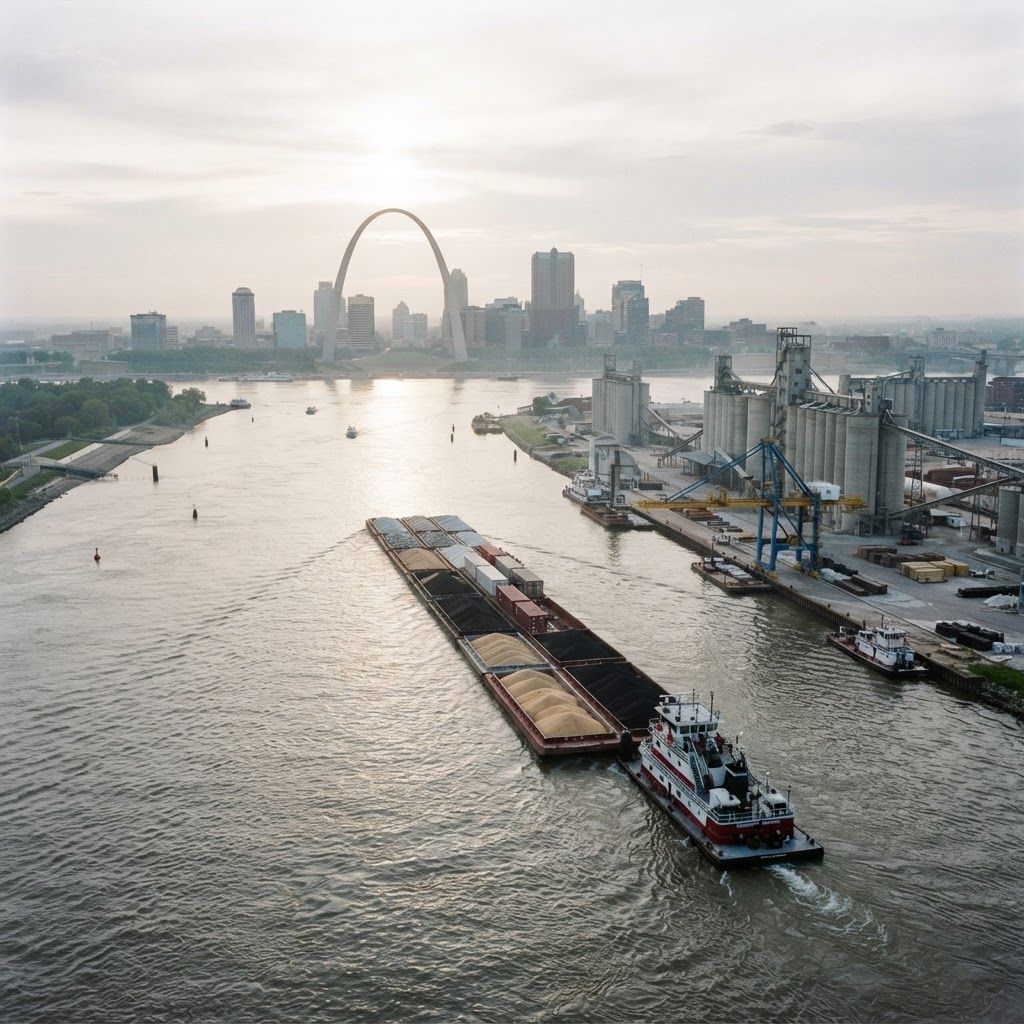
St. Louis holds a shipping distinction that deserves far more recognition than it gets. The port here is the northernmost ice-free and lock-free point on the Mississippi River, which means a barge loaded in St. Louis can travel all the way to the Gulf of Mexico without passing through a single lock or waiting out a winter closure. Upstream ports face both constraints. That single geographic fact makes the region one of the most efficient inland shipping origins in North America.
The scale is significant. The Port of Metropolitan St. Louis handles tens of millions of tons annually across roughly seventy miles of developed riverfront, ranking among the largest inland ports in the country by trip ton-miles. A single fifteen-barge tow carries the equivalent of roughly 1,000 trucks or 200 railcars, at a fraction of the fuel consumption and emissions per ton-mile.
Understanding the Shipping Segments
The word shipping covers several distinct businesses. Inland marine operators move bulk commodities, grain, coal, aggregates, chemicals, steel and petroleum products, by barge on the river system. Parcel carriers handle small package shipments through hub-and-spoke networks. Freight forwarders and non-vessel operating common carriers arrange international ocean and air shipments, booking space on carriers they do not own and handling documentation and customs. Customs brokers manage regulatory clearance. And specialized shippers handle project cargo, oversized loads, hazardous materials and other freight requiring specific expertise.
Most businesses need more than one. A manufacturer might use barge for inbound raw materials, ocean forwarding for imported components, LTL for domestic distribution and parcel for aftermarket parts.
The Ten Best Shipping Companies Serving St. Louis
1. American Commercial Barge Line
ACBL is one of the largest inland marine operators in the United States, moving dry and liquid bulk cargo across the Mississippi River system and the Gulf Intracoastal Waterway. Its fleet scale, terminal relationships and operational experience make it a primary option for agricultural exports, chemicals and industrial commodities originating in the region. For shippers with volumes large enough to justify barge, its network reach and equipment availability are difficult to match.
2. SCF Marine
SCF operates barge transportation and terminal services with strong presence on the upper Mississippi and Illinois River systems. Its combination of vessel operations with terminal and transload capability lets it handle the complete movement rather than just the water leg, which simplifies coordination considerably for shippers new to marine transportation. Its handling of steel, aggregates and agricultural products is well established.
3. Ingram Barge Company
Ingram is among the largest barge operators in North America, with substantial traffic through the St. Louis harbor. Its scale allows reliable capacity even during tight market conditions, and its logistics services extend into fleeting, shifting and terminal operations. For grain shippers moving crops to Gulf export elevators, it is one of the essential carriers on the system.
4. Kirby Corporation
Kirby specializes in liquid bulk transportation by tank barge, moving petrochemicals, refined products, agricultural chemicals and black oil across the inland waterway system. Given the chemical and refining presence in the greater St. Louis industrial corridor, its capabilities are directly relevant to a significant share of regional shippers. Safety systems and regulatory compliance in liquid bulk handling are its core competency.
5. FedEx
FedEx operates extensive sorting and delivery capacity serving the metro, including express air, ground, freight and international services. Its air express network reliability is the industry benchmark for time-definite domestic and international shipments, and its integration of express, ground and LTL freight under one account structure simplifies management for businesses shipping across multiple service levels. Regional facility investment has improved late pickup cutoffs meaningfully.
6. UPS
UPS maintains major regional operations and offers one of the most complete portfolios in the industry: ground and air parcel, freight, international forwarding, customs brokerage and supply chain services. Its ground network density gives it strong one and two-day coverage across the central United States from St. Louis, and its technology tools for address validation, delivery management and returns are mature. For e-commerce sellers, its returns infrastructure is a practical advantage.
7. DHL Express
DHL is the strongest option for international express shipping from the region. Its global network depth, customs expertise and service consistency to Europe, Asia, Africa and Latin America exceed what domestic-focused carriers deliver on cross-border shipments. For exporters, particularly those shipping documents, samples and time-critical goods internationally, it is frequently the correct choice.
8. Regional Freight Forwarders and Customs Brokers
The metro supports a community of independent forwarders and licensed customs brokers who arrange ocean and air freight, handle import and export documentation, manage classification and duty determination, and navigate foreign trade zone procedures. Their value is expertise and advocacy: a good broker prevents the classification errors, valuation problems and documentation gaps that cause customs holds and penalties. For any company importing regularly, this relationship matters more than most executives realize.
9. UniGroup Specialized Transportation
The Fenton-based organization's specialized divisions handle high-value, fragile and complex shipments requiring more than standard freight handling: laboratory and medical equipment, electronics, museum and fine art pieces, retail fixtures and trade show exhibits. Air-ride equipment, climate control, custom crating and trained handling crews are standard. When the cost of damage exceeds the cost of premium handling, this is the segment to use.
10. Port of Metropolitan St. Louis Terminal Operators
The port district's terminal and transload operators provide the physical interface between modes, handling barge loading and unloading, railcar transloading, bulk storage, container stuffing and heavy-lift operations. Several facilities offer direct rail service from multiple Class I carriers alongside river access, creating true tri-modal capability. For shippers wanting to use barge or rail without owning waterfront or trackage, these operators make it accessible.
Trends in Regional Shipping
Several dynamics are worth tracking. River conditions have become less predictable, with drought-driven low water periodically restricting barge drafts and tow sizes, which makes flexible modal planning more valuable. Container-on-barge service development continues to attract interest as a lower-emission alternative for containerized freight moving to Gulf ports. Parcel carriers have restructured pricing around dimensional weight and surcharges, making packaging optimization a genuine cost lever. Emissions reporting is pushing large shippers toward barge and rail where transit time permits. And foreign trade zone utilization in the region has grown as importers seek duty deferral advantages.
Practical Guidance for Shippers
Match mode to cargo characteristics and time sensitivity rather than defaulting to habit. For bulk commodities moving south, price barge against rail and truck, since the savings are frequently dramatic. Audit parcel invoices regularly, because surcharge accumulation is where parcel budgets quietly inflate. Engage a customs broker before your first import rather than after a problem. Verify insurance coverage and liability limits, which for standard freight are far lower than most shippers assume. Optimize packaging dimensions against carrier dimensional weight formulas. And for anything oversized, hazardous or unusually valuable, use a specialist rather than a generalist.
Final Thoughts
St. Louis shipping capability spans the full range from single envelopes to fifteen-barge tows, anchored by a river position that no competing inland city can replicate. Barge operators deliver unmatched bulk economics, parcel carriers provide dense fast coverage, forwarders and brokers manage international complexity, and terminal operators tie the modes together. Understanding which tool fits which shipment is where real savings live.