
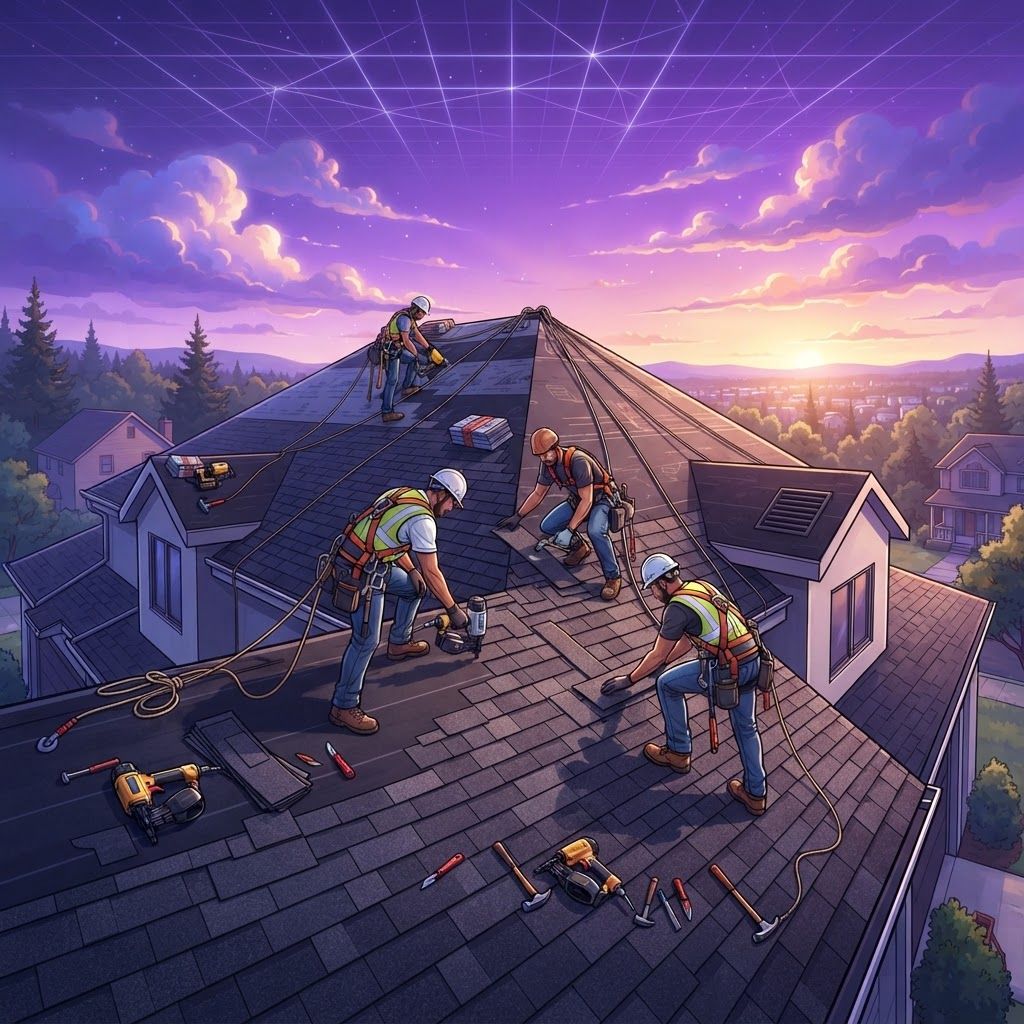
Why Roofs Fail Faster in the Inland Empire
A roof in San Bernardino endures conditions that would be considered extreme in most of the country. Summer surface temperatures on dark roofing can exceed 160 degrees, and the daily swing between afternoon heat and cool nights causes continuous thermal expansion and contraction that fatigues materials and fasteners. Ultraviolet radiation degrades asphalt binders and breaks down exposed underlayment. Santa Ana wind events apply uplift forces that find any weakness in edge detailing or fastening. And when rain does arrive, it often comes concentrated in intense storms that immediately expose flashing failures.
Wildfire risk compounds the problem. Ember intrusion, not direct flame, causes the majority of structure losses in wildland fire events, and roofs are the most common ignition point through vents, gaps at the roof edge, and accumulated debris in valleys and gutters. This is why roofing in San Bernardino is regulated more strictly than in many jurisdictions and why material choice carries genuine consequence.
Roofing Contractors Serving the City
The local market includes long-established regional roofers and specialized commercial firms. Golden West Roofing and Inland Roofing Company style contractors handle residential re-roofing across tile, shingle, and flat systems. Best Roofing and Waterproofing and Chandlers Roofing style firms combine roofing with waterproofing expertise, which matters on complex rooflines and structures with decks or parapets.
Highland Roofing and Rancho Roofing style companies serve residential neighborhoods with repair, maintenance, and full replacement, often with strong reputations built over decades of local referral. On the commercial side, Commercial Roof Management, Letner Roofing, and Anning-Johnson style contractors install and maintain single-ply membrane systems, built-up roofing, and modified bitumen on the region's extensive industrial and warehouse inventory.
Solar-integrated roofing has become its own category, with contractors licensed for both roofing and photovoltaic installation coordinating array mounting with roof warranty requirements. This matters considerably, because mounting solar on an aging roof without addressing the roof first creates an expensive removal and reinstallation problem later.
Material Options and How They Perform Locally
Asphalt composition shingles remain the most common residential material because of cost and ease of installation. Architectural or dimensional shingles substantially outperform three-tab products in wind resistance and appearance, and higher-grade lines carry improved granule retention that resists UV degradation. Expected life in this climate is generally shorter than manufacturer maximums suggest, particularly on south and west-facing slopes.
Concrete and clay tile are extremely well suited to the region and are visually dominant across much of Southern California. Tile is non-combustible, extremely durable, and creates an air gap that reduces heat transfer into the attic. Its weight requires adequate structural capacity, and critically, the actual waterproofing layer is the underlayment beneath the tile, which means a tile roof may need underlayment replacement while the tile itself remains reusable.
Metal roofing has grown in popularity for its longevity, fire resistance, wind performance, and reflectivity when finished with cool roof coatings. Standing seam systems eliminate exposed fasteners, which removes the most common leak path. Initial cost is higher, but service life often exceeds that of two shingle roofs.
For low-slope and flat roofs, single-ply membranes such as TPO and PVC dominate commercial installation. White TPO in particular delivers high solar reflectance, which meaningfully reduces cooling loads on large buildings. Built-up and modified bitumen systems remain in use, often with reflective coatings applied to improve thermal performance and extend service life.
Cool Roof and Fire Rating Requirements
California's Title 24 energy standards include cool roof provisions requiring minimum solar reflectance and thermal emittance for many roof replacements, particularly in the hot climate zones that include San Bernardino. In practice this steers material selection toward lighter colors, reflective coatings, or products with specific rated performance, and a knowledgeable contractor will confirm compliance rather than discovering it at inspection.
Fire rating is equally consequential. Class A is the highest roof covering fire rating, and it is required in wildfire hazard severity zones, which include substantial portions of the foothill areas near San Bernardino. Beyond the covering itself, ember-resistant details matter: enclosed eaves or ember-resistant venting, metal drip edge, non-combustible gutters kept clear of debris, and closed valleys or properly detailed metal valley flashing all contribute to the assembly's real-world performance.
Maintenance That Extends Roof Life
Most roof failures are preventable and begin at penetrations rather than in the field of the roof. Annual inspection should focus on flashing at chimneys, skylights, vents, and wall intersections, sealant condition at penetrations, tile breakage from foot traffic or debris, granule loss on shingles, ponding areas on flat roofs, and drainage clearance at scuppers, gutters, and downspouts.
Attic ventilation deserves particular attention in this climate. Balanced intake and exhaust ventilation reduces attic temperatures dramatically, which lowers cooling costs and extends roofing life by reducing heat load from below. Many older San Bernardino homes have inadequate intake ventilation, and correcting it during a re-roof is inexpensive relative to the benefit.
Choosing a Roofing Contractor Wisely
Roofing attracts more unlicensed operators than most trades, particularly following wind or storm events. Verify the contractor's California license with the C-39 roofing classification, confirm workers compensation coverage given the injury risk inherent in the trade, and require proof of general liability insurance. Ask whether the crew consists of employees or subcontracted labor, since that affects insurance coverage and accountability.
Require a written scope specifying the number of layers to be removed, the underlayment type and weight, flashing replacement rather than reuse, ventilation work, disposal, and the specific manufacturer and product line being installed. Manufacturer warranties frequently require certified installation, so confirm the contractor holds the relevant certification if an extended warranty is being promised. Distinguish clearly between the manufacturer's material warranty and the contractor's workmanship warranty, and get both in writing.
Be cautious of high-pressure sales following a storm, demands for large upfront payments, or offers to absorb an insurance deductible, which is unlawful. A reputable San Bernardino roofer will inspect thoroughly, photograph findings, explain options honestly including repair versus replacement, and provide a detailed proposal without urgency tactics. Given that a roof protects everything beneath it, that patience is worth insisting on.