
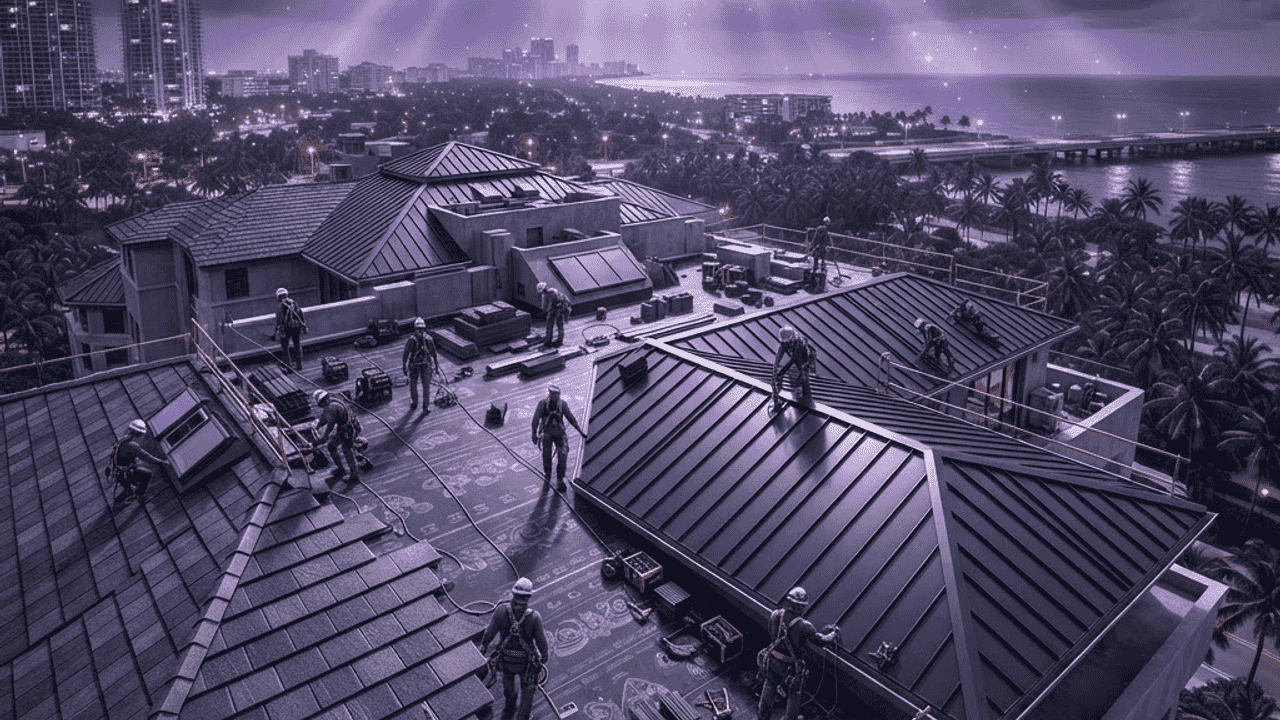
The Roof Is Miami's Most Tested Building Component
No part of a South Florida building works harder than the roof. It absorbs intense ultraviolet radiation year-round, endures surface temperatures that accelerate material aging, sheds torrential rainfall in short bursts, and must resist hurricane-force wind uplift and wind-borne debris. A roof that would last decades in a temperate climate can degrade far faster here, and a single failure during storm season can cause interior damage many times the cost of the roof itself.
Florida's building code responds accordingly. Roofing assemblies in the High Velocity Hurricane Zone require documented product approval, specific fastening patterns, secondary water barriers, and inspection at multiple stages. Roofing is not a trade where improvisation is acceptable.
Roofing Systems Used in Miami
Concrete and clay tile roofs are common on residential properties, offering longevity and strong wind performance when properly fastened. Metal roofing has gained popularity for its durability, reflectivity, and clean appearance. Modified bitumen and built-up systems remain standard on low-slope residential and commercial roofs. Single-ply membranes such as TPO and PVC dominate commercial flat roofs, with white surfaces reducing cooling loads. Asphalt shingles still appear on steeper residential slopes, though their lifespan in Miami is shorter than manufacturer averages suggest.
The Top 10 Roofing Contractors in Miami
1. Miami Roofing Specialists
A long-established residential and commercial roofer covering tile, metal, shingle, and flat systems. Known for thorough documentation of product approvals and clean inspection records.
2. Biscayne Tile Roofing Co.
Tile specialists experienced in concrete and clay installations, including proper underlayment layering, mortar and mechanical fastening methods, and precise hip and ridge detailing.
3. Coral Gables Metal Roof Works
Focused on standing seam and metal shingle systems, with expertise in panel engineering, concealed fastener detailing, and coordination with solar mounting requirements.
4. South Florida Flat Roof Experts
Low-slope specialists installing modified bitumen and single-ply membranes, with strong drainage design, tapered insulation planning, and detail work around rooftop mechanical equipment.
5. Doral Commercial Roofing Group
Serves warehouses and industrial facilities with large-scale membrane installation, restoration coatings, and preventive maintenance programs that extend service life.
6. Hialeah Storm Damage Roofers
Emergency response and repair specialists offering rapid tarping, documented damage assessment, and insurance claim support after severe weather events.
7. Kendall Residential Roofing
A neighborhood-focused roofer known for clear pricing, careful property protection during tear-off, and strong communication throughout multi-day residential replacements.
8. Aventura Premium Roofing
High-end residential roofer working with imported tile, copper accents, and complex architectural rooflines, delivering meticulous finish quality on luxury properties.
9. Little Havana Roof Repair Services
Repair-oriented contractor addressing leaks, flashing failures, and localized tile replacement, offering practical alternatives before recommending full replacement.
10. Homestead Roofing & Hurricane Hardening
Focused on wind mitigation upgrades including improved deck fastening, secondary water barriers, and truss connectors that can reduce insurance premiums while improving resilience.
Warranties, Codes, and Inspections
Understand the difference between a manufacturer material warranty and a contractor workmanship warranty; most leaks stem from installation details, so workmanship coverage matters enormously. Verify that the specific assembly has a Miami-Dade product approval or Florida product approval and that fastening will follow that approval exactly. Expect in-progress inspections, including deck nailing and dry-in inspections, before covering material is installed. Request a wind mitigation report after completion, since it may reduce insurance costs.
Trends in Roofing
Reflective and cool-roof surfaces are expanding as cooling costs rise and energy codes tighten. Solar-ready roofing has become a planning consideration even when panels are installed later, because mounting and flashing decisions are easier to make during replacement. Enhanced underlayment systems, including self-adhered secondary water barriers, are increasingly specified beyond code minimums. Drone inspections and infrared moisture surveys allow more accurate condition assessment on commercial roofs. Maintenance programs are also growing, as owners recognize that annual inspection is dramatically cheaper than emergency response.
How to Hire a Roofing Contractor
Confirm state licensing and insurance, and never accept a roofer working under someone else's license. Get at least three detailed proposals specifying materials by manufacturer and model, underlayment type, fastening method, and disposal responsibility. Beware of pressure tactics after storms and of contractors offering to absorb insurance deductibles, which is prohibited. Ask about crew supervision, daily cleanup, and protection for landscaping, pools, and driveways. Finally, pay according to milestones, hold final payment until the permit is closed and final inspection passes, and keep all documentation, since a properly papered roof adds real value when selling a Miami property.
Code, Insurance, and Documentation
Roofing in Miami-Dade is governed by high-velocity hurricane zone requirements, which are more stringent than standard Florida code and dictate approved product assemblies, fastening patterns, secondary water barriers, and inspection stages. Only products with current Notice of Acceptance approvals may be installed, and inspections occur at multiple points including deck nailing and dry-in rather than only at completion. A contractor who treats these as negotiable is exposing you to a failed inspection, a voided warranty, and potentially a denied insurance claim.
Insurance is closely tied to roof condition here. Carriers commonly require documentation of roof age, material, and remaining useful life, and some will decline coverage on assemblies beyond a certain age regardless of visible condition. Keep the permit, the final inspection approval, the manufacturer warranty registration, and photographs of the underlayment stage. That package protects both resale value and claim outcomes.
Choosing Between Systems
Concrete and clay tile offer excellent longevity and appearance but weigh substantially more and require adequate structural capacity. Metal roofing performs very well against wind and reflects heat effectively, with strong life expectancy at a higher initial cost. Architectural asphalt shingles remain the most economical option but have the shortest service life in this climate. Low-slope areas require modified bitumen, single-ply membrane, or fluid-applied systems rather than any of the above. Whatever the finish material, the underlayment and fastening beneath it determine whether the roof survives a storm, so resist proposals that economize there.