
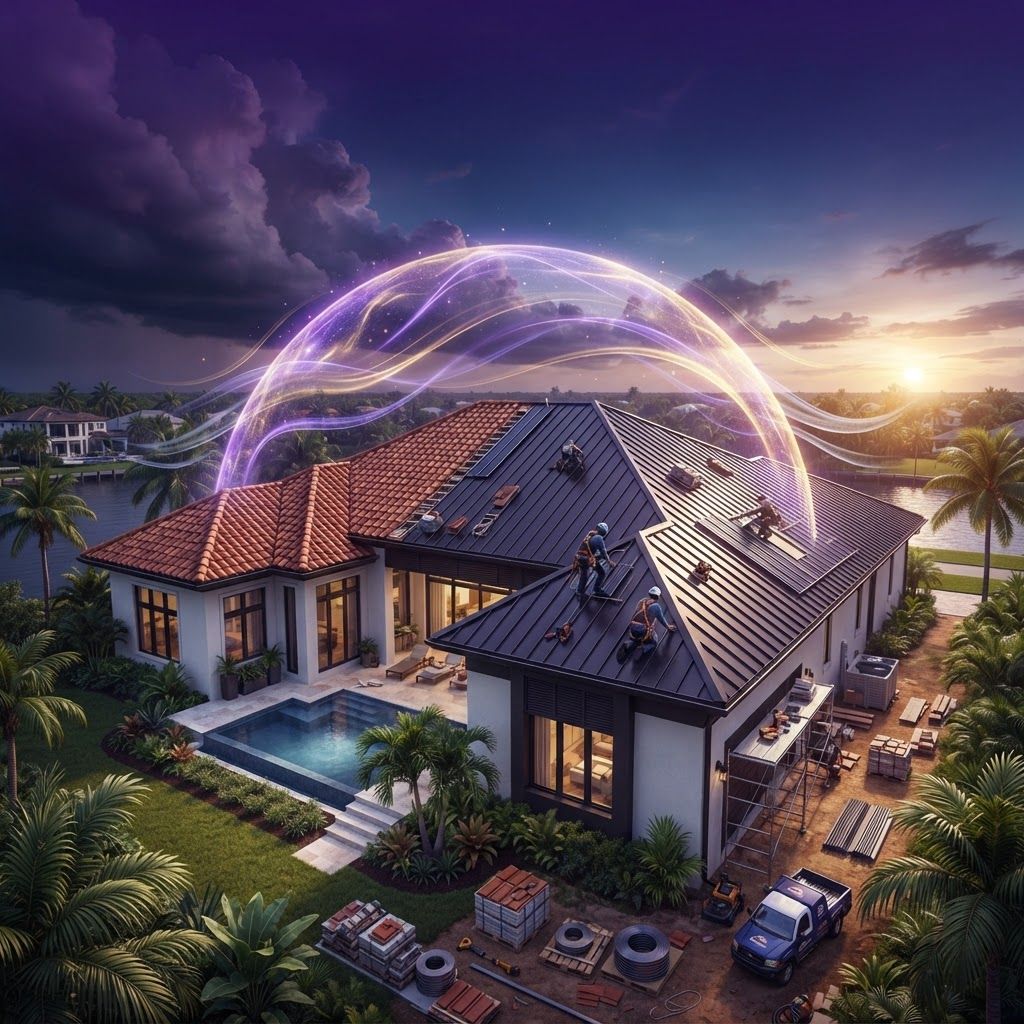
Why Roofing Matters More Here
Nowhere in the United States is roofing more consequential than in South Florida. The roof takes the full force of hurricane wind uplift, absorbs relentless ultraviolet exposure, and must shed extraordinary volumes of rain during the wet season. Miami-Dade County responded to that reality with the most stringent roofing regulations in the country, requiring documented product approval for every component in the assembly and prescribing fastening patterns, underlayment layers, and flashing details in detail.
These requirements are not bureaucratic excess. Post-storm investigations consistently show that roof failure is the initiating event in most catastrophic building damage, because once the roof opens, wind pressurizes the interior and water destroys everything below. Consequently, roofing quality directly affects both physical safety and insurance availability and pricing.
1. Concrete and Clay Tile Roofing Contractors
Tile roofing is the traditional South Florida system and remains the most common on residential construction. It performs extremely well in heat and ultraviolet exposure and lasts decades when installed correctly. The critical element is not the tile itself but the underlayment beneath it, which is the actual waterproofing layer. Contractors who specialize in tile understand mortar set versus mechanically fastened installation, proper hip and ridge detailing, and the flashing work at valleys and penetrations where most leaks originate.
2. Metal Roofing Specialists
Standing seam and metal panel roofing has grown rapidly in popularity because of its wind performance, longevity, and reflectivity, which reduces cooling load. Metal specialists handle panel fabrication, concealed clip systems that allow thermal movement, and the precise flashing required at transitions. Installation tolerances are tighter than with tile, and errors in panel alignment or fastener selection are difficult to conceal, so craftsmanship shows immediately.
3. Flat and Low-Slope Roofing Contractors
Commercial buildings, additions, and many mid-century homes use low-slope roofing systems including modified bitumen, built-up assemblies, and single-ply membranes. Success depends on drainage design, because water that ponds will eventually find a path inside. Specialists in this category address slope correction, drain and scupper placement, tapered insulation, and detailing at parapets and equipment curbs, which are the most failure-prone areas on any flat roof.
4. Shingle Roofing Contractors
Asphalt shingles remain common on residential structures because of lower initial cost, and manufacturers now offer high wind-rated products approved for the hurricane zone. Proper installation requires the specified nailing pattern, enhanced starter and hip and ridge treatments, and sealed roof deck techniques. Shingles have a shorter service life here than in cooler climates due to ultraviolet exposure, which owners should factor into lifecycle cost comparisons.
5. Roof Repair and Leak Detection Specialists
Not every problem requires replacement. Repair specialists locate leaks using moisture scanning, infrared imaging, and water testing, then correct the underlying defect rather than applying sealant over symptoms. Because water travels laterally along framing before appearing on a ceiling, the visible stain is rarely below the actual entry point, which is why systematic diagnosis outperforms guesswork and repeated patching.
6. Hurricane Mitigation and Roof Strengthening Contractors
A specialized segment focuses on improving storm resistance on existing buildings. Work includes secondary water barriers, enhanced roof deck nailing, engineered roof-to-wall connectors, and gable end bracing. These improvements frequently generate meaningful windstorm insurance premium reductions once documented on a mitigation inspection, and for many owners the premium savings recover a significant share of the cost over several years.
7. Commercial and Industrial Roofing Contractors
Large warehouse and industrial roofs demand different capability, including crews sized for extensive areas, coordination around rooftop mechanical equipment, and phasing that keeps operations running beneath the work. These contractors also perform roof asset management, using inspection programs and maintenance plans to extend service life, which is far more economical than reactive replacement across a portfolio of buildings.
8. Roof Coating and Restoration Companies
Where a roof is structurally sound but weathered, reflective coating systems can extend service life, reduce interior temperature, and lower cooling costs. Restoration requires honest assessment, since coating over a saturated or deteriorated substrate simply conceals a failing roof. Reputable contractors perform moisture surveys before recommending coating and will decline the work when replacement is genuinely required.
9. Skylight, Ventilation, and Accessory Installers
Every roof penetration is a potential leak, which makes skylight and vent installation a specialized skill. Contractors in this niche install impact-rated skylights, solar tubes, ridge and off-ridge ventilation, and mechanical equipment curbs with correct flashing and counterflashing. Adequate attic ventilation also matters functionally, reducing heat accumulation that shortens roofing material life and increases cooling demand.
10. Insurance Claim and Storm Damage Roofing Contractors
After a storm, contractors experienced in claims document damage thoroughly, provide emergency tarping, prepare estimates in the formats insurers expect, and coordinate with adjusters. The legitimate operators in this space are established local companies with permanent addresses and license history. They also understand Florida rules governing roofing contracts and insurance claims, including restrictions on incentives and the required contract disclosures.
Hurricane Code Requirements in Brief
Roofing in the High Velocity Hurricane Zone must use products with Miami-Dade Notice of Acceptance or equivalent state approval. Requirements address deck attachment, underlayment type and layering, fastener specification and spacing, edge metal securement, and flashing details. When more than a defined portion of a roof is replaced, the entire assembly generally must be brought to current code, including deck renailing and secondary water barrier installation. Inspections occur at multiple stages, including deck and dry-in, before final approval.
Insurance Implications
Roof condition and age now dominate property insurance underwriting in Florida. Carriers may decline coverage or require replacement on older roofs regardless of visible condition, and roof age often determines whether a policy is offered at all. Conversely, a new roof with documented mitigation features can significantly reduce premiums. Owners should retain permit records, product approval documentation, and mitigation inspection reports, because these documents have direct monetary value at renewal.
Warning Signs of a Failing Roof
Watch for interior ceiling stains or bubbling paint, cracked or slipped tiles, exposed or deteriorating underlayment, rusted or loose edge metal, granule accumulation in gutters from shingles, ponding water on flat sections, and daylight visible in the attic. Musty odors and elevated humidity indoors can indicate ongoing moisture intrusion before staining appears. Annual inspection, particularly before hurricane season, catches these issues while repair remains inexpensive.
Avoiding Storm-Chasing Operators
After major weather events, out-of-area operators arrive offering immediate work at attractive prices. Protect yourself by verifying Florida roofing licensure, confirming a permanent local business address and license history, refusing to pay large deposits, insisting that permits be pulled in the contractor name, and declining high-pressure same-day contracts. Legitimate contractors provide written scopes, product specifications, warranty terms covering both materials and labor, and proof of liability and workers compensation insurance verified with the carrier.
Final Thoughts
Roofing in Hialeah covers tile, metal, low-slope membrane, and shingle systems, along with repair, mitigation, coating, and claims work. Because the roof determines storm survival, insurance eligibility, and interior protection, this is the least sensible place to economize. Verify licensing, insist on approved products with documented permitting and inspection, prioritize underlayment and flashing quality over cosmetic considerations, and keep every record. A properly executed roof is the single most valuable investment a South Florida property owner can make.