
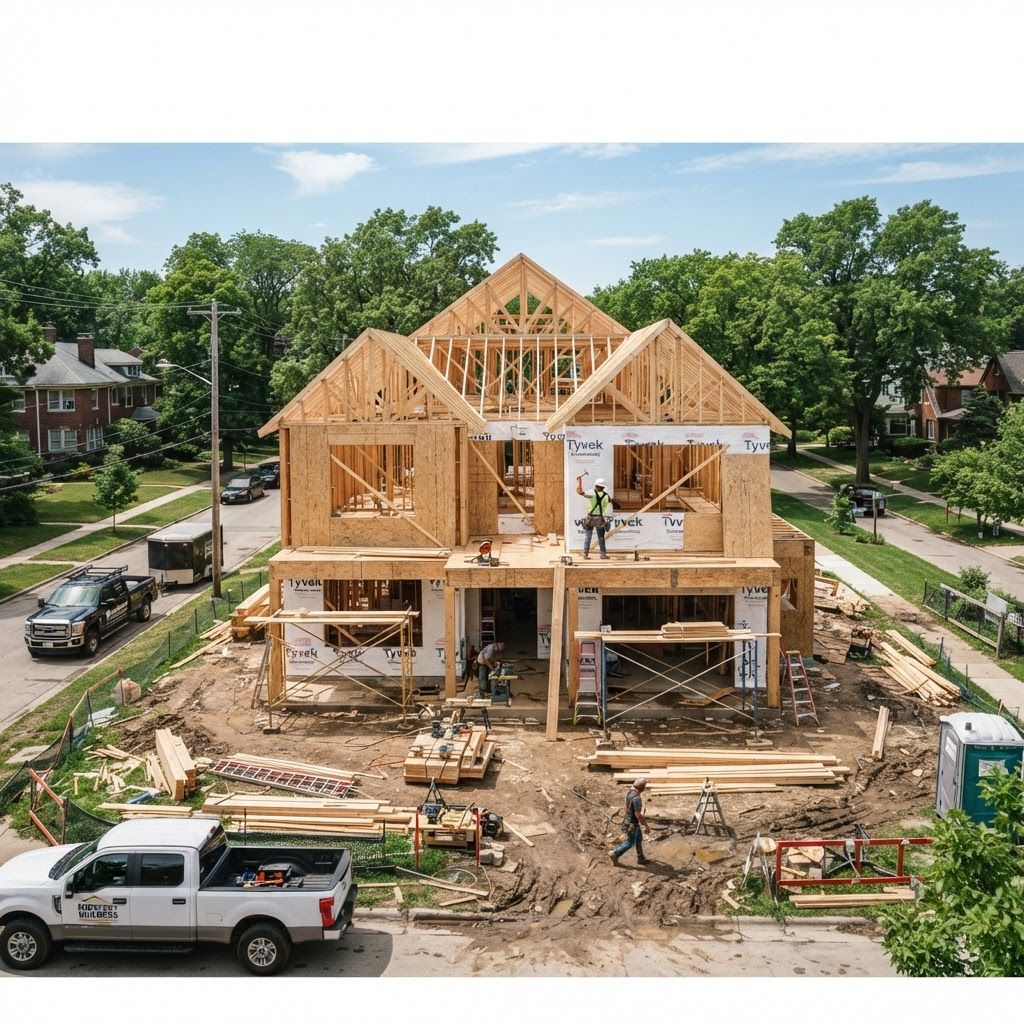
Why Residential Construction in St. Paul Requires Local Expertise
Building a home in St. Paul is not the same as building one in a newer suburban market. The city carries one of the most architecturally diverse housing inventories in the Upper Midwest, with Victorian homes in Summit-University, mid-century bungalows in Highland Park, and modern infill projects rising along the Green Line corridor. A residential construction company working here must understand foundation behavior in expansive clay soils, frost depth requirements that push footings well below four feet, and the layered review process that comes with building in a city that protects its heritage districts.
Minnesota energy code has also tightened significantly. Air sealing, continuous exterior insulation, mechanical ventilation, and blower-door verification are now standard parts of the conversation rather than premium upgrades. The builders that thrive in St. Paul are the ones who treat building science as a core competency rather than an afterthought, because a poorly detailed wall assembly in this climate does not just waste energy, it invites moisture problems that surface years later.
What Separates a Strong Builder From an Average One
Homeowners often compare bids line by line and choose the lowest number. Experienced buyers look at different signals. They ask whether the contractor carries a current Minnesota residential building contractor license, whether the general liability and workers compensation coverage is verifiable, and how change orders are documented. They look for allowance transparency, meaning the builder states exactly how much is budgeted for cabinetry, flooring, plumbing fixtures, and finish hardware instead of hiding vague placeholders that inflate later.
Schedule integrity matters just as much. St. Paul has a compressed exterior work season, and a builder who misses a fall dry-in window can push a project deep into winter with expensive temporary heat and concrete blankets. The strongest firms sequence trades early, order long-lead items such as windows and trusses months in advance, and communicate weekly rather than monthly.
The Ten Residential Construction Companies Worth Knowing
Summit Avenue Builders has built a reputation on historically sensitive custom homes and whole-house rebuilds in the Crocus Hill and Cathedral Hill areas. Their design-build studio handles millwork detailing in-house, which is a meaningful advantage when matching original casing profiles and stair parts.
Capital City Homes focuses on new construction on infill lots. They are known for tight cost control, standardized floor plans that can be customized without redesign fees, and a preference for panelized wall systems that shorten the framing window.
Mississippi Ridge Construction works on riverfront and bluff-adjacent properties where drainage, retaining structures, and soil stability drive the engineering. Their team routinely coordinates with geotechnical consultants before design begins.
Northern Craft Residential specializes in high-performance envelopes. Clients seeking near-passive performance, heat recovery ventilation, and all-electric mechanical systems tend to gravitate here.
Hamline Heritage Contractors serves the Hamline-Midway and Como neighborhoods with additions, second-story pop-tops, and structural remodels on smaller lots where setback and lot coverage math gets tight.
Landmark Family Builders is a multigenerational firm that emphasizes fixed-price contracts and detailed pre-construction estimating. Buyers who dislike surprises appreciate their long specification documents.
Twin Rivers Residential Group handles larger projects including duplex and small multifamily residential work, which has grown in demand as St. Paul zoning has become friendlier to gentle density.
Oakwood Custom Homes concentrates on luxury custom work with dedicated interior design support, curated material libraries, and a single point of contact through the entire build.
Frost Line Construction built its name on cold-weather scheduling discipline. They are frequently hired for projects that must break ground late in the season and still reach lockup before deep winter.
Union Park Building Company rounds out the list with a strong renovation-to-new-build pipeline, offering clients honest guidance on whether an aging structure is worth saving or better replaced.
Current Trends Shaping St. Paul Home Building
Three shifts stand out. First, accessory dwelling units have moved from novelty to mainstream, with homeowners adding garage-adjacent units for family members or long-term rental income. Second, electrification is accelerating. Cold-climate heat pumps paired with backup heat, induction cooking, and electric vehicle-ready panels are appearing in a growing share of specifications. Third, budget realism has improved. After several volatile years in material pricing, builders now favor shorter bid validity windows and escalation clauses on steel, lumber, and mechanical equipment.
There is also renewed interest in durable, low-maintenance exteriors. Fiber cement siding, standing seam metal accents, and thicker insulated glazing are common requests because they hold up against freeze-thaw cycling and reduce long-term upkeep.
How to Run a Smart Selection Process
Start with a written scope, even a rough one. Square footage, number of bedrooms, mechanical preferences, and a realistic budget range allow builders to respond with comparable numbers. Interview three firms rather than ten. Visit at least one active jobsite for each finalist and observe site cleanliness, material protection, and how the crew communicates. Ask for three references from projects completed at least two years ago, because warranty responsiveness reveals more than a freshly finished house ever will.
Review the contract carefully. Look for a clear payment schedule tied to milestones, a defined warranty period, lien waiver procedures, and a dispute resolution clause. Confirm who pulls permits and who is responsible for inspections and final certificate of occupancy coordination.
Final Thoughts
The best residential construction company in St. Paul is not a single answer, it is the firm whose specialty matches your project type, whose communication style matches your expectations, and whose track record survives scrutiny. The ten companies above represent a strong cross-section of the market, from heritage restoration specialists to high-performance new-build teams. Take the time to define your priorities first, then choose the builder whose strengths align with them.