
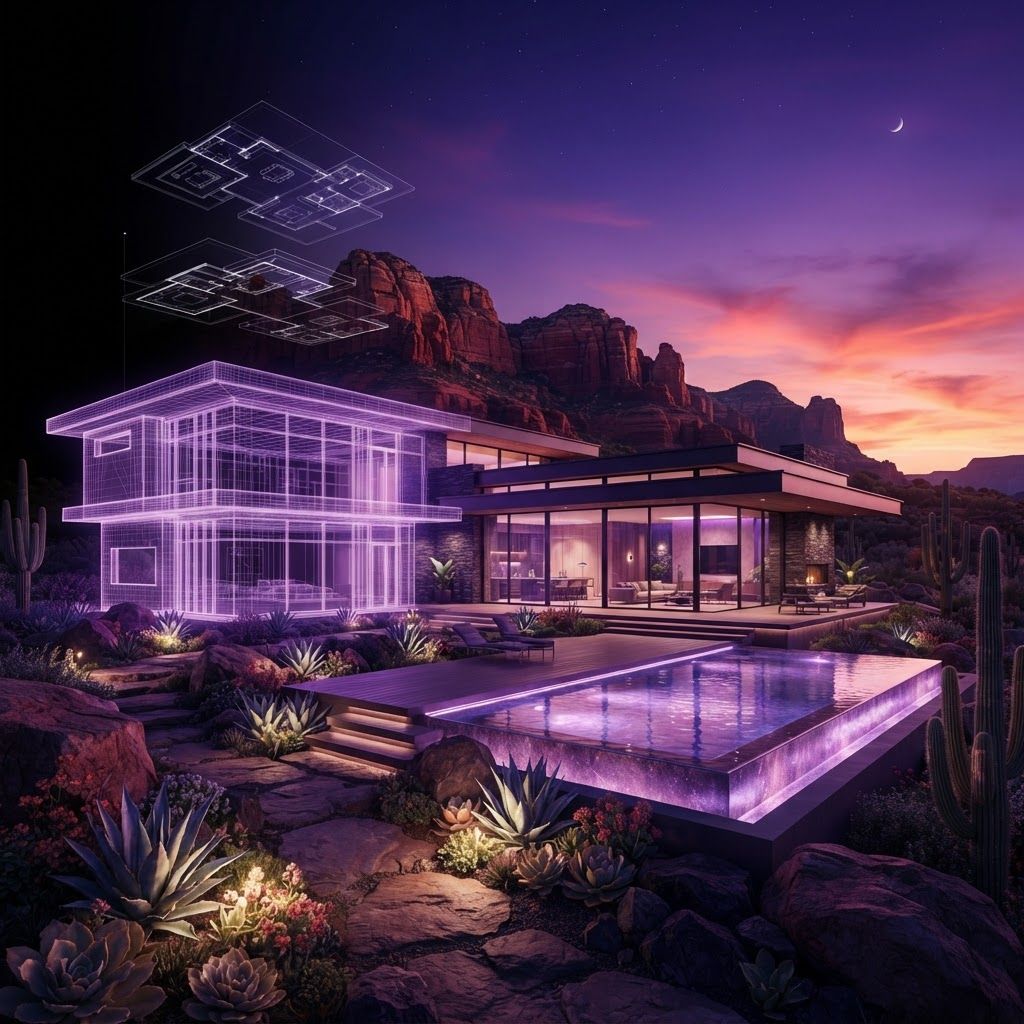
A Distinctive Residential Market
Scottsdale's housing market is unusual in both its price range and its architectural ambition. Within the same city, builders deliver efficient production homes in master-planned communities and multi-million-dollar hillside estates with structural engineering closer to commercial work. Desert contemporary architecture, characterized by low horizontal massing, deep overhangs, large expanses of glass and materials drawn from the surrounding landscape, has become the dominant idiom, and executing it well requires genuine technical skill.
Environmental conditions define much of that skill. Cooling loads dominate energy consumption, so envelope performance and glazing specification matter more here than insulation depth alone. Monsoon rainfall arrives fast and heavy, requiring drainage and waterproofing design that anticipates concentrated flow. Soils vary, with expansive clays and caliche requiring engineered foundation solutions. And north Scottsdale's hillside ordinances constrain grading, height, retaining walls, exterior colors and native plant disturbance in ways that shape design from the outset.
1. Luxury Custom Home Builders
At the top of the Scottsdale market, custom builders deliver fully bespoke homes in collaboration with architects and interior designers. These firms typically complete a small number of homes annually, assign a dedicated superintendent to each project, and maintain long-standing relationships with high-end trades. Work includes structural steel for long spans and large glazing, custom millwork, natural stone, integrated smart home systems and resort-quality outdoor environments. Their real differentiator is process discipline: detailed preconstruction budgeting, allowance transparency and rigorous quality control at each phase.
2. Semi-Custom Builders
Semi-custom builders offer a middle path, starting from proven floor plans and allowing substantial modification of layout, elevations, finishes and site orientation. For buyers who want personalization without the cost and timeline of a full custom build, this model is efficient. Because the plans are already engineered and permitted in similar form, design risk and cost uncertainty are lower. Buyers should confirm exactly which modifications are permitted and how upgrade pricing is structured before committing.
3. Production Home Builders in Master-Planned Communities
National and regional production builders remain active in Scottsdale and adjacent north valley communities, delivering homes in planned developments with shared amenities. Their advantages are price efficiency, predictable delivery, comprehensive warranty programs and design centers that simplify selections. Modern production homes also frequently meet strong energy performance standards, which matters in this climate. Buyers should evaluate lot orientation carefully, since west-facing glazing significantly increases cooling load, and should review which desirable features are standard versus optional.
4. Hillside and View Lot Specialists
Building on Scottsdale's slopes requires expertise that many otherwise capable builders lack. These projects involve geotechnical investigation, drilled pier or stepped foundations, substantial retaining structures, engineered access drives, careful blasting or rock removal, and design within hillside ordinance limits on cut, fill, height and visible mass. Native plant salvage and replanting are typically required. Builders with a genuine hillside portfolio can navigate design review efficiently and price the work accurately, which prevents the mid-project cost escalation that inexperienced firms encounter.
5. Whole-Home Renovation and Rebuild Specialists
Substantial portions of Scottsdale's housing stock date from the 1960s through 1990s, often on excellent lots in established neighborhoods. Firms specializing in extensive renovation and down-to-studs rebuilds preserve location value while delivering contemporary performance and layout. Typical scope includes removing interior walls for open plans, replacing windows and doors with high-performance units, upgrading insulation and mechanical systems, replacing roofing and stucco, and adding outdoor living space. Structural knowledge is essential, since older homes here frequently need foundation and framing remediation.
6. Additions and Casita Builders
Adding square footage rather than moving has become increasingly common. Builders in this segment construct primary suite additions, expanded living areas, home offices, garage conversions and detached casitas or guest houses. Casitas in particular suit Scottsdale households hosting extended family or seasonal visitors. The technical challenges are matching existing rooflines, stucco textures and foundation elevations convincingly, and extending mechanical and electrical capacity appropriately. Zoning setbacks, lot coverage limits and homeowner association approval all require early attention.
7. Sustainable and Net-Zero Home Builders
High-performance residential construction has strong economics in Arizona. Builders in this category focus on tight, well-insulated envelopes with verified air sealing, advanced framing, cool roofing and radiant barriers, high-efficiency variable-capacity heat pumps, heat pump water heating, solar photovoltaic arrays with battery storage, and water-efficient fixtures and landscaping. Because cooling demand is so high, efficiency measures generate larger absolute savings than in mild climates, and net-zero energy performance is realistically achievable on well-oriented lots.
8. Multifamily and Infill Residential Developers
Closer to downtown Scottsdale and along major corridors, residential construction increasingly means townhomes, condominiums, small-lot detached clusters and mixed-use residential. Builders in this segment manage higher-density zoning, structured or tuck-under parking, shared amenity construction, fire separation and acoustic requirements, and municipal design review focused on street presence. Their work is reshaping walkable areas of the city and serves buyers who prefer proximity over lot size.
9. Modular and Panelized Construction Providers
Off-site construction methods have gained traction, using factory-built modules or wall panels assembled on site. The advantages are relevant to Scottsdale: components are manufactured in controlled conditions rather than exposed to summer heat and monsoon rain, which improves consistency and reduces schedule risk. Precision manufacturing also produces tighter envelopes. Design flexibility is more limited than site-built construction, and site preparation, foundation work and utility connections still follow conventional processes.
10. Owner-Builder Support and Construction Management Firms
Some Scottsdale homeowners prefer to retain control of a project while relying on professional oversight. Construction management firms provide budgeting, scheduling, subcontractor procurement, permit coordination and quality inspection for a fee rather than a markup on the full contract. This model can reduce cost on straightforward projects and provides transparency into trade pricing. It requires meaningful owner involvement and appetite for decision-making, so it suits organized clients with available time rather than those wanting a turnkey experience.
Evaluating a Residential Builder
Verify licensing with the Arizona Registrar of Contractors, along with classification and complaint history, and confirm liability and workers compensation coverage directly with insurers. Ask how many homes the builder starts each year and how many superintendents it employs, since an overextended firm produces quality problems regardless of intent.
Visit completed homes that are one to three years old, not only new models. Stucco cracking, drainage performance, roof detailing, door and window alignment, and mechanical sizing reveal themselves after a full seasonal cycle. Speak with those homeowners about warranty responsiveness specifically.
Read the contract closely. It should specify scope in detail, list realistic allowances, tie payments to completed milestones, define a written change order process, state a completion timeline with reasonable weather provisions, and set out warranty coverage on workmanship, systems and structure.
Design Choices That Matter Locally
Several decisions have outsized effect on comfort and cost in Scottsdale. Orientation and glazing placement determine solar gain more than any mechanical system can compensate for, so minimizing unshaded west exposure is valuable. Deep overhangs, screens and shade structures pay for themselves. Roof color and reflectivity measurably affect attic temperature. Site drainage should be designed for intense short-duration rainfall, directing water away from foundations and hardscape. And desert-appropriate landscaping reduces water consumption while suiting the setting.
Final Thoughts
Residential construction in Scottsdale rewards specialization. A hillside estate, a production home in a master-planned community, a deep renovation of a mid-century property and a net-zero custom build are genuinely different undertakings, and the strongest builders concentrate on one or two of them. Matching builder experience to project type, verifying credentials thoroughly and reviewing homes that have already survived a few Arizona summers together form the most dependable path to a house that performs as well as it looks.