
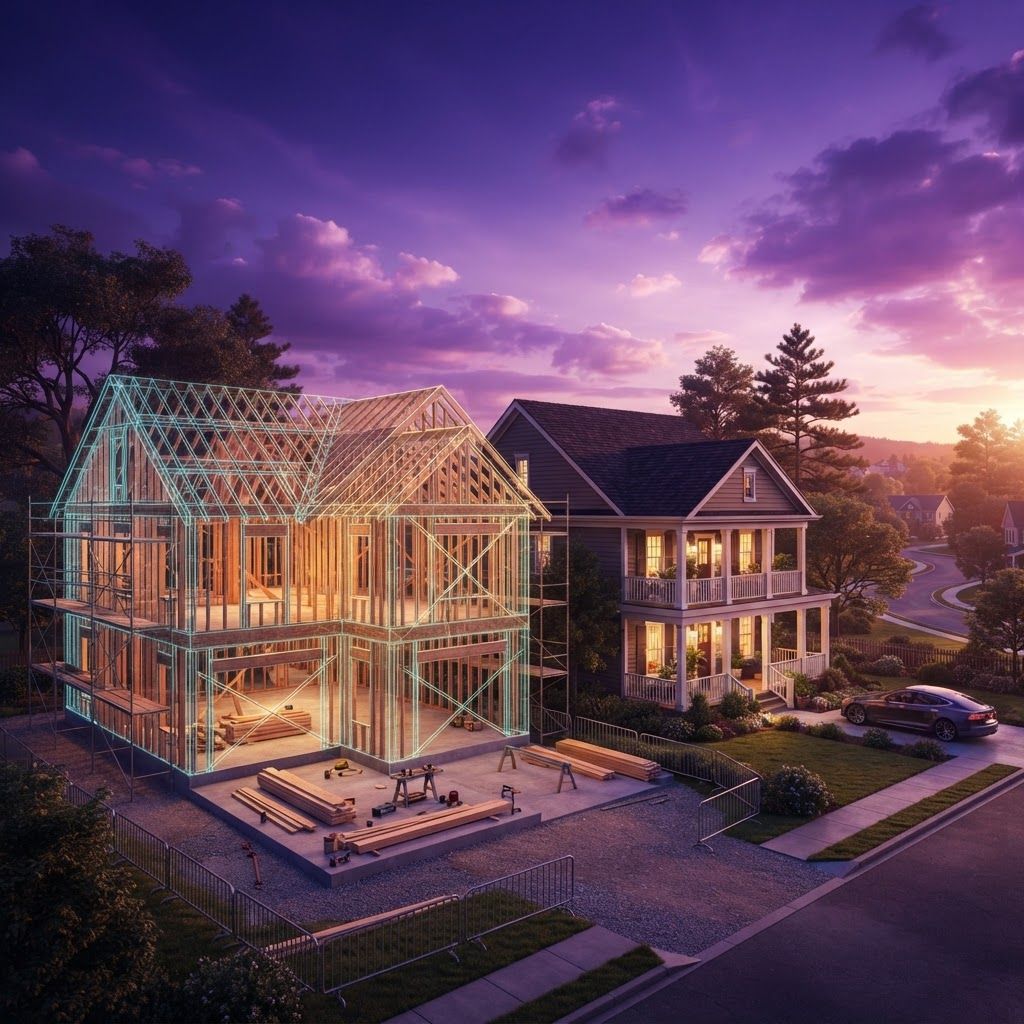
Residential Construction in Montgomery Today
Montgomery's housing market spans restored historic cottages in Cloverdale, established brick ranches across the midtown neighborhoods, and rapidly expanding subdivisions along the eastern corridor toward Pike Road. That variety means residential builders here work across an unusually wide range of construction types, from tight infill lots with mature trees to large greenfield developments where entire streets go up at once.
Local conditions shape how those homes are built. Expansive clay soils demand careful foundation engineering and drainage planning. Long, humid summers make envelope sealing, vapor management, and correctly sized air conditioning essential to comfort and durability. Severe weather season brings the need for properly rated roof assemblies and structural connections. Builders who respect these realities produce homes that age well; those who cut corners produce callbacks.
The Top 10 Residential Construction Companies in Montgomery
1. Southern Craft Homebuilders — A custom builder known for detailed millwork, thoughtful floor plans, and close collaboration with owners during design. The company limits its annual volume deliberately to preserve quality control on each home.
2. River Region Home Builders — Operates in the semi-custom space, offering refined base plans with substantial personalization in finishes, layouts, and outdoor living space. Its pricing transparency during selections is frequently praised.
3. Capital City Residential Construction — A production-oriented builder active in eastern Montgomery subdivisions, delivering efficient, well-specified homes at competitive price points with predictable timelines.
4. Heritage Custom Homes of Alabama — Specializes in traditional Southern architecture, including deep porches, brick and hardie exteriors, and interior detailing that reflects regional building heritage.
5. Cloverdale Construction Group — Focused on infill builds and whole-house reconstruction in established neighborhoods, where lot constraints, tree protection, and neighborhood character require a careful approach.
6. Pike Road Building Company — Serves the growing eastern suburbs with family-oriented plans, energy-efficient specifications, and an emphasis on flexible spaces for remote work and multigenerational living.
7. Cornerstone Residential Builders — Known for structural quality and building science literacy, including blower-door testing, continuous insulation details, and conditioned crawl space or slab assemblies suited to the climate.
8. Magnolia Estate Homes — A luxury builder handling larger custom residences with features such as outdoor kitchens, pool integration, home automation, and high-performance mechanical systems.
9. Gateway Home Construction — Combines new construction with major renovation and addition work, making it a practical choice for owners deciding between rebuilding and expanding an existing property.
10. Alabama Value Homes — Focuses on attainable, well-built starter homes, emphasizing durable finishes, low maintenance exteriors, and floor plans that maximize usable square footage.
Choosing the Right Builder
Match the builder type to your priorities. Production builders deliver cost efficiency and schedule certainty through repetition. Semi-custom builders balance personalization with process discipline. Full custom builders offer complete design freedom but require greater owner involvement and a longer timeline. Confusion about which model you are buying is the most common source of disappointment.
Tour completed homes and, if possible, one under construction at the framing stage. Framing reveals workmanship that finishes conceal: consistent stud spacing, proper bracing, clean plumbing and duct runs, and sealed penetrations. Ask which components are self-performed and which are subcontracted, and how long those subcontractor relationships have lasted.
Scrutinize the specification sheet. Two bids can differ by a large margin simply because one includes better windows, thicker insulation, upgraded HVAC equipment, or higher-grade cabinetry. Comparing allowances line by line is the only way to judge value honestly.
Review the warranty structure. A standard arrangement covers workmanship for one year, mechanical systems for two, and structural elements for ten. Just as important is the builder's reputation for actually responding after closing, which references can confirm quickly.
Cost, Financing, and Timeline Realities
Construction loans convert to permanent financing after completion, and lenders release funds through inspected draws tied to progress milestones. Owners should budget a contingency of roughly five to ten percent for changes and unforeseen conditions, particularly on custom projects where selections evolve.
Typical timelines run several months for production homes and longer for custom builds, with permitting, weather delays, and long-lead materials such as windows and mechanical equipment being the usual causes of extension. Builders who publish a realistic schedule and update it weekly manage expectations far better than those promising aggressive completion dates.
Trends in Local Home Building
Energy efficiency has moved from a premium upgrade to a baseline expectation, driven by cooling costs during long Alabama summers. High-performance windows, radiant barriers, sealed ductwork inside conditioned space, and variable-speed HVAC equipment are increasingly standard rather than optional.
Floor plans continue to adapt to how households actually live. Dedicated home offices, flexible bonus rooms, larger pantries, drop zones near garage entries, and covered outdoor living areas appear in most new plans. Durable exterior materials and low-maintenance landscaping also reflect buyer preference for lower long-term upkeep.
Final Thoughts
Montgomery's residential builders serve every tier of the market, from attainable first homes to substantial custom estates. The companies worth hiring share common traits: sound building science, transparent specifications, organized scheduling, and genuine responsiveness after move-in. Take time to compare specifications rather than headline prices, visit active job sites, and speak with recent owners. That diligence is what separates a home that performs for decades from one that generates frustration in its first year.