
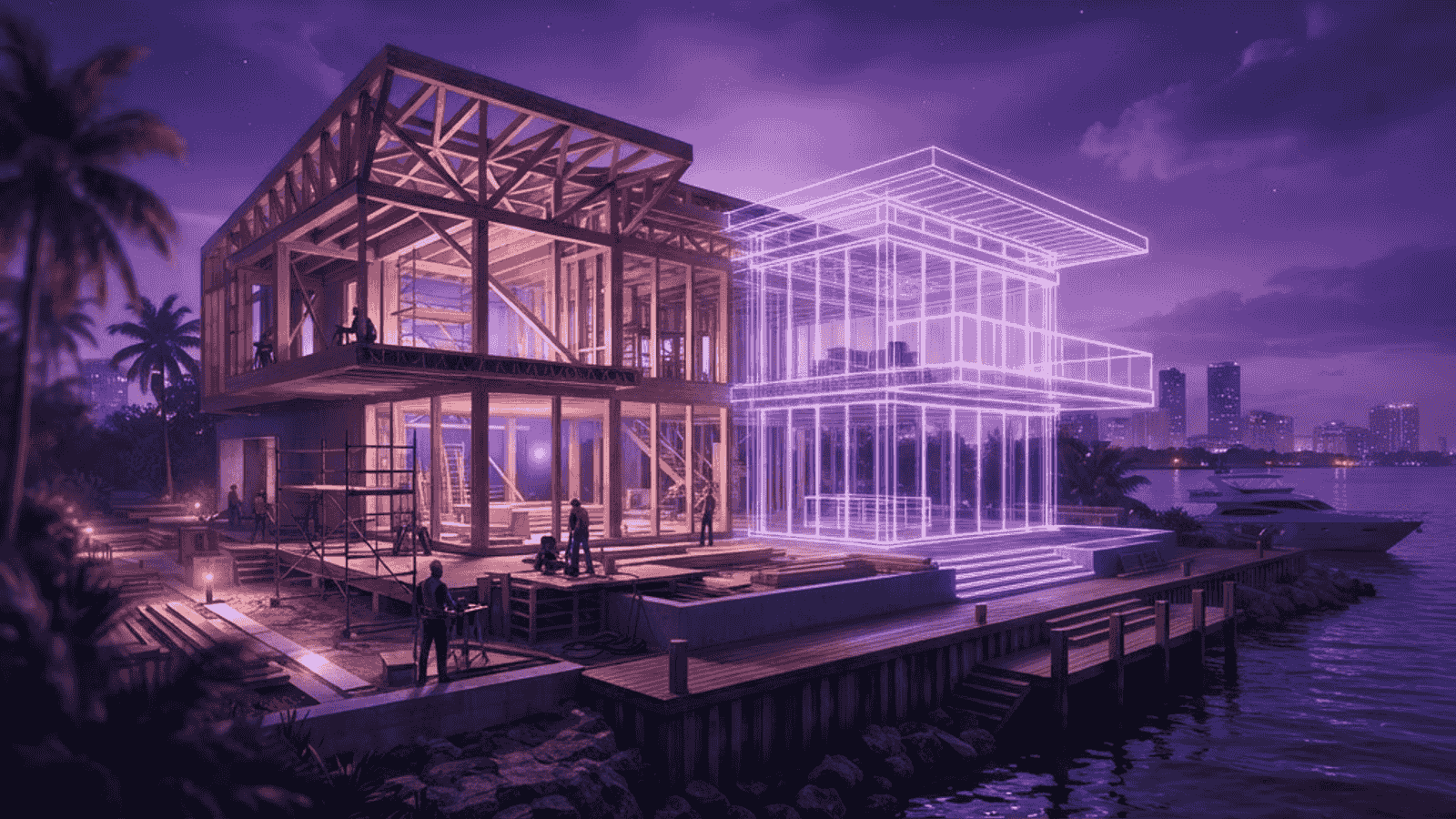
Building a Home in South Florida
Residential construction in Miami is a specialized discipline. A home here must resist hurricane-force winds and wind-borne debris, manage relentless humidity without inviting mold, tolerate salt exposure, and often sit above a mandated flood elevation. Concrete block and poured concrete construction dominate for good reason, and details that seem minor elsewhere, such as flashing design, ventilation strategy, and fastener metallurgy, determine whether a house performs for decades or generates callbacks within two years.
The market is equally diverse. Miami residential work ranges from compact infill houses in established neighborhoods to sprawling waterfront estates with dock permits, and from townhome communities to accessory dwelling units added to existing lots. The strongest builders are candid about which of these they do well.
Stages of a Custom Home Project
A typical project moves through feasibility and site analysis, design and engineering, permitting, site preparation and foundation work, structural shell, roofing and building envelope, mechanical and electrical rough-in, insulation and drywall, finishes and cabinetry, exterior work and landscaping, and finally inspections and closeout. Each phase has inspection gates, and a builder's ability to keep trades sequenced without idle time is the single biggest driver of schedule performance.
The Top 10 Residential Construction Companies in Miami
1. Coastal Living Homes Miami
A custom builder focused on waterfront residences, with expertise in elevated foundations, flood-compliant mechanical placement, and corrosion-resistant detailing for properties exposed to salt air.
2. Coral Gables Custom Residences
Known for architecturally refined homes in design-review neighborhoods, blending Mediterranean vernacular with modern performance systems. Craftsmanship in millwork, stucco, and tile is a signature.
3. Kendall Family Home Builders
A production and semi-custom builder delivering family homes with predictable pricing and clear specification packages. Efficient trade scheduling keeps timelines tight on suburban lots.
4. Palmetto Bay Fine Homes
Specialists in large single-family estates on generous lots, coordinating pools, guest houses, and extensive landscape work as part of a single delivery package.
5. Miami Modern Construction
Focused on contemporary architecture with expansive impact glazing, flat roof assemblies, and exposed concrete finishes. Detailing expertise prevents the water intrusion issues that plague minimalist designs.
6. Little Havana Infill Builders
Experts in tight urban lots, zero-lot-line conditions, and neighborhood infill where site access and staging are constrained. Also active in accessory dwelling unit construction.
7. Homestead Residential Group
Serving the southern county with value-oriented new construction and workforce housing, emphasizing durable, low-maintenance material selections and straightforward cost management.
8. Aventura Luxury Residences
High-end builder handling condominium-level finish standards in single-family homes, including imported stone, integrated smart home systems, and whole-house generator installations.
9. Biscayne Green Builders
Focused on energy efficiency and healthy building practices: high-performance envelopes, efficient cooling systems, solar readiness, and moisture-managed assemblies suited to the tropical climate.
10. South Miami Renovation & New Build
A hybrid firm handling both substantial whole-house remodels and ground-up construction, valued for realistic budgeting on projects where existing structures complicate the scope.
Cost, Contracts, and Timelines
Residential construction costs in Miami are influenced by structural requirements, impact-rated openings, elevation work, and finish level, which is why square-foot averages are unreliable planning tools. Fixed-price contracts offer certainty but require complete drawings; cost-plus contracts offer flexibility with transparent markups but demand disciplined owner decision-making. Either way, insist on a detailed allowance schedule, a written change order process, and a realistic schedule that accounts for permitting and long-lead items such as windows and cabinetry.
Trends in Miami Residential Construction
Resilience leads the list: impact windows, elevated equipment, whole-home generators, and backup water systems are now routine. Indoor-outdoor living remains central to the market, with covered terraces, summer kitchens, and large sliding systems. Energy performance is rising in importance as cooling loads dominate utility bills, pushing better insulation, tighter envelopes, and variable-speed equipment. Smart home integration has matured from novelty to expected infrastructure. Builders are also adopting prefabricated components and digital project management to offset labor constraints.
Choosing Your Builder
Tour completed homes and, if possible, one project currently under construction, since an active site reveals a builder's organization and safety culture. Confirm the license, insurance, and warranty terms, including how post-occupancy callbacks are handled. Ask who the actual project manager will be and how many jobs they oversee simultaneously. Most importantly, make sure the builder's typical project size and style match your own. In Miami's competitive market, the right fit between owner and builder consistently matters more than the lowest bid.
Designing for Wind, Water, and Heat
A house built well in Miami is built for three specific threats. Wind resistance drives the structural system, which is why reinforced concrete block and poured concrete dominate, paired with engineered connections, impact-rated glazing, and roof assemblies detailed to resist uplift. Water management drives site grading, foundation elevation relative to flood mapping, waterproofing at every penetration, and drainage that moves intense rainfall away from the structure quickly. Heat and humidity drive envelope decisions: continuous insulation, reflective roofing, deep overhangs and shading on western exposures, and mechanical systems sized for dehumidification rather than cooling alone.
Owners who understand these priorities make better decisions during design, because the choices that matter most are largely invisible in the finished house. Spending on glazing performance, waterproofing detail, and duct design returns far more comfort and durability than the equivalent amount spent on finishes.
Timelines, Costs, and Owner Involvement
A custom home in Miami-Dade typically moves through design, permitting, site work, structure, dry-in, mechanical rough-in, finishes, and closeout, with permitting alone often consuming several months. Budget certainty improves dramatically once selections are finalized, so owners who commit to finishes early tend to experience fewer surprises. Expect to make decisions continuously and to walk the site regularly; the projects that go best are those where the owner engages consistently without renegotiating settled decisions. Ask for references from clients whose homes were completed two or three years ago rather than recently, because durability in this climate reveals itself over time.