
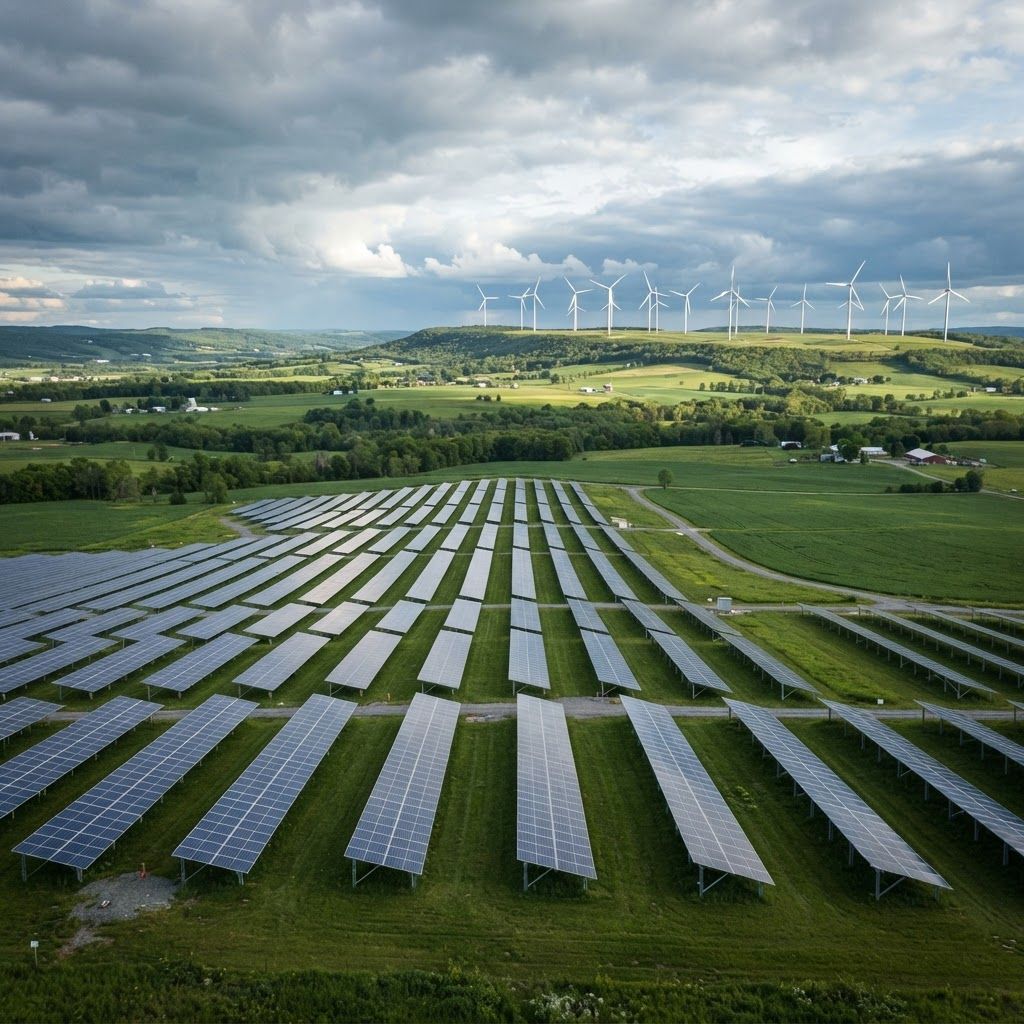
A City Built on Clean Power
Buffalo's relationship with renewable energy is older than the term itself. The city earned the nickname City of Light after hydroelectric power from Niagara Falls was transmitted to Buffalo in the 1890s, one of the first practical demonstrations of long-distance alternating current transmission. That legacy is not merely historical trivia. The Niagara Power Project remains one of the largest hydroelectric facilities in the United States, and its output gives Western New York some of the cleanest and most affordable electricity in the country.
That foundation shapes everything about the local renewable market. Because grid power is already low-carbon and relatively cheap, the economics of new renewable projects in Buffalo depend heavily on state incentives, demand charge management, resilience value and corporate sustainability commitments rather than simple energy arbitrage. Companies that succeed here understand that distinction and sell accordingly.
Policy Drivers Behind the Growth
New York's Climate Leadership and Community Protection Act set aggressive statutory targets, including a zero-emission electricity sector and large-scale storage deployment. The NY-Sun program, NYSERDA incentives, net metering successor tariffs and community distributed generation rules have collectively created a durable pipeline of work for developers, installers and engineering firms.
Buffalo has additional local drivers. The Buffalo Green Code and municipal sustainability commitments push public buildings toward efficiency and on-site generation. Large institutional energy users, including hospital systems and universities, have made public decarbonization pledges that require procurement of renewable capacity. And the region's manufacturing base has created demand for clean energy component production, most visibly at the RiverBend site in South Buffalo.
Ten Companies Leading the Sector
1. New York Power Authority Niagara operations anchor the region's clean energy identity. The Niagara Power Project supplies enormous volumes of hydroelectric generation and administers allocation programs that provide low-cost power to regional businesses in exchange for job and investment commitments, making it a central actor in local economic development as well as energy.
2. Tesla's Buffalo facility at RiverBend occupies the region's most prominent clean energy manufacturing site. Operations there have shifted focus over time across solar products, Supercharger hardware and other electrical assemblies, but the plant remains the largest single symbol of Buffalo's ambition to manufacture rather than merely consume clean technology.
3. Solar Liberty is among the longest-operating solar developers in Western New York, with a portfolio spanning residential rooftops, commercial systems, municipal installations and school districts. Its longevity in a sector with high company turnover is itself a meaningful signal of operational discipline.
4. Buffalo Solar Solutions focuses on residential and small commercial installations across Erie and Niagara counties, handling design, permitting, interconnection and incentive paperwork. Local installers differentiate largely on their ability to navigate municipal permitting variation, which in Western New York is considerable.
5. Montante Solar operates as part of a broader construction and development organization, which allows it to handle larger commercial and institutional projects where solar is one component of a wider capital improvement program. That integration is valuable for owners who prefer a single accountable contractor.
6. CIR Electrical Construction serves as an electrical contractor on renewable and infrastructure projects throughout the region. Behind every renewable installation sits substantial electrical work, including switchgear, interconnection and controls, and experienced electrical contractors are often the constraint on project schedules.
7. Ecology and Environment legacy practices, now part of larger consulting organizations, established Western New York as a center for environmental permitting and impact assessment. Utility-scale wind and solar projects require extensive ecological, avian, cultural resource and visual impact studies, and that expertise remains concentrated locally.
8. Viridi Parente is a Buffalo-based company developing battery energy storage systems designed for safety in occupied and industrial environments. Storage is the fastest-growing segment of the clean energy market, and having a manufacturer headquartered in the city is strategically significant for the region.
9. Sustainable Energy Developments and similar regional engineering firms provide feasibility analysis, energy modeling and owner's representation services. Independent technical advice is genuinely valuable in a market where developer projections are naturally optimistic.
10. Community solar developers active in Erie and Niagara counties have built a meaningful subscription market, allowing renters and homeowners with unsuitable roofs to receive bill credits from remote arrays. Community distributed generation has become one of the most effective mechanisms for broadening participation in New York's clean energy transition.
Technical and Market Realities
Buffalo's climate presents real engineering considerations. Snow loading requires structural attention on rooftop arrays, and winter production drops meaningfully, though cold temperatures actually improve panel efficiency and reflection from snow cover can partially offset losses. Well-designed systems account for this with appropriate tilt and mounting choices rather than treating regional solar as marginal.
Interconnection is the more common practical constraint. Distribution capacity in parts of Western New York is limited, and hosting capacity analysis has become an early-stage requirement for any commercial project. Developers who evaluate grid constraints before signing site agreements avoid the most expensive category of project failure.
Workforce is the third constraint. Skilled electricians, roofers and controls technicians are in short supply, and regional training programs through community colleges and union apprenticeships have become essential infrastructure for the sector.
How to Evaluate a Renewable Energy Provider
Ask for local references with systems that have operated through at least three winters, and request actual production data against original projections. Verify licensing, insurance and workers' compensation coverage. Understand exactly what the warranty covers, distinguishing between panel or equipment warranties from manufacturers and workmanship warranties from the installer, which is where most disputes arise.
Scrutinize financial structure. Cash purchase, loan, lease and power purchase agreements produce very different long-term outcomes, and the incentive treatment differs across them. Anyone unwilling to model those scenarios transparently should be treated cautiously.
The Road Ahead
Buffalo enters the next phase of the energy transition with unusual advantages: abundant clean baseload generation, available industrial land and buildings, an experienced construction workforce and a policy environment that rewards investment. The most likely growth areas are battery storage, building electrification, industrial process heat and grid modernization work rather than simple solar deployment. For businesses and homeowners in Western New York, the practical implication is that competent providers are available and the economics increasingly favor action.