
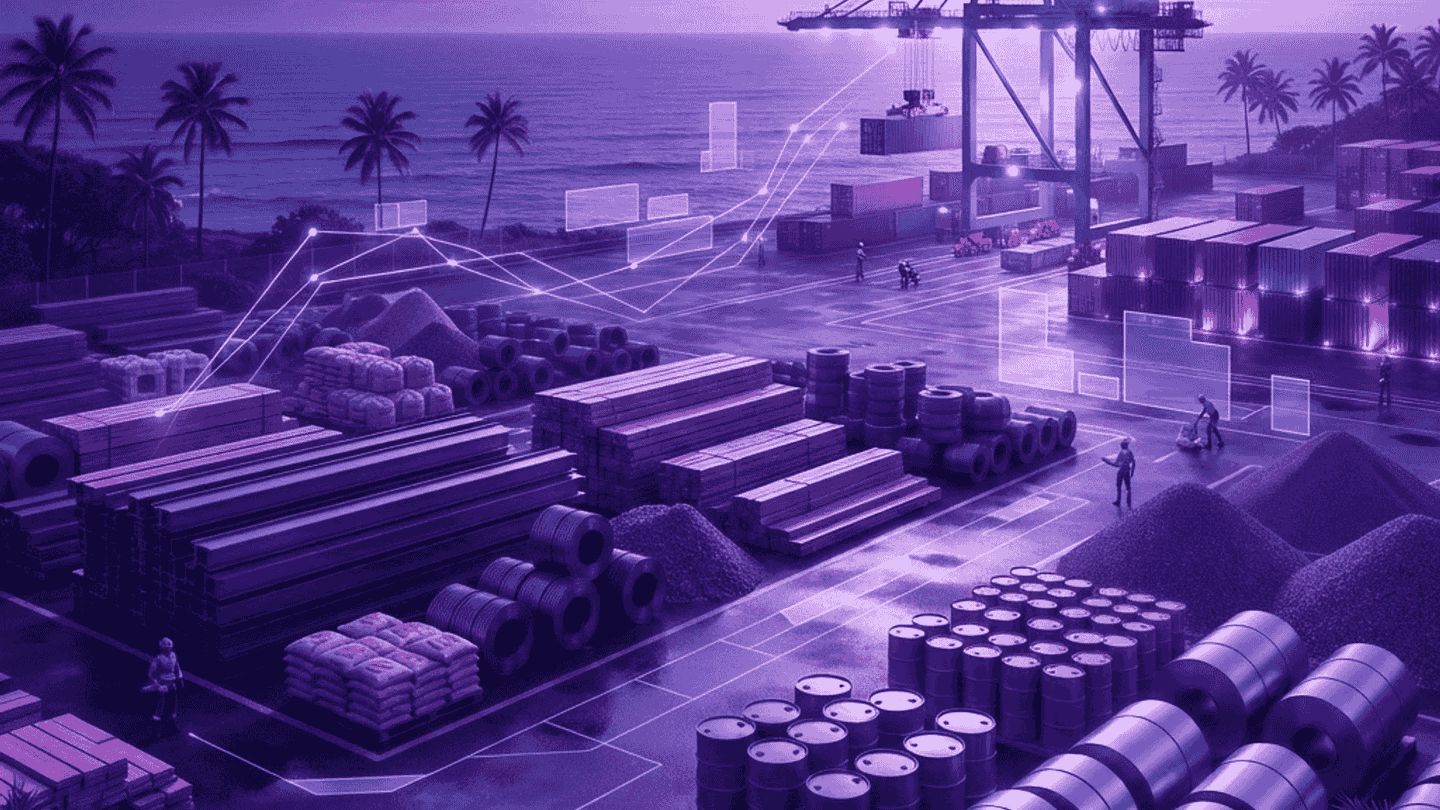
Every construction project in Honolulu begins with a supply chain question. Concrete, steel, lumber, aggregate, glass, plastics, and chemicals largely arrive by ocean vessel, and the timing of those arrivals dictates whether a schedule holds. Raw material suppliers on Oahu therefore operate as much like inventory banks as sellers, carrying substantial stock so that contractors are not exposed to every shipping disruption in the Pacific.
How Import Dependence Shapes Procurement
The practical consequence is that lead times must be planned in weeks, not days, for anything non-standard. Standard dimensional lumber, common rebar sizes, and typical cement grades are usually available locally. Specialty items such as architectural glass, structural steel in unusual sections, custom-fabricated components, or specific admixtures often require a dedicated order with a multi-week horizon. Experienced project managers front-load these decisions during design rather than discovering them during construction.
Local production does exist and matters considerably. Cement grinding and ready-mix concrete operations, asphalt plants, quarries producing crushed basalt aggregate, and rebar fabrication all operate on Oahu. Because concrete and aggregate are prohibitively expensive to import at scale, local capacity keeps costs viable and gives contractors a shorter, more reliable supply loop for the heaviest materials.
The 10 Best Raw Material Suppliers in Honolulu
1. Grace Pacific
Grace Pacific is one of Hawaii's most significant materials producers, with operations spanning aggregate quarrying, asphalt production, and paving construction. Its vertical integration means road and site work projects can source base material, asphalt, and installation from one organization. Quarry capacity on Oahu is a strategic asset in a market where importing aggregate is economically impractical.
2. Hawaiian Cement
Hawaiian Cement supplies cement, ready-mix concrete, and aggregate to projects across the island, from residential foundations to major commercial structures. Ready-mix logistics require tight coordination, since concrete has a limited working window after batching, and dispatch reliability is a core differentiator. Technical support on mix design helps engineers meet strength and durability requirements in marine-adjacent environments.
3. Honsador Lumber
Honsador Lumber is a long-established building materials supplier known for lumber, plywood, engineered wood, roofing, and home package programs. Its package business is particularly relevant in Hawaii, where owner-builders and small contractors benefit from pre-planned material kits that reduce omissions. Multi-island distribution capability supports projects beyond Oahu.
4. HPM Building Supply
HPM Building Supply combines material distribution with design services, truss and component manufacturing, and home building packages. Local fabrication of roof trusses and wall panels shortens site schedules and reduces waste. For clients navigating permitting and structural requirements, integrated design support is a meaningful advantage over pure distribution.
5. City Mill
City Mill operates as a hardware and building materials supplier with substantial contractor trade business alongside retail. Its convenience across multiple Oahu locations makes it a practical source for lumber, fasteners, plumbing, electrical, and finishing materials during active construction. Trade accounts value quick pickup on the mid-job items that stall progress when unavailable.
6. Pacific Steel & Supply
This supplier focuses on structural and reinforcing steel, including beams, plate, tubing, rebar, mesh, and fabrication services. Steel corrodes rapidly in Hawaii's marine atmosphere, so galvanized and epoxy-coated options are essential rather than optional upgrades. On-island cutting and bending capability reduces both waste and schedule risk for reinforcement packages.
7. Island Plastics & Composites
Serving manufacturers, marine builders, and sign makers, this supplier stocks acrylic and polycarbonate sheet, PVC, HDPE, fiberglass, and resin systems. UV resistance and moisture tolerance drive material selection in Hawaii, and technical guidance on grade selection prevents premature failure. Fabrication services such as cutting, forming, and bonding support smaller shops without in-house capability.
8. Hawaii Glass & Aluminum Supply
This supplier provides glass, aluminum extrusions, and glazing systems for construction and renovation work. Hurricane and wind-load requirements make impact-rated products a regular specification in Hawaii, and documentation of ratings is essential for permitting. Local inventory of common extrusion profiles allows storefront and window repair work to proceed without long waits.
9. Ameron Hawaii
Ameron Hawaii is known for concrete pipe and precast products used in drainage, utility, and infrastructure work. Precast manufacturing on island reduces the freight burden on extremely heavy components and shortens delivery timelines for municipal projects. Engineering support on specification and load rating is a standard part of the relationship.
10. Kapolei Industrial Chemicals
This supplier distributes industrial chemicals and process materials to manufacturers, water treatment operations, food processors, and cleaning product formulators. Regulated storage, transport compliance, and safety documentation are central to its operation. Reliable local stock of treatment chemicals is critical infrastructure for utilities and facilities that cannot pause operations.
Trends in Raw Material Supply
Sustainability is reshaping specifications. Low-carbon concrete mixes using supplementary cementitious materials, recycled steel content, FSC-certified lumber, and reclaimed aggregate are increasingly requested, particularly on public projects. Resilience requirements are also intensifying, with hurricane and seismic standards driving demand for engineered connectors, impact-rated glazing, and reinforced systems.
Prefabrication continues to gain share because it converts unpredictable on-site labor into controlled factory output, an appealing tradeoff in a market with a constrained skilled workforce. Digital tools have improved as well, with material takeoffs generated from building models reducing over-ordering and the disposal costs that follow.
Procurement Practices That Work in Hawaii
Lock in long lead time items during design, not construction. Build float into the schedule for ocean freight variability, particularly around peak shipping seasons and holiday periods. Where possible, prefer suppliers with on-island stock and fabrication rather than pure order-takers, because the ability to correct a shortfall locally is worth more than a small unit discount.
Finally, treat material specification as a durability decision. In a salt-air, high-humidity, high-UV environment, corrosion resistance, treatment ratings, and finish quality determine maintenance cost for decades. The suppliers worth building relationships with in Honolulu are the ones who raise those issues before you sign the purchase order.