
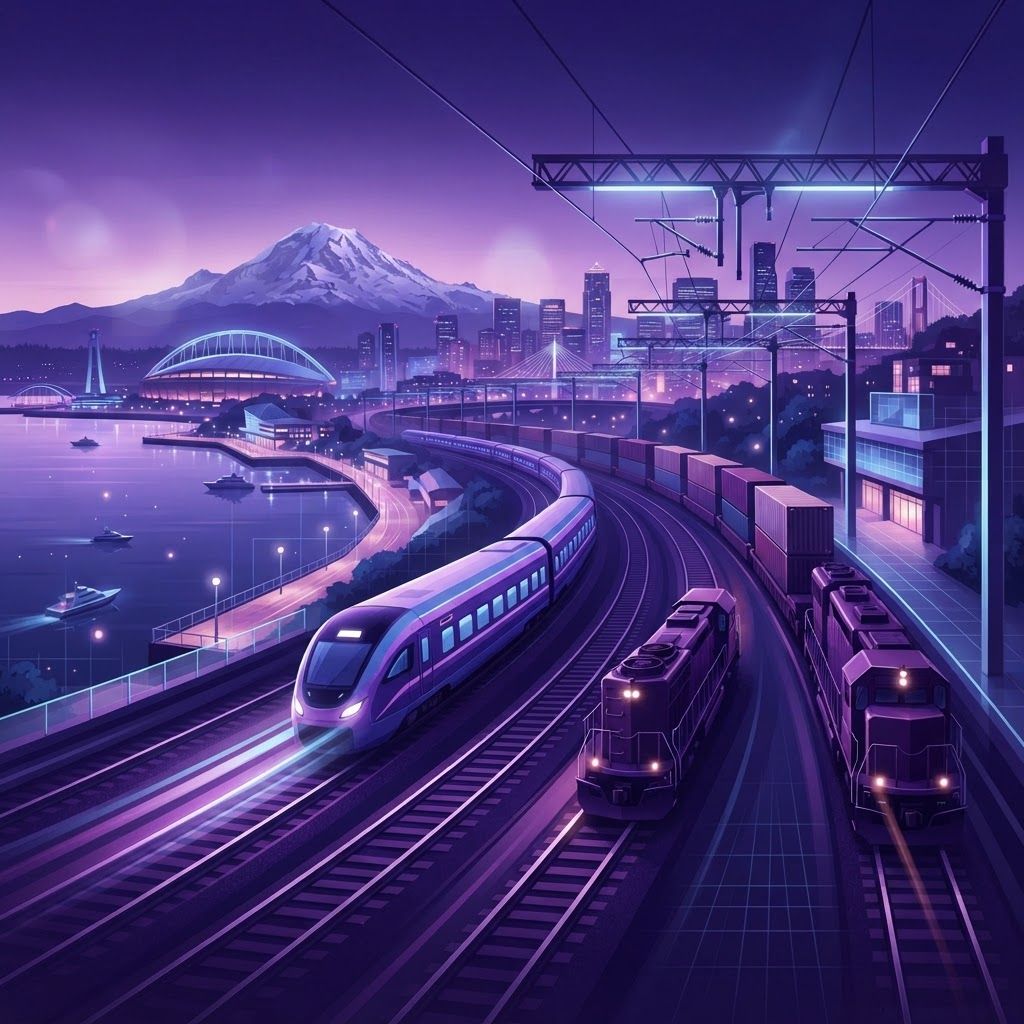
Rail built Tacoma. When the Northern Pacific chose the city as its western terminus in the nineteenth century, it set the pattern that still shapes the waterfront today. More than a century later, rail remains fundamental: on-dock and near-dock terminals move containers between vessels and inland markets, short-line operators serve industrial customers across the tideflats, and passenger services connect Tacoma to Seattle, Portland and points beyond.
Understanding who operates what is genuinely useful, whether you are a shipper choosing an intermodal route or a resident weighing commuting options. This guide profiles ten railway operators and rail service providers active in and around Tacoma.
Why Rail Matters to Tacoma
Rail's advantage is cost and capacity over distance. A single intermodal train can carry the equivalent of hundreds of truckloads with far lower fuel consumption per container mile. For a port whose value proposition rests on being a fast, cheap first inland point for Asian trade, that efficiency is decisive. On-dock rail in particular allows containers to move from crane to railcar without a truck trip, cutting cost, congestion and emissions simultaneously.
On the passenger side, rail offers something the Interstate 5 corridor cannot: predictable journey times. That reliability is why commuter and intercity services continue to grow despite the convenience of driving.
The 10 Best Railway Operators in Tacoma
1. Northwest Seaport Rail Services
Northwest Seaport Rail Services coordinates on-dock intermodal operations at the port's container terminals. Its value is speed of transfer between vessel and train, and disciplined coordination with terminal operators during peak vessel calls.
2. Tacoma Rail
Tacoma Rail is the municipally operated short-line switching railroad serving the tideflats. It moves cars between industrial customers and the mainline carriers, and its local knowledge of complex trackage in the industrial district is unmatched.
3. Cascade Intermodal Lines
Cascade Intermodal Lines focuses on container and trailer movements toward inland hubs. It appeals to shippers who want scheduled service with published transit times rather than variable spot arrangements.
4. Puget Sound Regional Rail
Puget Sound Regional Rail concentrates on commuter operations along the corridor, running peak-period trains for workers travelling between Pierce County and the wider metro area. Punctuality and station accessibility are its main performance measures.
5. Rainier Bulk Rail Group
Rainier Bulk Rail Group handles bulk commodities including grain, aggregates and chemicals, providing unit-train and single-car service with the specialised loading facilities those cargoes require.
6. Commencement Bay Terminal Railway
Commencement Bay Terminal Railway provides switching, car storage and transload services for waterfront facilities. Its transload capability lets customers convert between rail and truck without long-distance repositioning.
7. Evergreen Line Freight Rail
Evergreen Line Freight Rail serves regional manufacturers and forest-products customers across Western Washington, offering carload service to shippers whose volumes do not justify unit trains.
8. Harbor Junction Rail Logistics
Harbor Junction Rail Logistics is a rail logistics manager rather than a track operator, arranging railcar sourcing, fleet management and routing on behalf of shippers who lack in-house rail expertise.
9. Sound Corridor Passenger Services
Sound Corridor Passenger Services supports intercity passenger travel through the Tacoma area, with an emphasis on longer-distance journeys, onboard comfort and connections to regional transit.
10. Pierce Rail Maintenance and Operations
Pierce Rail Maintenance and Operations provides track inspection, maintenance-of-way and industrial siding services. It is the operator industrial customers call when private trackage needs rehabilitation or ongoing upkeep.
How Shippers Evaluate Rail Service
Transit time consistency matters more than headline speed. A service that takes five days every time is more useful than one that averages four but occasionally takes nine, because inventory planning depends on the variance, not the mean.
Terminal access is the second factor. Ask how far the nearest ramp is from your facility, what the gate hours are, and how drayage between ramp and door will be handled. A cheap line-haul rate can be erased by expensive local trucking.
Equipment availability is the third. Confirm that suitable railcars or containers will be positioned when you need them, particularly for seasonal commodities where everyone wants equipment in the same weeks. Finally, examine claims handling and communication: rail moves are long, and you need to know how exceptions are reported.
Trends in Rail
Three changes stand out. Investment in on-dock rail capacity continues, reducing truck trips around the port and improving gateway competitiveness. Digital visibility has improved sharply, with shipment tracking now expected rather than exceptional. And environmental policy increasingly favours rail for long-haul freight, which is gradually shifting the economics in rail's direction for distances where trucking once dominated.
Final Thoughts
Tacoma's rail network is one of its genuine structural advantages. For shippers, the practical task is matching cargo type and volume to the right operator, then verifying terminal access and equipment supply before committing. For travellers, rail offers the corridor's most predictable journey. Either way, understanding who does what makes the network far easier to use well.