
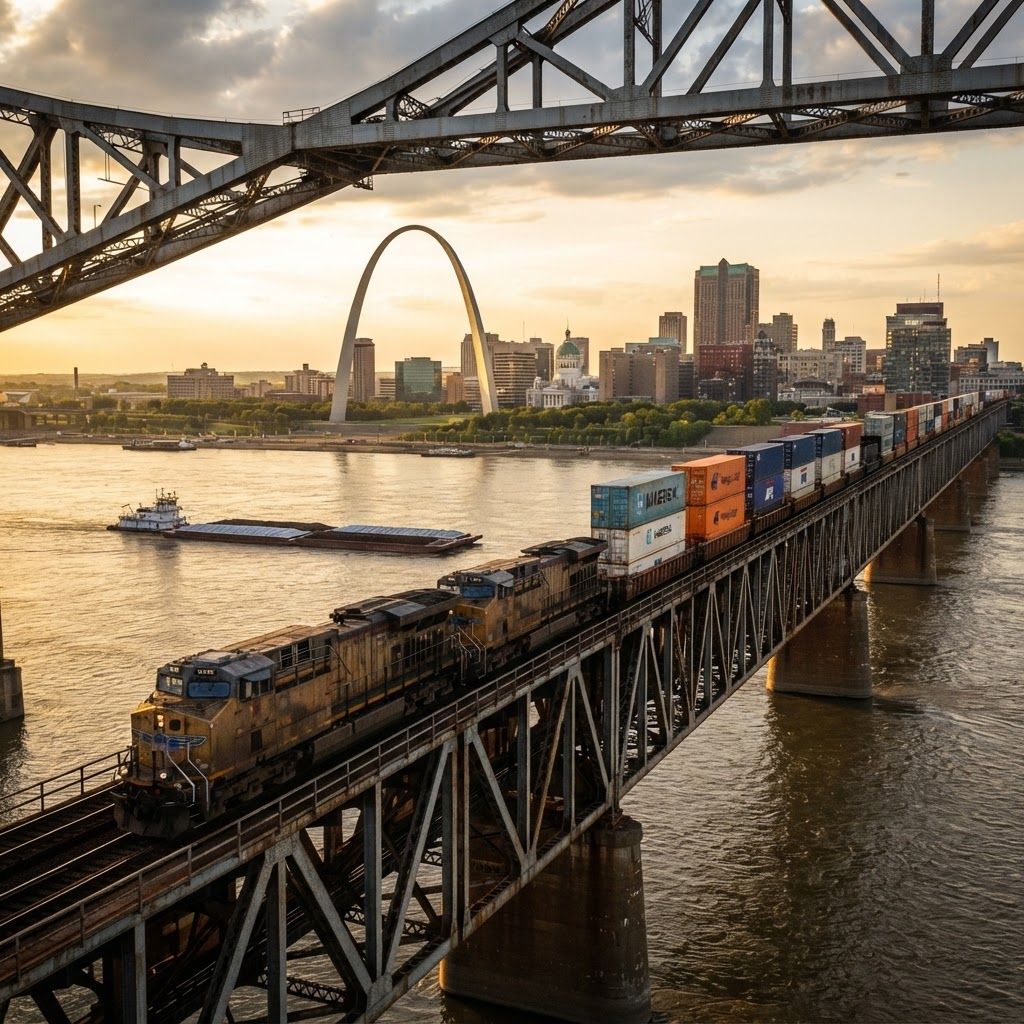
A Genuine Rail Capital
Among North American cities, only a small handful are served by all six Class I railroads. St. Louis is one of them, alongside Chicago and New Orleans. That fact deserves more attention than it usually receives, because it means shippers here have competitive rail options that companies in almost every other market simply do not.
The reason is geographic and historical. St. Louis sat at the natural crossing point where eastern railroads met western ones, and the Eads Bridge, completed in 1874, made it possible to move trains across the Mississippi without ferries. Railroads built enormous terminal infrastructure here, and while passenger volumes declined through the twentieth century, freight infrastructure endured and expanded. The region today handles millions of railcars annually across multiple intermodal terminals, classification yards and transload facilities.
How Rail Freight Actually Works
Understanding the structure helps shippers use it. Class I railroads operate the long-haul networks and handle the line-haul movement between regions. Regional and short line railroads provide first-mile and last-mile service, connecting industrial facilities to the Class I network, and they are often far more flexible and customer-responsive than the majors. Terminal railroads manage the switching, interchange and yard operations that let cars move between different carriers within a hub. Intermodal marketing companies and drayage providers connect rail to truck at both ends.
For a shipper, rail becomes compelling above roughly 700 miles of haul length, for dense or heavy commodities, and for anything where emissions reduction is a priority. Rail moves a ton of freight several times farther per gallon of fuel than trucking, which is why modal shift is central to most corporate sustainability plans.
The Ten Most Important Railway Operators in St. Louis
1. Union Pacific Railroad
Union Pacific operates the largest network in the western United States and maintains major facilities in the St. Louis region, including significant intermodal and classification capacity. Its reach spans the West Coast ports, the Gulf, Mexico gateways and the Pacific Northwest, making it the primary option for westbound and import container traffic. Its intermodal service on the transcontinental lanes is well developed, and its automotive and agricultural product handling is substantial.
2. BNSF Railway
BNSF is the other western giant, with a network spanning the Pacific Northwest, California, the Southwest and the northern plains. Its intermodal franchise is among the strongest in North America, and it moves enormous volumes of agricultural products, coal, industrial materials and consumer goods through the region. For shippers moving import containers from West Coast ports to the Midwest, BNSF and Union Pacific are the two realistic choices, and having both available creates genuine pricing competition.
3. CSX Transportation
CSX operates the dominant network across the eastern United States, connecting St. Louis to Atlantic ports, the Southeast, the Northeast and eastern Canada. Its strength in chemicals, automotive, aggregates and intermodal makes it critical for eastbound freight and for import traffic arriving through East Coast ports, which has grown substantially as shippers diversified away from West Coast reliance.
4. Norfolk Southern
Norfolk Southern provides the other major eastern network, serving the Southeast, Mid-Atlantic and Northeast with particular strength in automotive, metals, chemicals and intermodal. Its terminal presence in the region and its interline arrangements make it a strong option for manufactured goods moving east. Having both eastern Class I railroads present gives St. Louis shippers the same competitive dynamic eastbound that they enjoy westbound.
5. Canadian National Railway
CN operates the only truly tri-coastal network in North America, reaching the Pacific at Prince Rupert and Vancouver, the Atlantic at Halifax and Montreal, and the Gulf at New Orleans and Mobile, with a main line running directly through the Mississippi corridor. For shippers moving freight to or from Canada, or seeking alternative port gateways, CN offers routings unavailable from any other single carrier. Its grain, forest products, chemicals and intermodal services are significant regionally.
6. Canadian Pacific Kansas City
CPKC created something genuinely new in North American railroading: a single railroad network connecting Canada, the United States and Mexico without interchange. For a region positioned in the middle of that corridor, the implications are substantial, particularly as nearshoring shifts manufacturing toward Mexico. Its automotive, agricultural and intermodal services on the north-south axis have grown quickly and offer routings that previously required multiple carriers.
7. Terminal Railroad Association of St. Louis
The TRRA is the operational heart of St. Louis railroading and one of the most important terminal railroads in the country. Jointly owned by the Class I carriers it serves, it manages the bridges, yards, switching and interchange operations that allow cars to move between six different railroads within the terminal district. It operates critical Mississippi River crossings including the Merchants Bridge, whose recent reconstruction significantly increased regional capacity. Without the TRRA, the multi-railroad advantage St. Louis enjoys would not function in practice.
8. Alton and Southern Railway
The Alton and Southern operates a major classification yard in the Metro East and provides switching and terminal services for industries and connecting carriers across the eastern side of the terminal district. Its Gateway Yard is one of the region's principal hump and flat classification facilities, sorting cars into outbound trains for multiple Class I destinations. For industrial shippers in the Illinois portion of the metro, it is the essential connection to the national network.
9. Regional Short Line and Industrial Switching Railroads
Several short line and switching railroads operate across the bi-state region, serving industrial parks, grain elevators, chemical plants, aggregate operations and transload facilities. These carriers are frequently the most customer-responsive operators in the rail industry, offering flexible switching schedules, car storage, transloading and the willingness to serve smaller volumes that Class I railroads decline. For a shipper wanting rail access without a private siding, a short line partner with transload capability is usually the answer.
10. Amtrak
On the passenger side, Amtrak serves the Gateway Transportation Center downtown with the Missouri River Runner connecting St. Louis to Kansas City via Jefferson City and Columbia, the Lincoln Service corridor to Chicago, and the Texas Eagle running through to San Antonio and beyond. The Chicago corridor in particular has benefited from track improvements that raised speeds and improved reliability, making rail genuinely competitive with driving for that trip. Downtown-to-downtown service with MetroLink and bus connections at the station makes it practical without a car at either end.
Trends in Regional Railroading
Precision scheduled railroading reshaped Class I operations over the past decade, improving asset utilization while drawing criticism over service consistency, and carriers have since rebalanced somewhat toward growth and service reliability. Intermodal continues to take share from long-haul trucking, supported by chassis pool improvements and better drayage coordination. Infrastructure investment in the terminal district, particularly bridge reconstruction, has removed longstanding capacity constraints. Sustainability reporting is driving deliberate modal shift by large shippers. And the CPKC merger has created new north-south competitive dynamics that continue to develop.
How Shippers Should Approach Rail
Determine whether you have or can access rail service, either through a private siding, a nearby transload facility or an intermodal ramp. Calculate total landed cost including drayage on both ends rather than comparing line-haul rates to truckload rates directly. Build transit time variability into your inventory planning, because rail is reliable but less precise than trucking. Leverage the competitive environment, since having six Class I carriers available is real negotiating power. Work with a short line or intermodal marketing company if your volumes are modest. And ask about emissions reporting, since carriers can supply the data your sustainability disclosures require.
Final Thoughts
The rail advantage in St. Louis is structural, historical and genuinely rare. Six Class I railroads, a jointly owned terminal railroad that makes interchange work, capable short lines serving local industry, and passenger service connecting three major corridors add up to a rail market with few peers. Shippers who learn to use it gain cost and emissions advantages that competitors in single-railroad markets cannot match.