
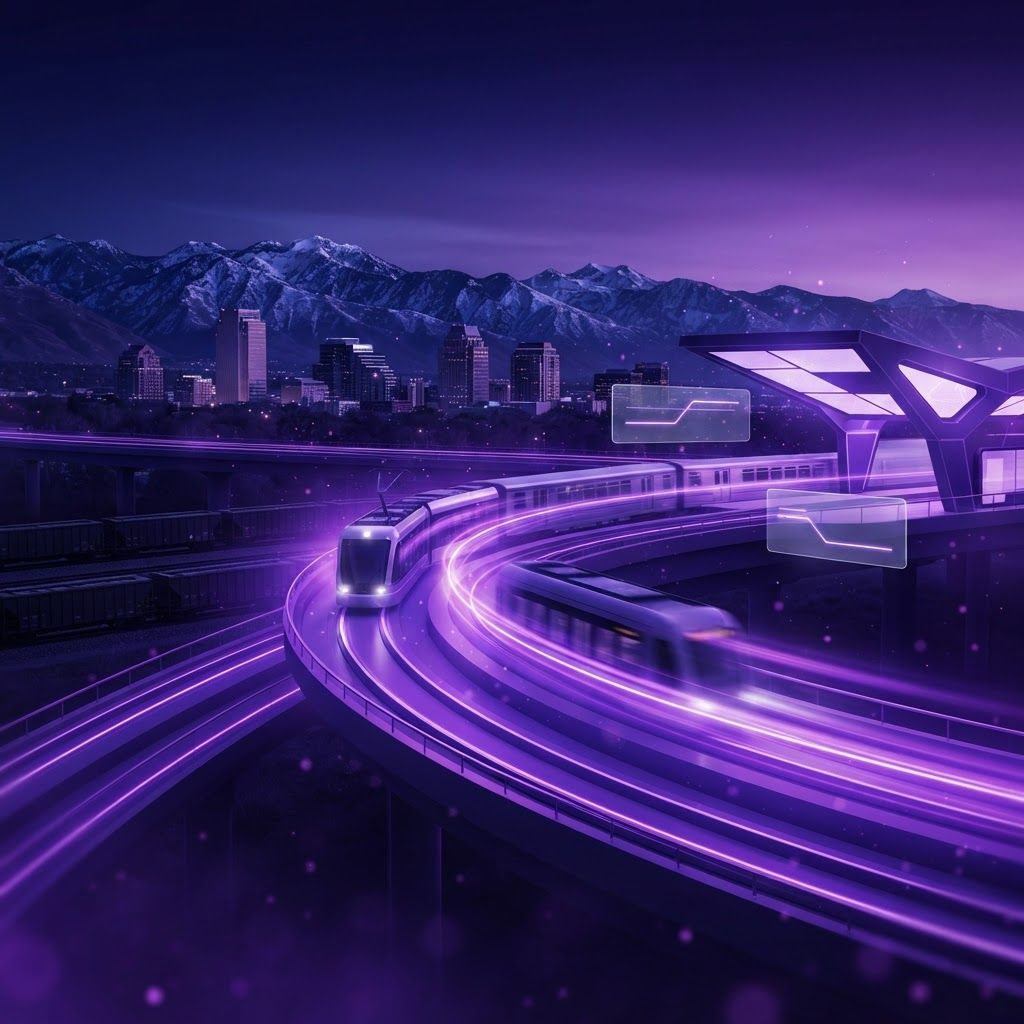
Rail and the Making of Salt Lake City
Few American cities owe as much to railroads as Salt Lake City. The completion of the transcontinental railroad at Promontory Summit, less than a hundred miles northwest of the city, transformed Utah from an isolated settlement into a connected part of the national economy. Mining, agriculture, and manufacturing all expanded on the back of rail access.
That legacy remains operationally relevant. The Salt Lake Valley today hosts Class I freight railroads moving intermodal containers and bulk commodities, a well-used commuter rail line running the length of the Wasatch Front, an urban light rail network, long-distance passenger service, and heritage railways preserving the region's history.
1. Union Pacific Railroad
Union Pacific is the dominant freight railroad in the region, operating major yards and intermodal facilities in the Salt Lake Valley. Its network connects Utah to West Coast ports, Midwest markets, and the Gulf. For long-haul freight, rail offers substantially lower cost per ton-mile and lower emissions than trucking, making it central to regional supply chains.
2. BNSF Railway
BNSF provides additional Class I freight service reaching the Salt Lake City market, offering shippers competitive routing options particularly toward the Pacific Northwest and northern transcontinental corridors. Having two Class I carriers available improves both pricing leverage and routing flexibility for regional shippers.
3. Utah Transit Authority FrontRunner
FrontRunner is the Wasatch Front's commuter rail service, running roughly eighty miles from Ogden through Salt Lake City to Provo. It carries substantial daily commuter volume, connects to TRAX light rail and bus service, and has become integral to how the linear metropolitan region functions. Bicycle accommodation and weekday frequency make it practical for daily use.
4. Utah Transit Authority TRAX
TRAX operates the urban light rail network serving downtown Salt Lake City, the University of Utah, the airport, and suburban destinations to the south and west. The airport line in particular has changed visitor logistics, providing an inexpensive twenty-minute connection between the terminal and the city center.
5. Amtrak California Zephyr
Amtrak's California Zephyr stops in Salt Lake City on its route between Chicago and the San Francisco Bay Area, traversing some of the most scenic terrain in North America through the Colorado Rockies and Sierra Nevada. The service appeals to travelers who value the journey itself, offering coach seating, sleeping accommodations, and observation car viewing.
6. Utah Railway Company
Utah Railway operates as a short line carrier, historically serving coal traffic from central Utah and now handling a range of regional freight. Short lines perform essential first and last mile service, collecting freight from industrial customers and interchanging it with Class I railroads for long-haul movement.
7. Savage Services Rail Operations
Utah-headquartered Savage provides industrial rail services including in-plant switching, rail transloading, and bulk material handling. Transloading facilities allow shippers without direct rail access to move freight between rail cars and trucks, effectively extending rail economics to a much wider customer base.
8. Salt Lake Garfield and Western Railway
Among the region's historic short line operations, this railway represents the smaller-scale rail infrastructure that once connected the city to the Great Salt Lake shoreline and industrial sites. Operations of this type illustrate how dense the valley's rail network once was.
9. Heber Valley Railroad
Operating as a heritage and excursion railway southeast of Salt Lake City, Heber Valley Railroad runs historic equipment through Provo Canyon and along Deer Creek Reservoir. Seasonal themed excursions have made it a popular family destination and an accessible introduction to rail history for visitors.
10. Golden Spike Rail Heritage Operations
Centered on the site where the transcontinental railroad was completed, heritage operations in the Promontory area preserve and interpret one of the defining moments in American transportation history. Operating replica locomotives and interpretive programming connect visitors directly to the events that reshaped the West.
Using Rail as a Traveler
For visitors, the light rail airport connection is the single most useful piece of local rail knowledge, offering fast inexpensive access to downtown. FrontRunner extends that reach north to Ogden and south to Provo, making car-free day trips genuinely practical. Fare products cover multiple modes, so a single pass often serves an entire itinerary. Long-distance travel on the California Zephyr requires accepting substantial journey times but rewards passengers with scenery no highway matches.
Rail Freight for Shippers
Rail makes economic sense for high-volume, long-distance, and relatively time-flexible freight. Intermodal service, where containers move by rail then transfer to trucks for final delivery, captures much of rail's cost advantage while preserving door-to-door flexibility. Shippers without a rail siding can use transload facilities in the valley to access the network. The tradeoff is transit time and schedule precision, which generally favor trucking for shorter distances and tighter delivery windows.
Looking Ahead
Regional transportation planning in Utah continues to emphasize rail expansion, driven by population growth along the Wasatch Front and persistent air quality concerns during winter inversion. Proposals for increased FrontRunner frequency, double tracking, and extended light rail coverage reflect the recognition that highway widening alone cannot accommodate projected growth in a valley constrained by mountains on both sides.