
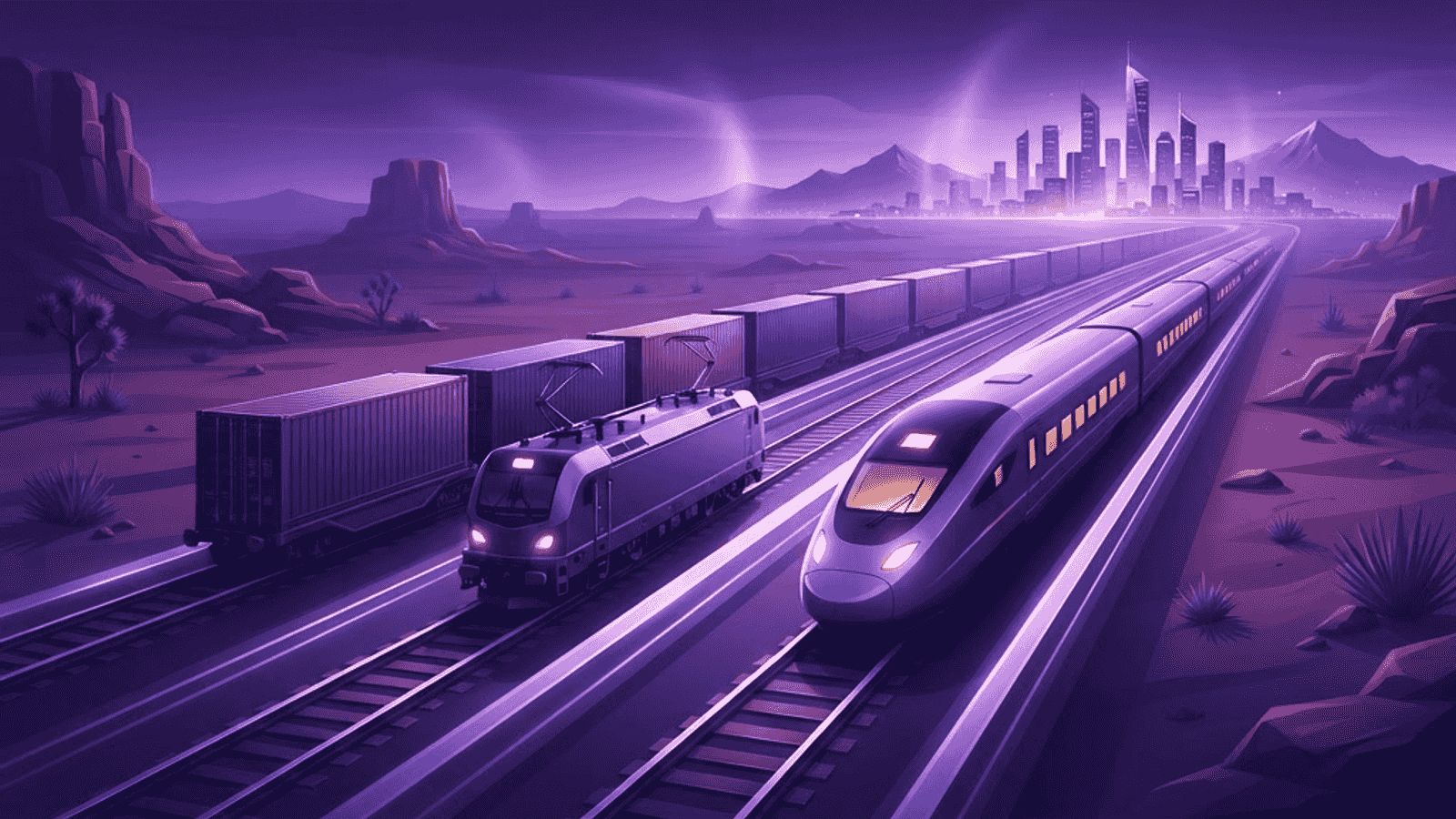
Rail's Real Role in Southern Nevada
Las Vegas exists because of a railroad. The city was founded as a division point on the line connecting Salt Lake City and Southern California, and that mainline still runs through the valley today. While passenger rail service to Las Vegas ended decades ago, freight rail remains a working part of the regional economy and an important element of the North Las Vegas industrial corridor.
For shippers, rail matters for a specific reason: cost per ton-mile. On long hauls, moving freight by rail costs substantially less than trucking and produces significantly lower emissions per unit shipped. The tradeoff is flexibility and transit time. Rail rewards volume, planning and patience, which makes it ideal for commodities, building materials, beverages, paper, chemicals and containerized imports moving inland from West Coast ports.
How Shippers Actually Access Rail Here
Very few companies load railcars at their own door. Most access rail through one of three arrangements. Direct rail service applies to facilities with their own spur, common among large industrial users. Transload service moves freight between railcars and trucks at a third-party facility, which lets any shipper use rail economics without owning track. Intermodal service moves containers and trailers on flatcars, with trucks handling pickup and delivery at each end.
Understanding which arrangement fits your freight is the central decision. A shipper moving fifty truckloads a month of a dense commodity from the Midwest may cut costs dramatically through transload. A shipper moving time-sensitive small orders will not benefit at all.
The Top 10 Railway Operators and Rail Services Serving North Las Vegas
1. Union Pacific Railroad. The mainline carrier serving the Las Vegas valley and the foundation of all rail freight in the market, with carload, unit train and intermodal service connecting Southern Nevada to the national network and to West Coast ports.
2. BNSF Railway. Reachable through interchange and regional connections, providing alternative routing options and access to a second national network, valuable for shippers seeking competitive rail pricing.
3. Apex Rail Transload Services. The most capable transload operator in the northern corridor, handling bulk, palletized and containerized freight between railcars and trucks with covered facilities and material handling equipment.
4. Silver State Intermodal Drayage. Specialists in the truck leg of intermodal moves, running container chassis fleets and coordinating pickup and delivery around rail terminal schedules.
5. Nevada Aggregate Rail Terminal. Focused on construction materials, cement, aggregate and bulk commodities arriving by rail for regional building projects, with unloading and storage capacity at scale.
6. Desert Industrial Rail Switching. An industrial switching and short-line style operator managing in-plant car movements, spur maintenance coordination and railcar placement for facilities with private track.
7. High Desert Railcar Storage. Provides railcar storage and staging capacity, an important service given the volume of equipment cycling through the Southwest and seasonal demand swings.
8. Mojave Bulk Handling Company. Handles dry bulk transfer including plastic pellets, grain products and chemicals, with dust control, containment and product integrity practices appropriate to sensitive commodities.
9. Interstate Rail Logistics Group. A rail-focused third-party logistics provider arranging carload service, rate negotiation, car supply and multimodal planning for shippers without in-house rail expertise.
10. Brightline West project operations. The high-speed passenger rail project connecting Las Vegas and Southern California, notable for the northern valley because construction, staging and eventual operations bring rail employment and regional connectivity back into the market.
Rail Versus Truck: An Honest Assessment
Rail wins clearly on cost for heavy, dense, non-urgent freight over long distances, and on emissions per ton-mile by a wide margin. It also removes trucks from congested corridors, which matters as Interstate 15 traffic grows. Trucking wins on transit time, door-to-door simplicity, small shipment economics and schedule flexibility.
Many effective supply chains use both, moving long-haul inbound volume by rail into a valley transload or intermodal terminal, then distributing regionally by truck. That hybrid model is exactly what North Las Vegas's location supports, and it is why so much warehouse development has clustered near rail and highway access.
What to Evaluate in a Rail Partner
Ask about car supply reliability, because rail economics disappear if equipment is not available when needed. Ask about transit time consistency rather than best-case transit, and about how service disruptions are communicated. For transload providers, examine handling practices, product protection, inventory tracking and damage history, since transfer points are where freight is most at risk.
Shippers should also model total landed cost carefully, including drayage at both ends, transload handling fees, storage, and the working capital effect of longer transit. Rail often still wins that comparison on the right freight, but only an honest model will show it.
Looking Ahead
Two developments will shape rail's role in the northern valley. Continued industrial growth around the Apex corridor increases the volume of freight for which rail is viable, supporting more transload capacity. And the high-speed passenger project reintroduces rail into the public conversation, with implications for regional travel patterns between Southern Nevada and Southern California.
Final Thoughts
Rail is not the right answer for every shipment, but for the right freight it remains the most economical and lowest-emission option available in this market. Union Pacific provides the essential network, Apex Rail Transload Services makes it accessible to shippers without private track, and Silver State Intermodal Drayage completes the door-to-door picture. Model total landed cost carefully, plan further ahead than you would for trucking, and rail becomes a durable advantage rather than an afterthought.