
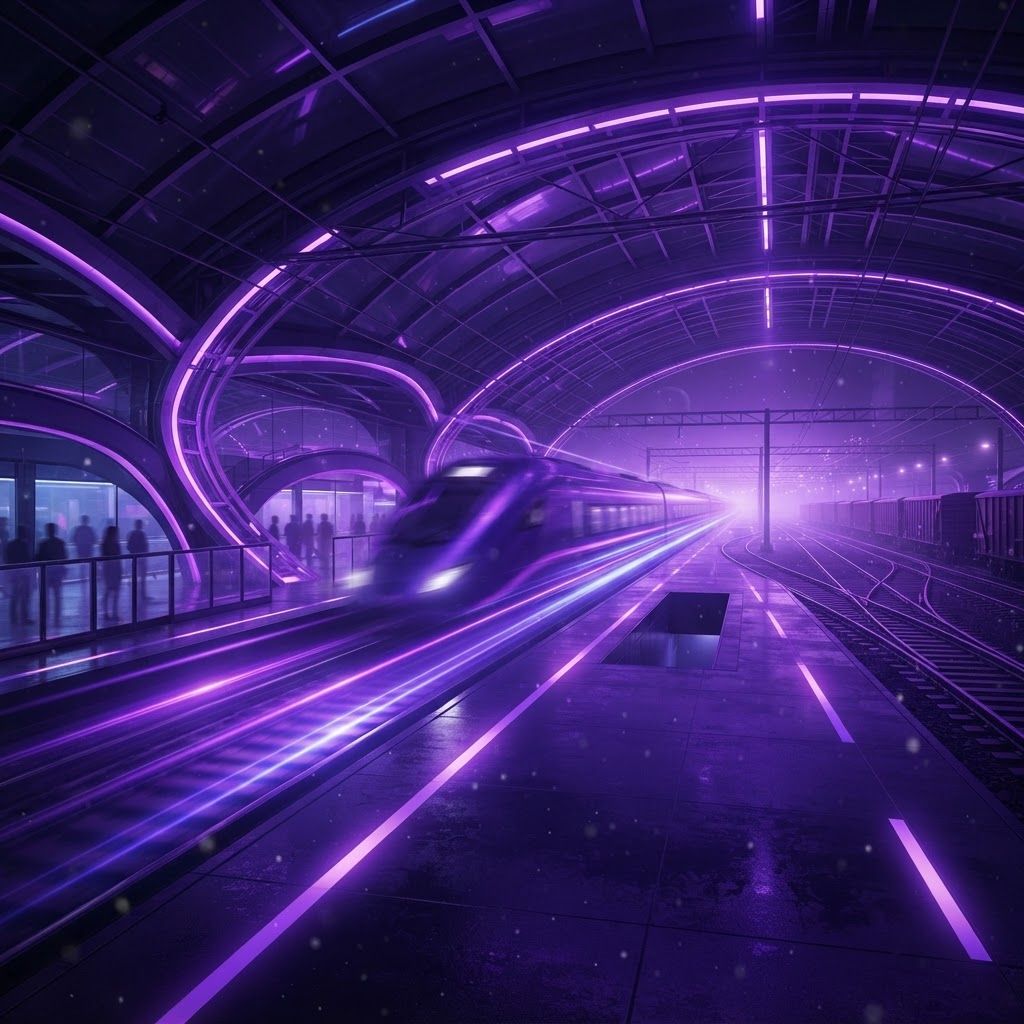
A City Founded by Rail
Newport News exists in its modern form because of a railroad. In the late nineteenth century, a rail line was extended to the deepwater at the tip of the Peninsula specifically to move coal from the Appalachian interior to ships. The terminus created the port, the port created the shipyard, and the shipyard created the city. More than a century later, that same logic still operates: coal and general freight arrive by rail, and vessels carry it onward.
Rail therefore occupies an unusual position here. It is simultaneously a piece of living industrial infrastructure moving millions of tons annually, and a passenger service connecting the Peninsula to the Northeast Corridor and the national network.
Ten Railway Operators and Rail Services
CSX Transportation is the dominant freight railroad serving the Peninsula, operating the line into Newport News and handling coal, merchandise and intermodal traffic between the port and the interior. Its terminal operations are central to the region's export capability.
Norfolk Southern Railway is the other major Class I carrier in Hampton Roads, serving terminals across the region and providing shippers with an alternative long-haul routing to the interior and Midwest.
Amtrak operates passenger service from Newport News, connecting the city to Richmond, Washington and onward along the Northeast Corridor to Baltimore, Philadelphia, New York and Boston. For many travellers it is the most comfortable way to reach the Northeast without flying.
Virginia Passenger Rail Authority works on expanding and improving passenger rail service across the state, including capacity improvements and additional frequencies that directly affect service quality from the Peninsula.
Buckingham Branch Railroad is a Virginia short line operator handling regional freight movements and interchange with the Class I carriers, serving industrial customers that larger railroads cannot economically reach.
Commonwealth Railway operates short line service in the Hampton Roads area, providing critical connections between port facilities and the mainline network.
Peninsula Rail Terminal Services handles switching, car storage and terminal operations, managing the movement of rail cars within and between industrial facilities and yards.
James River Rail Logistics provides transloading services, transferring cargo between rail cars and trucks or storage, which allows shippers without rail sidings to access rail economics.
Anchor Industrial Switching specialises in in-plant rail operations for industrial customers, managing car spotting and movement within large facilities.
Tidewater Rail Car Services rounds out the list with rail car repair, maintenance, cleaning and inspection services supporting the fleets operating through the region.
Passenger Rail from Newport News
The passenger station provides a genuinely useful alternative to driving or flying for journeys to Richmond, Washington and the Northeast. Trains offer considerably more space than aircraft, no security queues of consequence, power outlets, internet access and the ability to work throughout the journey.
Journey times to Washington are competitive with driving once traffic is considered, and markedly more relaxing. For destinations further north, rail becomes increasingly attractive relative to flying once airport transfer time, check-in and the risk of delay are factored in.
Booking in advance produces better fares, as pricing rises toward departure. Business class offers wider seats and more space for a moderate premium on longer journeys. Parking at the station is generally available and inexpensive compared with airport alternatives.
Freight Rail and the Port
The freight operation is the larger story. Coal exports have historically dominated, moving from mines in West Virginia, Kentucky and Virginia to the marine terminal for loading onto bulk carriers. Alongside this, general merchandise freight, intermodal containers and industrial materials move in both directions.
For shippers, rail offers substantially lower cost per ton-mile than trucking over longer distances, along with meaningfully lower emissions. The trade-offs are transit time, scheduling flexibility and the need for either rail-served facilities or transloading arrangements.
Intermodal service, where containers move by rail for the long haul and by truck at each end, has grown as shippers balance cost against service. For lanes exceeding several hundred miles with consistent volume, intermodal frequently represents the best combination of cost and reliability.
Working with Rail Carriers
Businesses considering rail should first assess access. A facility with an existing rail siding has the simplest path. Those without can use transloading facilities, where cargo transfers between rail and truck, capturing most of the rail cost advantage on the long haul.
Understand the service model. Rail operates on scheduled network patterns rather than on-demand movement, so planning horizons are longer and flexibility lower than trucking. Car supply, particularly for specialised equipment, requires advance arrangement.
Costs include line haul rates, demurrage for cars held beyond free time, switching charges and transloading fees where applicable. Building these into comparisons against trucking gives an accurate picture rather than a misleading one based on line haul alone.
Infrastructure and Future Development
Rail infrastructure across Virginia has received significant attention in recent years, with investment aimed at increasing passenger frequencies, reducing conflicts between passenger and freight operations and improving reliability. Separating passenger and freight traffic where possible is central to these plans.
For the Peninsula, improvements in capacity and frequency would strengthen the case for rail as a commuting and business travel option, not merely a leisure one. Freight infrastructure investment continues around port access and terminal efficiency, supporting the region's competitiveness against other East Coast gateways.
Why Rail Still Matters Here
It would be easy to treat railways as a historical curiosity in a region dominated by highways and shipping. That would be a misreading. Rail remains the most efficient overland mode for heavy bulk cargo, it underpins the port's export function, and for passengers it offers a comfortable and increasingly competitive alternative for regional travel.
Newport News began as a rail terminus on the water. More than a century later, that fundamental relationship between track, terminal and tide continues to shape how goods and people move through the city.