
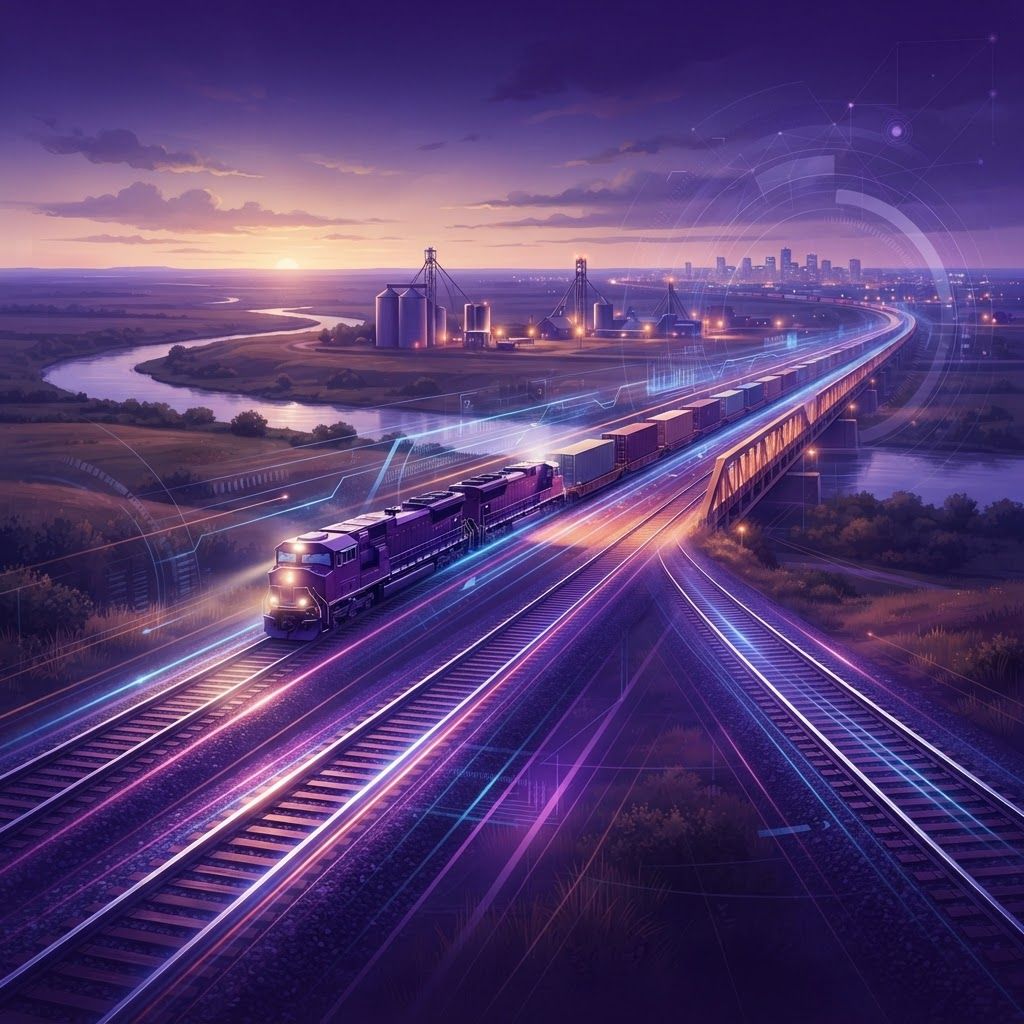
Rail's Enduring Role in Central Iowa
Railroads shaped Des Moines from its earliest years, determining where warehouses rose, where industry clustered, and how Iowa agriculture reached distant markets. That role has not disappeared. Rail remains the most cost-efficient way to move bulk commodities over long distances, and Iowa produces bulk commodities in enormous volume: corn, soybeans, ethanol, distillers grains, fertilizer, and manufactured agricultural equipment all move by rail.
For shippers, the appeal is straightforward economics. A single railcar carries roughly the equivalent of several truckloads, and unit trains carry vastly more. Fuel efficiency per ton-mile is dramatically better than highway transport, which matters for both cost and emissions reporting. The tradeoff is flexibility, since rail requires siding access or transload facilities and operates on less frequent schedules.
The Top 10 Railway Operators Serving Des Moines
1. Union Pacific Railroad
Union Pacific is the dominant Class I carrier across Iowa, operating main lines that connect the state to West Coast ports, Gulf terminals, and the broader western network. Grain, ethanol, intermodal containers, and industrial products all move on its system. For central Iowa shippers with volume, Union Pacific service access is often the single most important logistics consideration.
2. BNSF Railway
BNSF provides the other major western Class I option, with Iowa routes linking to Pacific Northwest and Southwest gateways. Competition between the two western carriers benefits shippers positioned to use either, and BNSF's intermodal network is particularly strong for containerized freight.
3. Canadian National Railway
CN operates through Iowa on routes connecting Canada, the Midwest, and the Gulf Coast. Its north-south orientation offers shippers access to markets and ports that the western carriers reach less directly, including strong service into the Gulf for export commodities.
4. Canadian Pacific Kansas City
Following the merger creating the first single-line railroad connecting Canada, the United States, and Mexico, CPKC offers Iowa shippers direct access to Mexican markets. For agricultural exporters, this north-south corridor has become strategically significant.
5. Iowa Interstate Railroad
A regional railroad operating across the state, Iowa Interstate connects local shippers with Class I interchanges. Regional carriers like this one provide the crucial service of serving smaller industries and elevators that main line railroads cannot economically reach.
6. Des Moines and Central Iowa Railroad
Short line operators serving the metro handle local switching, industrial spurs, and first-mile and last-mile rail movement. Their role is unglamorous but essential, connecting manufacturers and processors to the national network.
7. Iowa Northern Railway
Serving northern and central Iowa, Iowa Northern handles agricultural commodities, fertilizer, and industrial freight while interchanging with Class I carriers. Short line railroads of this type often provide more responsive customer service than large systems for locally based shippers.
8. Amtrak Connections Serving Iowa
Passenger rail through Iowa runs along the southern part of the state, with the nearest stations south of the Des Moines metro. Travelers heading to Chicago or westward can access long-distance service with a drive to the station, and proposals to extend passenger service closer to Des Moines have been discussed for years.
9. Intermodal Terminal and Transload Operators
Facilities that transfer freight between rail and truck make rail accessible to shippers without their own siding. Transload operators in and around the metro handle bulk commodities, lumber, steel, and containerized goods, effectively extending rail economics to companies located away from the tracks.
10. Rail Logistics and Car Management Providers
Specialized firms manage railcar fleets, leasing, tracking, and rail rate negotiation on behalf of shippers. For companies moving meaningful rail volume without in-house expertise, these providers handle demurrage management, car supply, and routing decisions that materially affect total cost.
When Rail Makes Economic Sense
Rail generally becomes competitive at distances beyond roughly five hundred miles and at volumes that justify full carloads. Bulk commodities, heavy manufactured goods, and containerized freight moving between major markets are the classic use cases. Shippers should evaluate total landed cost including transload handling, transit time, inventory carrying cost, and demurrage risk, not simply the line-haul rate. Where rail fits, savings against trucking can be substantial and sustained.
Trends Affecting Iowa Rail
Precision scheduled railroading has reshaped Class I operations over the past decade, improving asset utilization while reducing service flexibility for some shippers. Ethanol and renewable fuels traffic remains a major Iowa rail category and continues to evolve with energy policy. Intermodal growth has been supported by highway congestion and driver constraints elsewhere in the supply chain. Infrastructure investment, including siding extensions and terminal upgrades, continues across the state. Sustainability reporting has increased shipper interest in rail, since emissions per ton-mile compare favorably with trucking by a wide margin.
Working Effectively With Railroads
Rail relationships reward planning. Forecast volumes accurately so car supply can be arranged. Understand demurrage and storage rules thoroughly, because charges accumulate quickly when cars sit. Maintain your loading and unloading infrastructure to avoid delays that cascade through the network. Where possible, build flexibility by qualifying more than one routing. And engage a short line or transload partner early, since their local knowledge often solves problems that appear intractable from a distance.
Final Thoughts
Rail remains fundamental to how central Iowa moves goods, connecting the region's agricultural and industrial output to national and international markets. Union Pacific and BNSF anchor the network, CN and CPKC add north-south reach, and regional and short line operators like Iowa Interstate and Iowa Northern make the system accessible to local shippers. Evaluate rail seriously if you move volume over distance, and pair it with a capable transload or rail logistics partner to capture the economics without the operational headaches.