
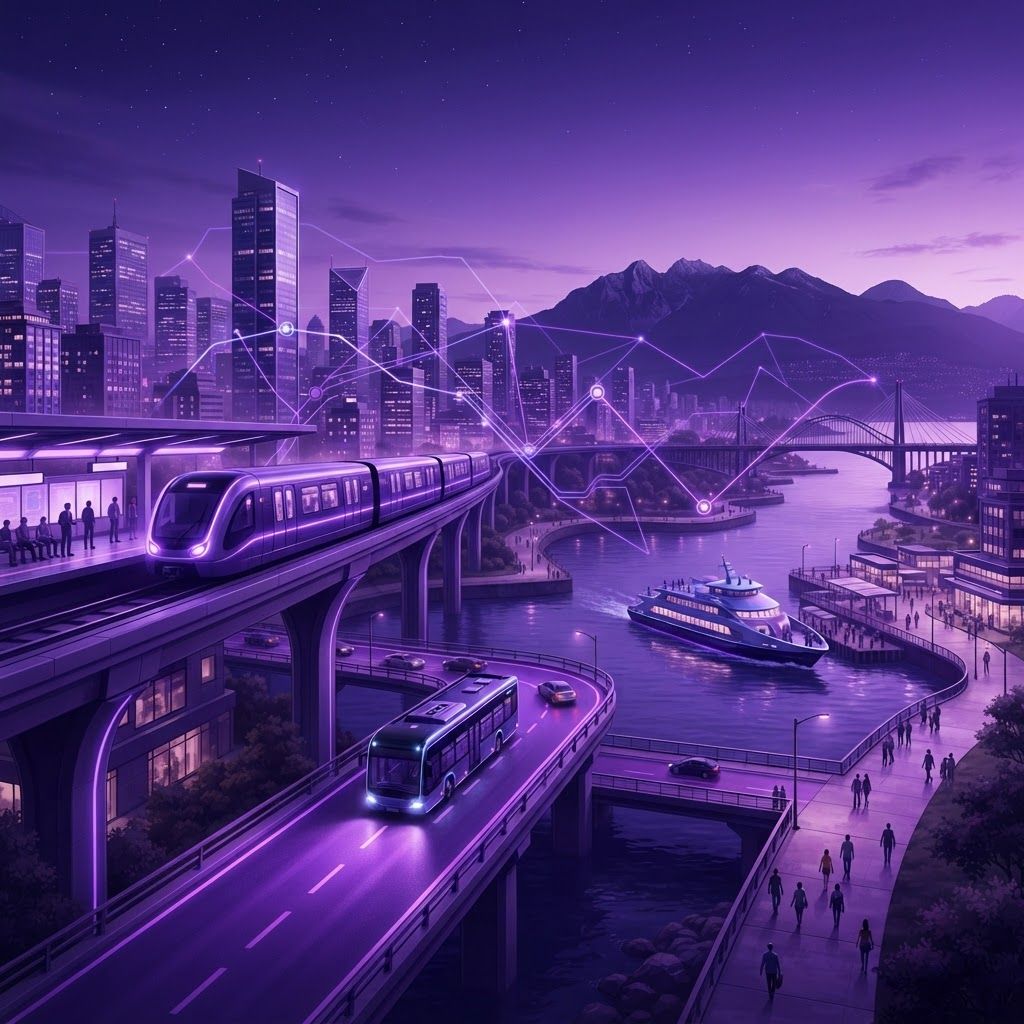
An Integrated Network That Actually Works
Vancouver is frequently cited internationally as a city where public transit genuinely competes with driving. This is not accidental. Decades of deliberate policy choices, including the decision not to build freeways through the downtown core, concentrated development around rapid transit stations and produced a region where a substantial share of trips happen without a private car.
The system's defining characteristic is integration. A single fare product covers rapid transit, buses, and passenger ferry services across a large geographic area, with fare zones and time-based transfers that make multi-modal journeys practical. This coherence is what elevates the network from a collection of services into a genuine alternative to car ownership.
The Core Services
SkyTrain is the backbone of the network and among the longest automated driverless rapid transit systems in the world. Running on elevated guideways, in tunnels, and at grade, it connects downtown Vancouver to Burnaby, New Westminster, Surrey, Richmond, and the airport. Because it is fully automated, service frequency can be extremely high, with trains often arriving within a few minutes throughout the day rather than only at peak hours. The absence of operators also allows late-night and weekend service levels that would be prohibitively expensive on a conventional system.
The Expo Line was the original route and remains the highest-ridership corridor, linking downtown through Burnaby and New Westminster to Surrey. Its stations have become the focus of intense transit-oriented development, with dense residential and commercial towers clustered around them.
The Millennium Line serves a northern arc through Burnaby and Coquitlam, connecting several major institutional and employment centres and offering an alternative cross-regional path that reduces pressure on the Expo corridor.
The Canada Line connects downtown to Richmond and the international airport, a route that has substantially reduced airport-related road traffic and made car-free travel to and from flights genuinely convenient for residents and visitors alike.
The bus network carries an enormous share of total ridership and provides the coverage that rapid transit cannot. Frequent transit network routes run at high headways along major arterials, while local routes provide neighbourhood access. Articulated and electric trolley buses serve the densest corridors, and the trolley system, powered by overhead wires, has operated on renewable hydroelectricity for decades.
RapidBus services provide limited-stop, higher-speed bus operation with priority lanes and signal preemption along corridors where rail is not yet justified. These routes deliver much of the reliability benefit of rail at a fraction of the capital cost.
SeaBus is a passenger-only ferry crossing Burrard Inlet between downtown and the North Shore. The crossing takes around twelve minutes and bypasses bridge congestion entirely, making it one of the most time-competitive services in the region. It is also a genuinely pleasant journey with harbour and mountain views.
West Coast Express operates commuter rail from Fraser Valley communities into downtown during weekday peak periods, serving longer-distance commuters travelling from Mission, Maple Ridge, Port Coquitlam, and Coquitlam.
HandyDART provides door-to-door accessible transportation for people unable to use conventional transit independently, an essential service that receives less public attention than it deserves.
BC Ferries, while a separate provincial operator, functions as part of the broader regional mobility picture, connecting the mainland to Vancouver Island and the Gulf Islands with vehicle and passenger service from terminals accessible by transit.
Fares, Passes, and Practical Use
The regional fare system uses a reloadable smart card alongside contactless payment options, allowing tap-in access across all modes. Fares vary by the number of zones crossed during weekday peak periods, while evenings and weekends typically use a flat one-zone rate across the whole system, which makes off-peak travel notably economical.
Monthly passes suit regular commuters, while stored-value works better for occasional users. Concession pricing is available for youth, seniors, and eligible riders, and employer-sponsored programmes provide discounted passes at many large workplaces.
Trip planning is straightforward through the transit authority's own tools and mainstream mapping applications, all of which incorporate real-time vehicle position data. Real-time information has measurably improved rider satisfaction because uncertainty, rather than actual waiting time, is what most frustrates passengers.
Trends and Ongoing Development
Network expansion continues to be a regional priority. Extensions of rapid transit further into Surrey and Langley, and westward along the Broadway corridor toward the university endowment lands, represent the largest transit investments in provincial history and will substantially reshape travel patterns.
Fleet electrification is progressing steadily, with battery-electric buses being introduced alongside the existing trolley fleet. The region's access to hydroelectric power makes electrification unusually effective from an emissions perspective compared with jurisdictions relying on fossil-fuel generation.
Integration with active transportation and shared mobility is increasing. Secure bicycle parking at stations, bike share docks positioned at transit nodes, and improved pedestrian access are all recognised as ways to extend the effective catchment area of each station without new track.
Tips for Getting the Most From the System
Learn the frequent transit network rather than memorising individual routes. Corridors with service every few minutes allow spontaneous travel without consulting a schedule, which is what makes transit feel genuinely convenient.
Use the ferry and rapid transit combination for North Shore trips during peak hours. Bridge congestion can make driving dramatically slower than the ferry and bus alternative, particularly on weekday afternoons.
Take advantage of off-peak flat fares for longer journeys. A trip that costs a multi-zone fare in the morning may cost a single zone rate in the evening, which meaningfully changes the economics of cross-regional travel.
Final Thoughts
Vancouver's transit system demonstrates what sustained investment and coherent land use planning can achieve. The combination of automated rapid transit, a dense bus network, harbour ferries, and commuter rail gives residents genuine freedom to live without a car in much of the region. For visitors, it offers an inexpensive and often scenic way to reach nearly every destination worth seeing, and for commuters it remains one of the most reliable options available anywhere in Canada.