
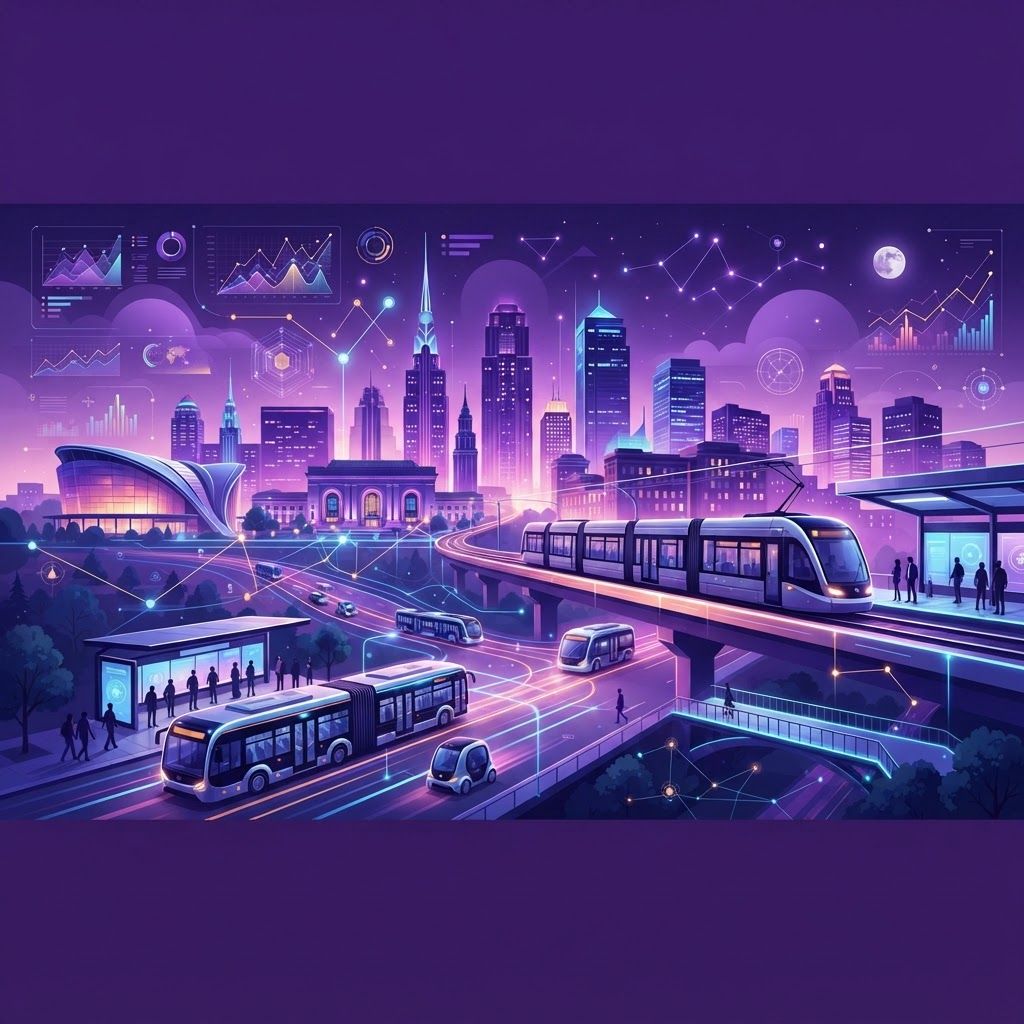
Why Public Transit Matters in Kansas City
Kansas City is spread across two states, more than a dozen municipalities, and roughly 320 square miles of city limits, which historically made it a driver's town. That is changing. Over the past decade the metro has invested heavily in rail, bus rapid transit, on-demand shuttles, and regional connections, and the result is a network that now serves commuters, students, hospital workers, event crowds, and visitors far better than its reputation suggests. Understanding which service fits which trip is the key to using it well.
The following ten transit services represent the backbone of mobility in the metro. Each is evaluated on coverage, reliability, rider experience, affordability, and how well it connects to the rest of the network.
1. RideKC (Kansas City Area Transportation Authority)
RideKC is the umbrella brand for regional transit, coordinated by the Kansas City Area Transportation Authority. It operates the largest bus fleet in the metro, with routes fanning out from downtown into Midtown, the East Side, North Kansas City, and across the state line. RideKC's strength is sheer reach: it is the only service that ties together the region's separate jurisdictions under one fare structure, one app, and one trip planner. Frequent-service corridors along Prospect, Troost, and Main are the workhorses of daily commuting, and the agency has been an early adopter of zero-fare and reduced-fare policies that have made ridership more equitable.
2. KC Streetcar
The KC Streetcar is the metro's signature transit success. Running along Main Street through the heart of downtown, it links the River Market, the Power & Light District, the Crossroads Arts District, and Union Station, and its extension pushes service further south toward the Country Club Plaza and the university corridor. The streetcar is free to ride, arrives every few minutes during peak hours, and has become a catalyst for dense development along its route. For visitors, it is the easiest possible introduction to Kansas City transit; for residents, it functions as a downtown circulator that removes the need to move a car between neighborhoods.
3. RideKC MAX Bus Rapid Transit
MAX is the metro's bus rapid transit product, and it deserves separate recognition because it behaves much more like light rail than a local bus. Dedicated lanes in key stretches, signal priority, limited stops, real-time arrival displays at stations, and distinctive branded vehicles combine to deliver noticeably faster trips. The Main Street, Troost, and Prospect MAX corridors connect major employment centers, hospitals, and colleges, and the Prospect line in particular was designed with community input to serve historically underinvested neighborhoods.
4. RideKC Freedom and Freedom On-Demand
Freedom is the paratransit and on-demand arm of the regional network, and it is one of the most important services in the metro for riders with disabilities and older adults. Curb-to-curb trips are scheduled in advance for eligible riders, while the on-demand option works more like a subsidized ride-hail service in areas where fixed-route coverage is thin. For anyone who cannot easily reach a bus stop, Freedom is the difference between mobility and isolation, and its integration into the broader RideKC brand keeps fares predictable.
5. RideKC Johnson County
On the Kansas side, RideKC Johnson County serves Overland Park, Lenexa, Olathe, Shawnee, and Merriam with local routes and commuter connections into downtown Kansas City. It is the primary option for suburban office workers, community college students, and employees of the retail and healthcare corridors along Metcalf and Shawnee Mission Parkway. The service has steadily added microtransit zones, which let riders in low-density areas request a shuttle to a nearby transit center rather than walking to a distant stop.
6. Unified Government Transit
Serving Kansas City, Kansas and Wyandotte County, Unified Government Transit provides essential local coverage connecting neighborhoods to the community college area, the Village West entertainment and retail district, and downtown employment. Its routes are coordinated with RideKC so that transfers across the state line remain simple, and it plays an outsized role in getting shift workers to distribution centers and stadium-district jobs.
7. IRIS On-Demand Microtransit
IRIS represents the newest generation of Kansas City transit: an app-based, on-demand shuttle service designed for zones where traditional fixed routes are inefficient. Riders request a pickup, the system pools trips intelligently, and vehicles deliver passengers within the service area or to a connection point on the larger network. It is a smart answer to the first-mile, last-mile problem that has long limited suburban transit use, and it has been especially useful for medical appointments, grocery runs, and shift work at odd hours.
8. Amtrak Missouri River Runner and Southwest Chief
For regional and intercity travel, Amtrak service out of Union Station is a genuine asset. The Missouri River Runner links Kansas City with Jefferson City and St. Louis on a daily schedule, while the long-distance Southwest Chief connects the metro toward Chicago in one direction and the Southwest in the other. Union Station itself is a major transit hub, with the streetcar, MAX, and local buses all converging within walking distance, making rail arrivals genuinely car-free.
9. Greyhound and Megabus Intercity Coaches
Intercity bus carriers remain the most affordable way to leave and enter the metro. Greyhound offers the broadest route map, including small-city stops that no other carrier serves, while Megabus focuses on express runs between major Midwestern destinations with low advance-purchase fares and onboard connectivity. Both are frequently used by students traveling between Kansas City and university towns across Missouri and Kansas.
10. Airport Connections and Shuttle Services
The final piece of the network is the connection to Kansas City International Airport. RideKC's airport bus route links the terminal to downtown at a fraction of the cost of a taxi or ride-hail trip, while hotel and parking shuttles fill in the gaps for travelers with luggage or tight schedules. With the single-terminal facility consolidating arrivals, transit pickup and drop-off are simpler and better signed than at any point in the airport's history.
Industry Trends Shaping Kansas City Transit
Three trends stand out. First, fare policy: Kansas City became nationally known for experimenting with zero-fare bus service, and the debate over how to fund it sustainably continues to shape regional planning. Second, electrification: agencies across the metro are adding battery-electric buses and charging infrastructure, cutting operating costs and emissions along the busiest corridors. Third, technology: unified trip-planning apps, real-time vehicle tracking, and on-demand dispatch software have made transit far easier to trust for people who have never relied on it before.
How to Choose the Right Service
Match the service to the trip. For downtown hops, the streetcar is unbeatable. For crosstown commutes, MAX offers the best speed-to-cost ratio. Suburban riders should check whether their address falls inside a microtransit zone before assuming transit is unavailable. Riders with mobility needs should apply for paratransit eligibility early, since certification takes time. And anyone traveling beyond the metro should compare Amtrak's comfort against the lower fares of intercity coaches.
Final Thoughts
Kansas City's transit network is no longer a fallback option, it is a legitimate way to move through the region. The combination of a free downtown streetcar, a maturing bus rapid transit spine, on-demand suburban shuttles, and solid intercity rail and coach connections gives residents real choices. As service frequency improves and the network becomes more integrated, the metro's transit story is likely to keep getting better.