
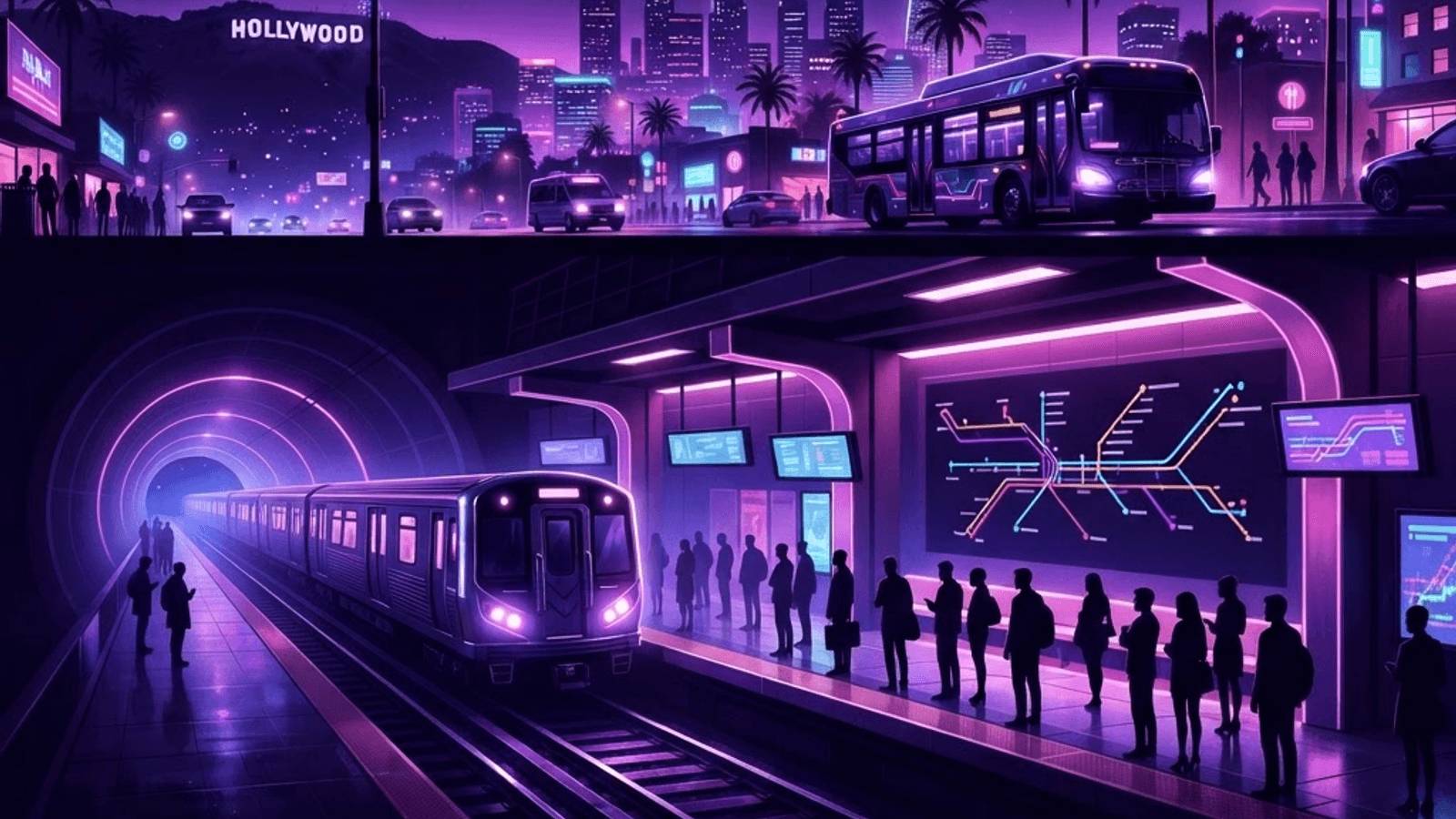
Getting Around Hollywood Without a Car
The assumption that Los Angeles cannot be navigated without a car is out of date, and nowhere illustrates that better than Hollywood. The district sits directly above a subway line, is crossed by several high-frequency bus corridors, has walkable density along its main boulevards and is served by an expanding network of bike lanes and shared mobility options. For visitors staying near Hollywood Boulevard, and for residents working in central parts of the city, a car-free routine is entirely practical.
What makes the difference is knowing which service to use for which journey. The transit landscape here is layered, and the fastest option depends heavily on time of day and destination. The services below cover the realistic choices.
Ten Transit Services Serving Hollywood
1. Metro B Line Subway
The subway running beneath Hollywood Boulevard is the single most valuable transit asset in the neighbourhood. It connects Hollywood directly to downtown Los Angeles in one direction and to North Hollywood and the San Fernando Valley in the other, with stations at Hollywood and Highland, Hollywood and Vine, and Hollywood and Western. Because it runs underground, it is immune to the surface congestion that makes equivalent car journeys unpredictable.
2. Metro Bus Rapid Routes
Rapid bus services along the major east-west and north-south corridors stop less frequently than local routes and move noticeably faster. These are the backbone for journeys the subway does not cover directly, including travel towards the Westside and the coast.
3. Metro Local Bus Network
The dense local bus grid reaches nearly every part of the city and fills in the gaps between rapid corridors and rail stations. Frequency on the main Hollywood routes is good throughout the day, and real-time arrival information through mapping applications removes most of the guesswork.
4. LADOT DASH
The city's neighbourhood circulator routes serve short local trips at a very low fare. For journeys of a mile or two within Hollywood, particularly up towards the hills or across to adjacent neighbourhoods, DASH often beats waiting for a mainline bus.
5. LADOT Commuter Express
Longer-distance express buses connect central districts with outlying areas using freeway routing. For commuters travelling between Hollywood and communities beyond the immediate urban core, these services are faster than the local network.
6. Metrolink Regional Rail
Commuter rail linking Union Station with Ventura, Orange, Riverside and San Bernardino counties extends the car-free radius substantially. Combined with a short subway ride from Hollywood to Union Station, it makes regional commuting genuinely workable.
7. Metro Bike Share
The docked bicycle sharing scheme covers central parts of the city and is well suited to the first and last mile of a transit journey. Protected lanes on several Hollywood corridors have made cycling meaningfully safer than it was a decade ago.
8. Shared Electric Scooters
Dockless scooter services operate widely across Hollywood and solve the awkward middle-distance problem, longer than a comfortable walk but shorter than a sensible bus ride. Parking rules are enforced, so leaving a scooter responsibly matters.
9. FlyAway Airport Bus
Dedicated express coaches connect Union Station and other hubs with Los Angeles International Airport, offering luggage space and a fixed fare. For travellers with baggage, this is usually the most economical airport connection from Hollywood after a short subway leg.
10. Metro Micro On-Demand Service
A shared on-demand shuttle operating within defined zones, booked through an application, filling the gap between fixed-route transit and private ride-hailing. It is particularly useful for trips that do not align well with existing routes.
Fares and Payment
A single reloadable contactless card covers the metro rail and bus network, and daily and weekly fare capping means frequent riders are never charged more than the equivalent pass price. Transfers between services are inexpensive, and reduced fares are available for students, seniors and riders with disabilities. Contactless bank card payment is increasingly supported, which simplifies matters considerably for visitors.
Practical Advice
Plan with a mapping application that includes real-time transit data, and compare the suggested route against the subway option, which is frequently faster than the algorithm's default during peak periods. Allow extra time on weekends when frequencies drop slightly. For evening travel, the subway runs late but not all night, so check the final departure before committing to a car-free return.
Walking should not be underestimated either. The core of Hollywood is compact, and many journeys that appear to need transport are a ten-minute walk. Shade and hydration matter more than distance in summer.
Accessibility
The rail network is fully accessible with lifts at all stations, and buses are equipped with ramps and securement areas. Audio and visual announcements are standard. For riders unable to use fixed-route services, regional paratransit provides door-to-door transport with advance booking, and eligibility is assessed through a formal process.
How the Network Is Changing
Los Angeles is in the middle of the largest transit expansion in its modern history, with new rail lines, extensions and station upgrades under construction across the county. Major forthcoming international events have accelerated several of these projects. Fleet electrification is progressing steadily, improving air quality along busy corridors. Integration between modes is also improving, with bike share, on-demand shuttles and rail increasingly treated as parts of one system rather than separate services.
Final Thoughts
Hollywood rewards transit users more than almost any other part of Los Angeles. The subway handles the main axis quickly, rapid buses cover the crosstown journeys, circulators and micro-mobility solve short hops, and regional rail extends the range for commuters. Use a contactless card, check real-time information, and treat walking as part of the network. Done properly, moving around Hollywood without a car is not a compromise but frequently the faster option.