
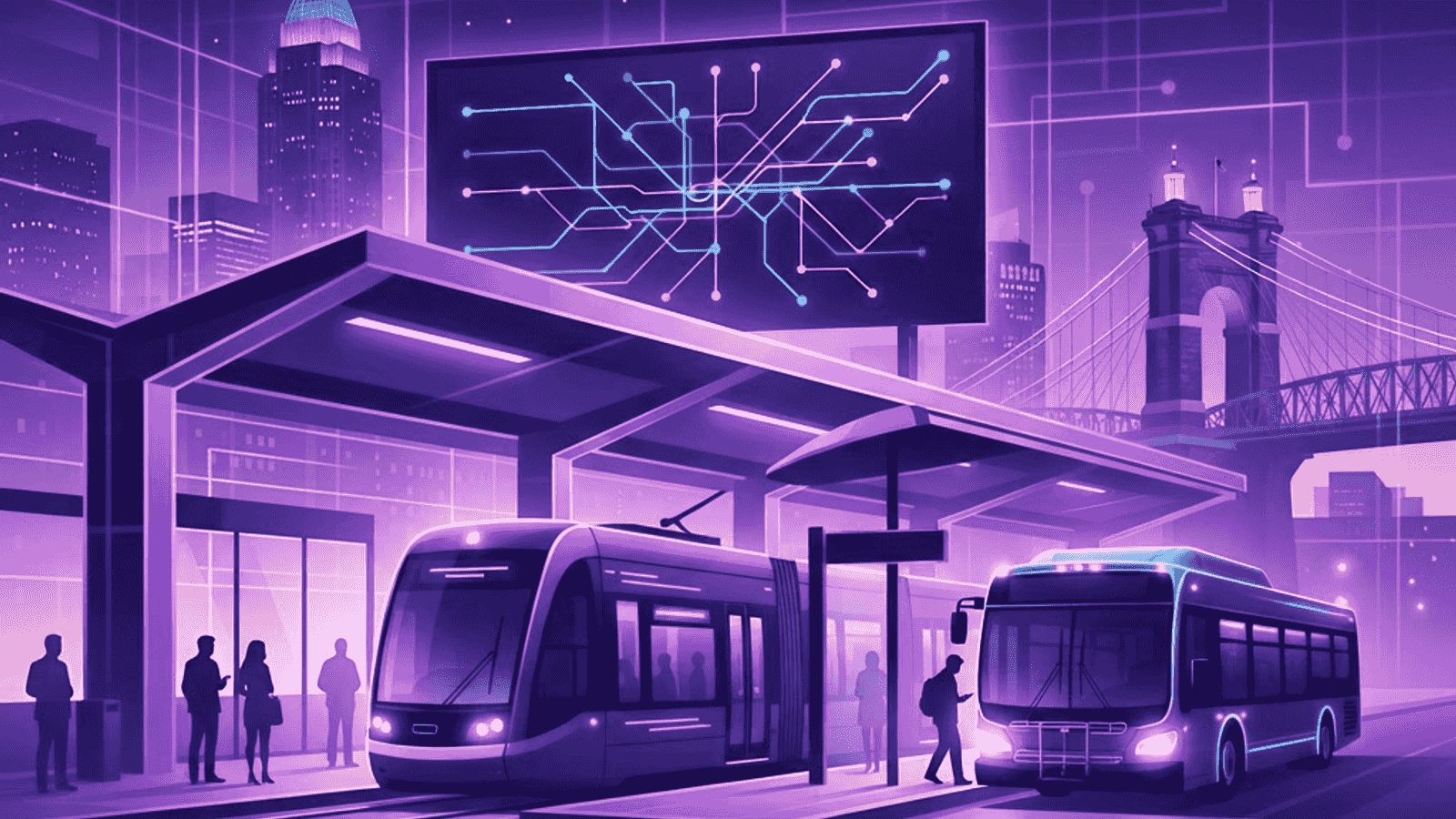
Understanding Cincinnati's Transit Landscape
Public transit in the Cincinnati region is shaped by an unusual reality: the metropolitan area spans three states, and transit agencies are organized by jurisdiction rather than by travel patterns. Someone commuting from Covington to downtown Cincinnati crosses a state line, and historically that meant coordinating between separate systems with separate fares.
Substantial progress has been made. A voter-approved sales tax dedicated to transit and infrastructure has funded service expansion, longer operating hours, and bus rapid transit planning. Mobile fare payment now works across the main systems, and route redesigns have prioritized frequency on high-demand corridors over broad but infrequent coverage. The result is a network that is meaningfully more useful than it was a decade ago.
The Top 10 Public Transit Services in Cincinnati
1. Metro
Operated by the Southwest Ohio Regional Transit Authority, Metro is the backbone of public transportation in Hamilton County. Its network of local, express, and crosstown routes converges on Government Square downtown and reaches employment centers, universities, hospitals, and shopping districts across the county. Recent investment has increased frequency on core corridors, extended evening and weekend service, and funded a transition toward bus rapid transit on the busiest routes.
2. Transit Authority of Northern Kentucky
TANK serves Boone, Kenton, and Campbell counties and provides the critical cross-river connections into downtown Cincinnati. Its routes link Covington, Newport, Florence, and Erlanger with Cincinnati employment centers and the international airport. For anyone living in Northern Kentucky and working downtown, TANK is often faster and far cheaper than driving and parking.
3. Cincinnati Bell Connector
The downtown streetcar loop connects The Banks riverfront district, downtown, and Over-the-Rhine including Findlay Market. Fare-free operation has substantially increased ridership, making it genuinely useful for visitors moving between the convention center, stadiums, restaurants, and the Music Hall district. Frequency varies, so checking arrival times before waiting is worthwhile.
4. Metro Access
Metro's paratransit service provides origin-to-destination transportation for riders whose disabilities prevent them from using fixed-route buses. Trips are reserved in advance and operate within the service area during fixed-route hours. For many residents it is the essential service that makes independent living and employment possible.
5. TANK RAMP
The Northern Kentucky equivalent paratransit program provides accessible door-to-door service for eligible riders across the TANK service area. Like Metro Access, it requires an eligibility determination and advance reservation, and it coordinates with the fixed-route network.
6. Airport Route Service
TANK operates service connecting Cincinnati/Northern Kentucky International Airport with downtown Cincinnati and Northern Kentucky destinations. At a fraction of taxi or rideshare cost, it is the most economical airport connection available, though travelers with early flights or heavy luggage should verify schedules carefully.
7. Butler County Regional Transit Authority
BCRTA serves Butler County to the north, including Hamilton, Middletown, Oxford, and Miami University, with connections toward the Cincinnati metro. Its university-focused service is particularly robust, moving large volumes of students without cars around Oxford and to regional destinations.
8. Clermont Transportation Connection
Serving Clermont County east of the city, this system provides fixed-route and demand-response service linking suburban and rural communities with employment and medical destinations, including connections toward Cincinnati. In lower-density areas, demand-response service fills gaps that fixed routes cannot economically cover.
9. Warren County Transit Service
Warren County's transit program provides demand-response and limited fixed-route service in the fast-growing corridor between Cincinnati and Dayton, including Lebanon and Mason. It serves a population that includes both commuters and residents needing medical and social service access.
10. Red Bike
Cincinnati's bike share system complements transit effectively, solving the last-mile problem between transit stops and final destinations. Stations across downtown, Over-the-Rhine, Clifton, and Northern Kentucky, along with electric-assist bikes that make the city's hills manageable, turn a long walk from a bus stop into a short ride.
Trends Shaping Regional Transit
Dedicated funding has been transformative. The sales tax approved for transit has allowed Metro to move from managing decline to planning expansion, including bus rapid transit corridors with dedicated lanes, signal priority, and enhanced stations that meaningfully reduce travel times.
Fare technology has also modernized, with mobile ticketing apps replacing exact-change requirements and enabling fare capping so frequent riders are not penalized for paying per trip. Route redesign philosophy has shifted toward frequency, concentrating service on corridors where ridership justifies buses every fifteen minutes rather than spreading hourly service thinly across a large area.
Practical Tips for Riders
Plan trips using the agencies' mobile apps or a general transit trip planner, and pay attention to whether a route operates on weekends, since some commuter-oriented services do not. If your trip crosses the river, check whether a single route serves both ends or whether a transfer between Metro and TANK is required.
For commuters, ask your employer about transit benefit programs, which allow pre-tax payroll deduction for transit passes and often include employer subsidies. Many downtown Cincinnati employers participate, and the savings compared with monthly parking are substantial.
Visitors should note that the streetcar is fare-free and covers most downtown and Over-the-Rhine attractions, making it the easiest introduction to the city without a car. Combining it with Red Bike covers nearly all of the central city comfortably.
Final Thoughts
Cincinnati's transit network is more capable than its reputation suggests, particularly for trips into and around the central city. Metro and TANK together cover the core commuting patterns, the streetcar handles downtown circulation, paratransit programs serve riders with disabilities, and suburban county systems extend reach outward. With dedicated funding now supporting expansion, the region's transit trajectory is genuinely positive.