
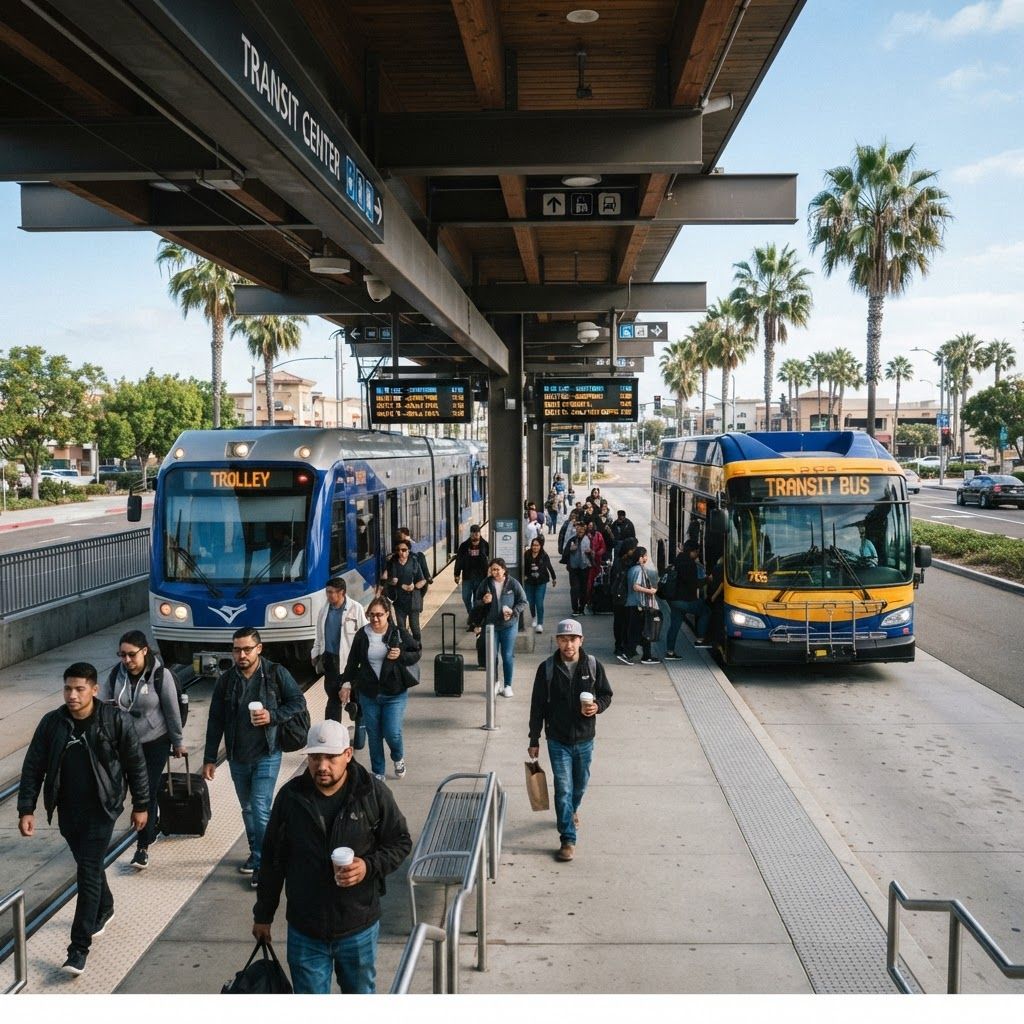
Transit in a Growing South Bay City
Chula Vista has grown rapidly over the past two decades, and that growth has outpaced highway capacity. The practical result is that public transit has shifted from a service of last resort to a genuinely competitive option for many trips, particularly commutes toward downtown San Diego and journeys to the international border. For students, seniors, workers without cars, and households trying to avoid the substantial expense of a second vehicle, transit is essential infrastructure.
The network here combines several layers: light rail providing high-capacity north-south service, trunk bus routes running frequently along major corridors, neighborhood circulators feeding those trunk lines, express services bypassing local stops, and demand-responsive options serving areas too dispersed for fixed routes. Understanding how these layers interact is the key to using the system well.
How These Services Were Assessed
We evaluated frequency and span of service, reliability, accessibility, fare value, information quality, and network connectivity. A service that runs every ten minutes until midnight serves fundamentally different needs than one running hourly on weekdays only, and both have legitimate roles. Integration mattered heavily, since transit's usefulness depends on the ease of transferring between services.
1. South Bay Light Rail Service
The light rail line forms the backbone of local transit, running frequently between Chula Vista, downtown San Diego, and the border crossing. Level boarding, generous capacity, and dedicated right-of-way make it fast and predictable even during peak congestion. Stations have become development anchors, with housing and retail clustering nearby.
2. Chula Vista Trunk Bus Routes
High-frequency bus routes along major arterials carry the largest share of local bus ridership. Their value lies in simplicity: riders can arrive at a stop without consulting a schedule and expect a bus shortly. Signal priority and consolidated stop spacing have improved travel speeds noticeably on several corridors.
3. Eastlake Neighborhood Circulators
Eastern Chula Vista's newer residential communities are lower density and harder to serve with trunk routes. Neighborhood circulators solve this by looping through subdivisions and delivering riders to major transfer points. Timed connections make the transfer experience reasonable rather than punishing.
4. Border Express Transit Service
Express service to the border crossing serves an enormous daily travel market, including cross-border workers, students, and shoppers. Limited-stop operation shortens travel time substantially, and higher-capacity vehicles handle peak surges. Clear multilingual information makes the service accessible to occasional riders.
5. Sweetwater Paratransit Services
For riders whose disabilities prevent use of fixed-route service, paratransit provides curb-to-curb transportation with trained operators and accessible vehicles. Reservation flexibility and on-time performance are the metrics that matter most here, and this service has invested in both. Travel training programs also help some riders transition to fixed routes where possible.
6. Bayfront Shuttle Circulator
Serving the bayfront district, waterfront parks, and event venues, this circulator handles visitor and event traffic that would otherwise generate significant parking demand. Frequent short loops and simple flat fares suit occasional riders who do not want to study a system map.
7. Third Avenue Village Connector
Downtown Chula Vista's Third Avenue district benefits from a dedicated connector linking parking areas, transit stations, and the commercial core. The service supports local businesses by extending the practical walking radius, and its frequency during evening hours helps restaurants and entertainment venues.
8. Otay Employment Shuttle Program
Employer-sponsored shuttles fill gaps that public routes cannot economically serve, particularly for industrial employment centers with shift schedules outside normal transit hours. This program coordinates funding between employers and transit agencies, producing service that benefits workers who otherwise could not reach these jobs without a car.
9. Harborline Microtransit On-Demand
Microtransit uses smaller vehicles dispatched dynamically through an app, serving zones where fixed routes would run mostly empty. Riders get near door-to-door service at fares closer to transit than rideshare. The model has proven especially useful for connecting outlying areas to rail stations.
10. Pacific Regional Fare and Trip Planning Services
Behind the vehicles sits the information and payment layer. Unified fare media, mobile ticketing, real-time arrival prediction, and integrated trip planning collectively determine whether the network feels usable. Continued investment here has arguably improved the rider experience as much as any new route.
Getting the Most Value From Transit
Frequent riders should almost always use a monthly or regional pass rather than paying per ride, as the break-even point typically falls well below daily commuting volume. Discounted fare categories exist for seniors, riders with disabilities, students, and youth, and enrollment is usually straightforward. Combining transit with cycling extends reach considerably, since bike racks and secure station parking let riders cover the first and last mile quickly. For occasional trips, checking real-time arrival information before leaving home avoids most waiting.
Trends and Coming Improvements
Several changes will shape transit in Chula Vista. Bus electrification is progressing, reducing emissions and noise on urban routes. Transit priority treatments such as dedicated lanes and signal preemption are being applied to the busiest corridors, improving speed without new vehicles. Fare technology continues to consolidate toward contactless payment and account-based systems that automatically apply the best available fare. Transit-oriented development around rail stations is increasing ridership potential while addressing housing demand. And microtransit is maturing from pilot experiment into a permanent network layer for low-density areas.
Challenges the Network Still Faces
Honest assessment requires acknowledging limitations. Service frequency outside peak hours remains thin in some areas, making transit impractical for irregular schedules. Operator recruitment constrains service expansion. Some newer developments were designed around automobile access, with street patterns that make efficient bus routing difficult. And crossing-related congestion near the border can affect schedule reliability. Progress on these issues depends on sustained funding and land use decisions as much as on transit operations.
Final Thoughts
Public transit in Chula Vista works well for a substantial share of trips, particularly commutes along major corridors and journeys toward the border or downtown San Diego. The layered network of light rail, trunk buses, circulators, paratransit, and microtransit covers a wide range of needs, and improvements in payment technology and real-time information have made the system considerably easier to use. Learn the layers, choose the right fare product, and transit becomes a genuinely practical alternative to driving.