
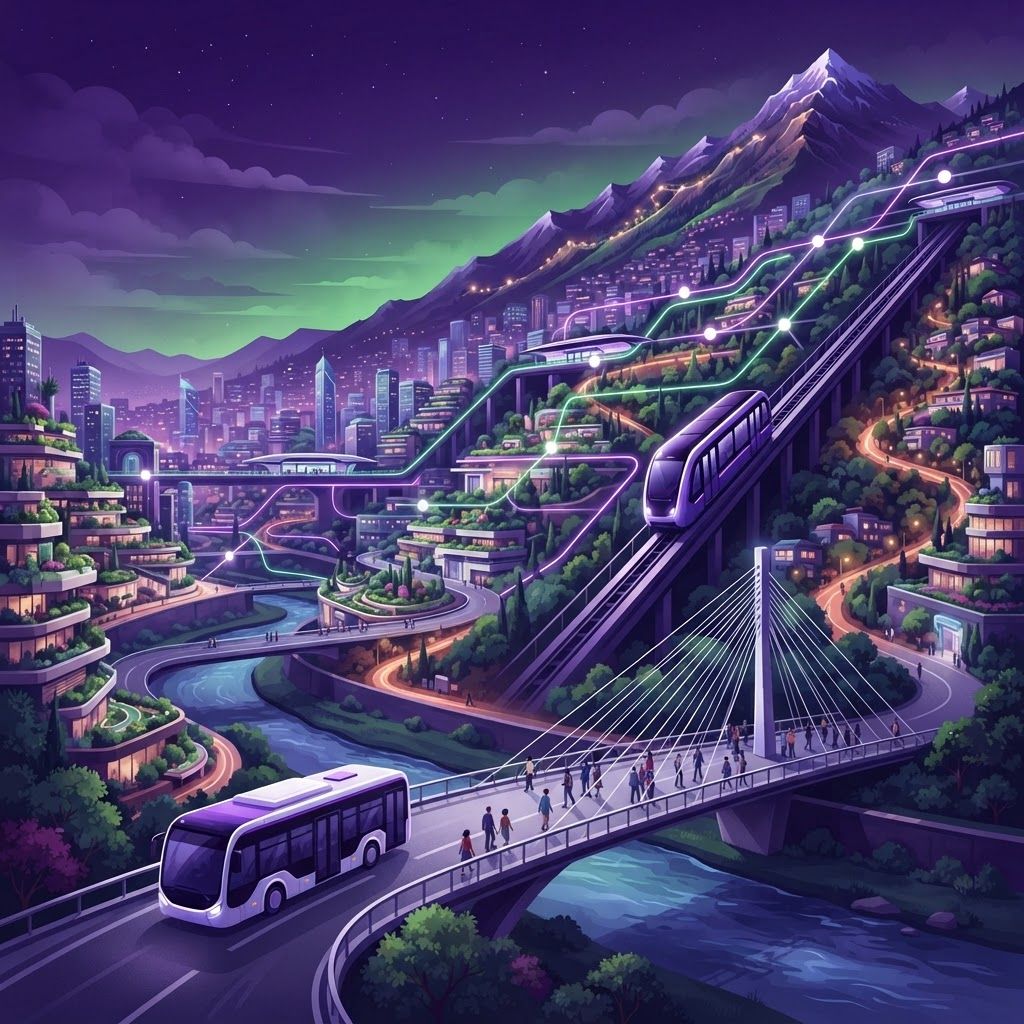
A Transit System Shaped by Geography and Ambition
Chattanooga's public transportation system is unusual for a city of its size. It includes a free downtown electric shuttle that predates most American electric bus programs, a funicular railway climbing one of the steepest passenger grades in the world, a conventional fixed-route bus network, paratransit service and a well-established bike share system.
That mix exists because of both geography and policy. The city is hemmed in by mountains and a winding river, which constrains road capacity and concentrates activity in a compact downtown core. And in the 1990s, as part of the environmental turnaround that redefined the city, local leadership invested deliberately in electric transit as both an air quality measure and a downtown revitalization tool. The shuttle that resulted became a model studied by other cities.
The Core Services
CARTA fixed-route bus service forms the backbone of the system, with routes radiating from downtown to neighborhoods, employment centers, shopping districts and the airport. Frequencies vary by route, with the strongest service on the main corridors.
The free downtown electric shuttle runs frequently along a route linking the Tennessee Aquarium and riverfront with the Southside and the parking facilities at either end. It is free to riders, quiet, and genuinely the best way for visitors to move around the core without repeatedly paying for parking.
The Lookout Mountain Incline Railway climbs the mountain on a dramatically steep grade, operating as a scheduled transportation service and simultaneously as one of the region's most popular attractions.
CARTA Care-A-Van paratransit provides origin-to-destination service for riders whose disabilities prevent them from using fixed-route buses, operating with advance scheduling and eligibility certification.
Bike Chattanooga bike share offers docked bicycles across dozens of stations concentrated downtown and along the riverfront, with both short-term passes and annual memberships.
Downtown parking shuttle connections link peripheral parking facilities to the core, functioning as park-and-ride infrastructure for commuters and event attendees.
CARTA airport service connects Lovell Field to the transit network, providing a low-cost alternative to taxis and rideshare for travelers with time and light luggage.
Regional commuter and vanpool programs support workers traveling from surrounding counties, reducing single-occupancy commuting on the interstate corridors.
Micromobility scooter services operate in the downtown area under city permitting, filling short-trip gaps between transit stops and destinations.
The Tennessee Riverwalk and pedestrian bridge network deserves inclusion as active transportation infrastructure, with the Walnut Street Bridge serving as a genuine pedestrian corridor connecting the North Shore to downtown rather than merely a scenic feature.
Using Transit as a Visitor
Visitors staying downtown can and should leave the car parked. The free shuttle covers the aquarium district, the Southside restaurants and most hotels on a frequent loop. The pedestrian bridge connects to the North Shore's shops and Coolidge Park on foot. Bike share fills in the riverfront distances. The Incline handles Lookout Mountain, though reaching its lower station requires a bus connection or a short drive.
What transit does not cover well is the outlying mountain trailheads, Chickamauga Battlefield and the more distant attractions. Those genuinely require a vehicle, and visitors planning a mix of downtown and outdoor activities should plan for a car on the outdoor days only.
Using Transit as a Resident
For commuters, the calculus depends heavily on route alignment. Corridors with frequent service make transit commuting practical and considerably cheaper than driving and parking downtown. Neighborhoods served only by low-frequency routes present a harder case, and many residents use transit selectively rather than exclusively.
Monthly passes reduce per-trip cost substantially for regular riders, and employer-sponsored transit benefit programs make it cheaper still where offered. Mobile ticketing has eliminated the exact-change friction that once discouraged casual ridership.
Accessibility
Fixed-route buses are equipped with ramps or lifts and securement areas, and stop announcements assist riders with visual impairments. Paratransit covers those who cannot use fixed-route service, with trips scheduled in advance within a defined service area. Riders should apply for eligibility certification before they need the service, because the process takes time.
The downtown core is generally walkable with good sidewalk coverage, though some older areas and the steeper terrain present challenges that no transit system can fully resolve.
What Makes the System Notable
Three things distinguish Chattanooga's approach. The first is the early and sustained commitment to electric vehicles, which reduced downtown emissions and noise and gave the city a national reputation in sustainable transit. The second is the integration of transit with downtown revitalization, where the free shuttle functioned as an economic development tool by connecting parking supply to retail and dining demand. The third is the retention of the Incline, a nineteenth-century piece of infrastructure kept in continuous operation rather than abandoned.
Challenges and Trends
Like most mid-size American transit systems, coverage outside the core is the persistent challenge. Low-density development patterns make frequent service expensive to provide, and ridership outside peak corridors is thin. Funding constraints and operator recruitment limit how quickly service can expand.
Trends point toward continued fleet electrification, better real-time arrival information, mobile fare integration across modes and pilot programs for on-demand microtransit in lower-density zones. Regional coordination with surrounding counties is an ongoing effort as the metro grows beyond the historic service boundary.
Practical Tips
Download the transit agency's app for real-time arrivals and mobile ticketing. Use the free shuttle rather than moving your car between downtown destinations. Check Incline operating hours seasonally, since they vary. Reserve paratransit trips well ahead. And for any trip beyond the core, verify the route frequency before committing, because a thirty-minute headway and a sixty-minute headway produce very different experiences if you miss a bus.
Chattanooga will not be mistaken for a transit metropolis, but within its compact core it offers a genuinely useful, pleasant and unusually forward-thinking public transportation network.