
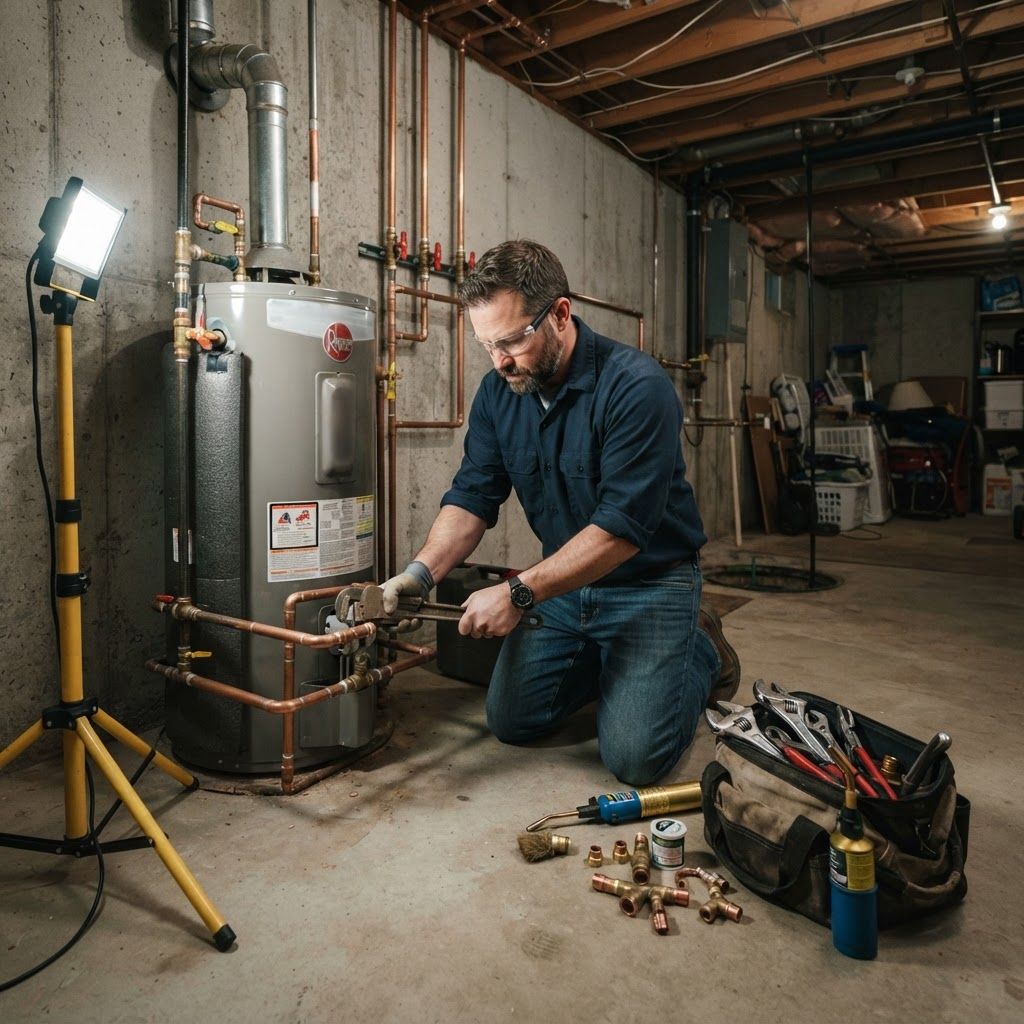
Plumbing Challenges Specific to St. Louis
The St. Louis region's plumbing infrastructure reflects its age. Large portions of the city and inner suburbs were built between the 1890s and 1950s, which means original cast iron drain stacks, galvanized steel supply lines and vitrified clay sewer laterals are still in service in many homes. Each of these materials has a predictable failure pattern. Cast iron corrodes from the inside and eventually loses its bottom channel. Galvanized supply lines constrict with scale until pressure drops noticeably. Clay laterals develop joint separations that invite root intrusion.
Two additional local factors matter. Water in much of the region is moderately hard, which accelerates scale accumulation in water heaters, fixtures and tankless units. And freeze events, while not constant, are severe enough to burst unprotected lines in crawl spaces, garages and exterior walls, producing predictable seasonal surges in emergency calls.
Understanding these patterns changes how homeowners should think about plumbing. Much of the work in this market is not repair of a random failure but planned replacement of material reaching the end of a known service life.
Ten Leading Plumbing Companies
1. Hoffmann Brothers is one of the largest home service companies in the region, offering plumbing alongside heating, cooling and electrical work. Its scale supports genuine 24-hour response and a broad technician bench, which matters during freeze events when demand spikes region-wide.
2. Roto-Rooter maintains substantial local capacity for drain cleaning, sewer camera inspection and emergency service. For an active backup at an inconvenient hour, availability is the deciding factor and this is where scale helps.
3. Classic Aire Care provides plumbing along with mechanical services, with a service model built around scheduled maintenance relationships rather than purely reactive calls.
4. Ferguson Plumbing Services handles residential repair, fixture replacement and water heater work throughout the metro area with a straightforward diagnostic and quoting process.
5. Lawson Family Plumbing serves the region with residential plumbing repair, water heater installation and repiping, and has built its reputation on transparent flat-rate pricing.
6. Kirkwood Plumbing works across the mid-county communities on repair, remodel plumbing and drain work, with familiarity in older homes where fixture and rough-in dimensions differ from modern standards.
7. Anytime Plumbing emphasizes rapid dispatch for emergency work including burst lines, sewer backups and failed water heaters, with coverage across a wide portion of the metro area.
8. Rich's Plumbing handles residential and light commercial plumbing with a smaller crew structure that gives customers consistency in who performs the work.
9. Bone Dry Plumbing extends established home service capability into plumbing, useful when work overlaps with roofing, gutters or exterior water management.
10. Rooter Man of St. Louis concentrates on drain and sewer services including hydro jetting, camera inspection and trenchless lateral repair, a focused specialty in a market full of aging laterals.
Verification Before You Hire
Plumbing licensure in the St. Louis area is administered at the municipal and county level rather than statewide, so requirements differ between St. Louis City, St. Louis County and individual municipalities. Confirm that the company holds the license required where your property sits, not merely a license somewhere in the region.
Verify general liability and workers compensation coverage. Plumbing failures can cause substantial water damage, and adequate liability limits protect you if a repair goes wrong. Ask whether the technician dispatched is a licensed journeyman or master plumber, an apprentice under supervision, or a technician without plumbing licensure performing limited work.
Pricing structure deserves clarity upfront. Flat-rate pricing quoted before work begins is generally preferable to hourly billing for defined tasks because it removes uncertainty. For diagnostic work, ask whether the trip or diagnostic fee is credited toward the repair if you proceed.
Sewer Laterals and Trenchless Options
Sewer lateral problems are among the most expensive plumbing issues in this market, and they are common given the prevalence of clay pipe. The correct first step is always a camera inspection with recorded footage, which identifies whether the issue is a root intrusion, an offset joint, a belly holding water, or a full collapse. Any recommendation for replacement made without camera evidence should be questioned.
Trenchless methods have changed the economics considerably. Pipe bursting and cured-in-place lining can replace or rehabilitate a lateral with minimal excavation, preserving driveways, mature trees and landscaping. Trenchless is not always appropriate, particularly with severe collapses or significant grade problems, but it should be evaluated before committing to open-trench replacement.
Homeowners in some municipalities participate in lateral repair programs funded through property tax assessments that offset a portion of qualifying repair cost. Contractors active in your municipality will know whether such a program applies and what documentation it requires.
Repiping and Water Heaters
Whole-house repiping is a common project in older St. Louis housing. Modern options include copper, which remains the traditional standard, and PEX, which installs faster, resists freeze damage better and costs less. Both are code-compliant; the choice usually turns on accessibility, budget and homeowner preference.
For water heating, tank units remain the value choice with typical service life of eight to twelve years in hard water conditions, shorter if never flushed. Tankless units offer endless hot water and longer life but require adequate gas supply, proper venting and annual descaling in this water chemistry. Heat pump water heaters are increasingly attractive where conditioned basement space allows, offering substantial efficiency gains.
Preventive Measures That Pay
Simple maintenance prevents most emergencies. Flush the water heater annually. Exercise the main shutoff valve so it works when needed, and make sure every adult in the household knows where it is. Insulate lines in unconditioned spaces before winter and disconnect exterior hoses. Install a water alarm or automatic shutoff device near the water heater and laundry, since these are the most common sources of significant water damage.
Have the sewer lateral camera inspected before purchasing an older home. It is inexpensive relative to the cost of a lateral replacement discovered after closing, and it is the single most valuable optional inspection in this market.
Final Perspective
The St. Louis plumbing market includes large multi-trade service companies with round-the-clock availability and smaller specialists with focused expertise, and both have their place. Use large firms for emergencies where response time governs, and specialists for planned work like repiping or trenchless lateral replacement. Insist on camera evidence before any sewer recommendation, verify local licensure and insurance, and get flat-rate pricing in writing. Handling aging pipe on a planned schedule rather than an emergency one is the difference between a manageable expense and a ruined basement.