
Plastics Manufacturing in the Omaha Metro
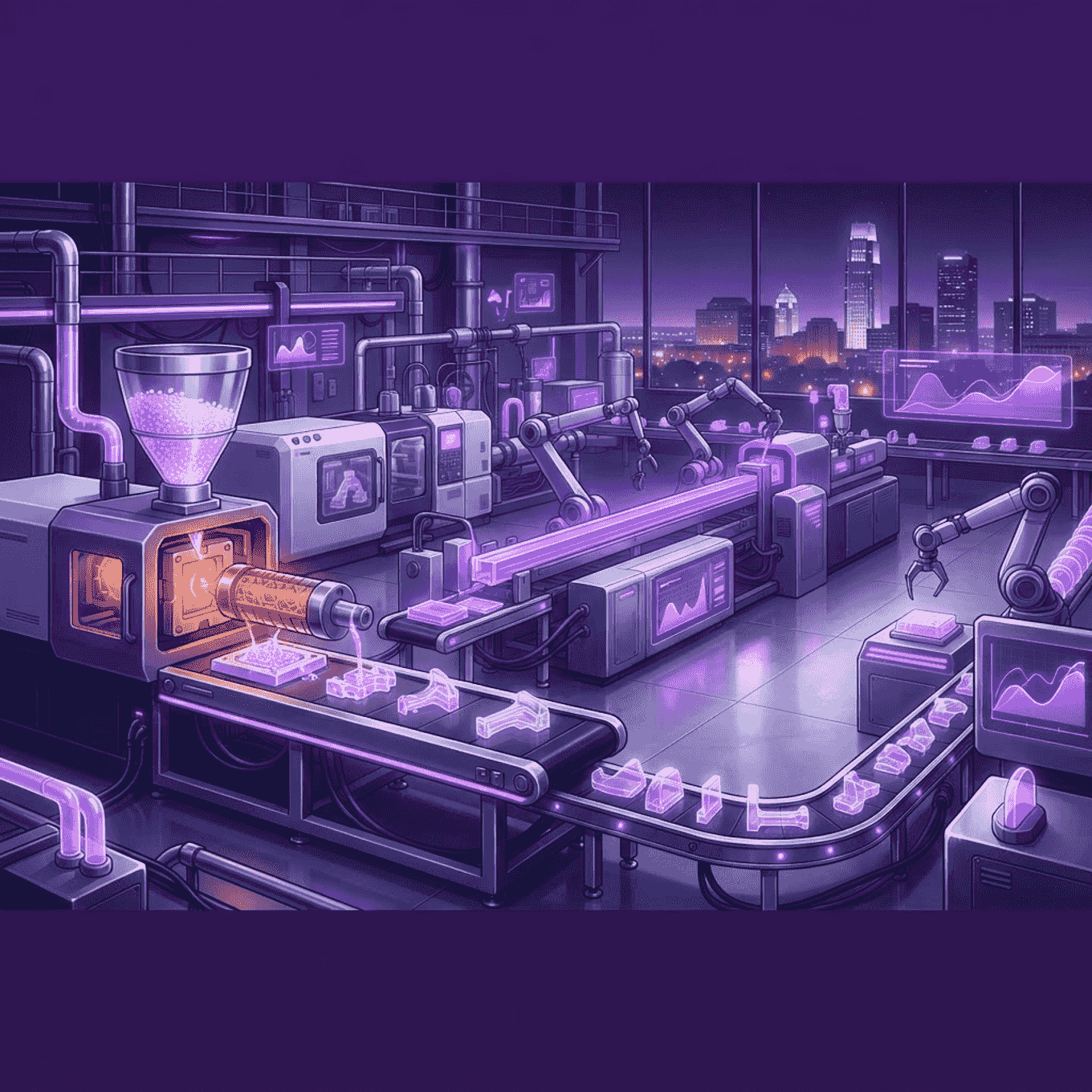
Plastics may be the least visible pillar of Omaha's manufacturing economy, and also one of the most broadly useful. Nearly every other industry in the metro depends on it: food processors need packaging, equipment builders need housings and guards, construction suppliers need insulated forms and profiles, healthcare providers need disposables and device components, and agriculture needs tanks, fittings and durable outdoor parts. To serve that range, local manufacturers have developed capability across injection molding, thermoforming, extrusion, blow molding, rotational molding and CNC machining of engineering polymers.
The metro's plastics companies tend to compete on responsiveness and engineering support rather than sheer scale. Many will help a customer select resin, adjust a part's geometry to reduce cycle time or sink marks, evaluate whether a family tool makes sense, and then run production in quantities that would be too small for a high-volume automotive molder to accept. That combination of technical involvement and flexibility is the defining local characteristic.
Why Omaha Works for Plastics Production
Freight economics come first. Plastic parts are frequently bulky and light, meaning shipping cost per unit of value is high. Producing near the point of use materially reduces landed cost, and Omaha's central location and interstate access make it an efficient base for serving the entire midsection of the country. Resin arrives efficiently by rail and truck, and finished goods reach regional customers within a day.
Energy and space costs reinforce the case. Molding and extrusion are energy-intensive and require substantial floor area for presses, material handling, granulators and warehousing. Competitive industrial power rates and reasonable industrial rents let Omaha processors keep more capacity available. The region also has a workforce comfortable with process work, plus tooling and machining resources nearby for mold maintenance and repair, which prevents the long downtime that occurs when a damaged tool must travel across the country.
How These Manufacturers Were Selected
Evaluation criteria included process capability, quality systems, engineering and tooling support, industry reputation and reliability of delivery. Companies demonstrating documented quality management, investment in modern presses and automation, meaningful design-for-manufacturability input and responsible material handling practices ranked highest.
The Top 10 Plastic Manufacturers in Omaha
1. Airlite Plastics
Headquartered in Omaha, Airlite Plastics is the metro's flagship plastics manufacturer, producing packaging, foodservice products and insulated concrete form building systems. The company operates extensive injection molding, thermoforming and expanded polystyrene capability, and its combination of consumer packaging expertise and construction products innovation gives it unusual breadth. Airlite's scale, automation and long Omaha history make it a genuine industry anchor.
2. Midwest Plastic Molding
Midwest Plastic Molding focuses on custom injection molding for industrial, agricultural and consumer customers, supported by in-house tooling maintenance. Its engineering team is known for pragmatic advice on wall thickness, draft and gate location that improves part quality while shortening cycle times, which directly reduces piece price.
3. Heartland Injection Molding
Serving medical device, instrumentation and precision industrial customers, Heartland Injection Molding emphasizes tight tolerance work, controlled environments and thorough process validation. Scientific molding practices, cavity pressure monitoring and detailed documentation make it a natural fit for regulated applications where process repeatability is non-negotiable.
4. Papio Polymer Solutions
Papio Polymer Solutions machines engineering plastics including acetal, nylon, polycarbonate, UHMW and PEEK into bearings, wear strips, guides, manifolds and custom components. Machined polymer work is essential to food processing and material handling equipment, and the shop's material knowledge helps customers choose grades that resist wear, chemicals or heat as required.
5. Omaha Thermoforming
Specializing in heavy-gauge thermoforming, Omaha Thermoforming produces equipment housings, machine panels, trays and protective covers. Thermoforming's low tooling cost makes it ideal for large parts at moderate volumes, and the company guides customers toward the process when injection molding tooling would never pay back.
6. Cornhusker Extrusions
Cornhusker Extrusions manufactures custom profiles, tubing and edge trim in rigid and flexible materials for construction, furniture, transportation and industrial customers. Its die-making capability and tight dimensional control allow complex cross sections to be produced consistently, including co-extruded profiles combining rigid and soft materials.
7. Missouri River Plastics Group
This company provides contract molding along with assembly, decorating, pad printing, ultrasonic welding and packaging services. Customers who prefer to receive finished, retail-ready or line-ready products rather than loose components value the consolidation, and the company's inventory management programs help smooth demand variability.
8. Elkhorn Custom Molders
Elkhorn Custom Molders concentrates on low- and mid-volume programs, prototype tooling and bridge production for companies moving a product from concept to market. Its aluminum tooling options and rapid iteration approach let developers validate designs in real production material before committing to expensive hardened steel molds.
9. Sarpy Precision Plastics
Focused on small, high-precision components, Sarpy Precision Plastics runs micro-molding and tight-tolerance work for electronics, fluid handling and medical customers. Automated inspection, cleanroom-adjacent assembly and careful resin traceability support applications where a few thousandths of an inch determines whether an assembly functions.
10. Benson Blow Molding
Rounding out the list, Benson Blow Molding produces bottles, tanks, containers and hollow industrial parts for chemical, agricultural and consumer customers. Its expertise in multilayer structures and chemical resistance helps customers meet regulatory requirements for storing and transporting demanding contents safely.
Trends Shaping the Plastics Industry
Sustainability now drives real engineering decisions. Customers ask for recycled content, mono-material designs that are easier to recycle, lightweighting to reduce resin use, and regrind programs that keep scrap in the loop. Automation continues to expand, with robotic part removal, in-mold labeling and automated inspection improving both consistency and labor efficiency. Material innovation is also accelerating as bio-based and high-performance resins open applications previously reserved for metal. Finally, supply chain resilience has become a purchasing priority, favoring domestic molders who can hold safety stock and respond to schedule changes without ocean freight risk.
How to Choose a Plastics Manufacturing Partner
Match the process to the part before comparing quotes. High volumes justify injection molding tooling; large panels at moderate volume favor thermoforming; hollow vessels point to blow or rotational molding; and very low volumes may be best machined. Discuss tooling ownership, maintenance responsibility and storage explicitly, because unclear tool agreements cause serious disputes later. Ask about resin sourcing, lot traceability and how the molder handles material price movement. Review quality methods including first-article inspection, in-process checks and capability studies. Finally, evaluate engineering responsiveness during quoting, since a molder who asks thoughtful questions early is far more likely to deliver parts that work.
Final Thoughts
Omaha's plastics manufacturers cover an impressive spectrum of processes and volumes, backed by engineering support that smaller programs rarely receive from larger national suppliers. Bringing a supplier into the conversation while the part design is still flexible almost always produces better tooling decisions, lower piece prices and fewer surprises at launch. For companies serving the central United States, the metro's combination of capability, location and cost structure is difficult to beat.