
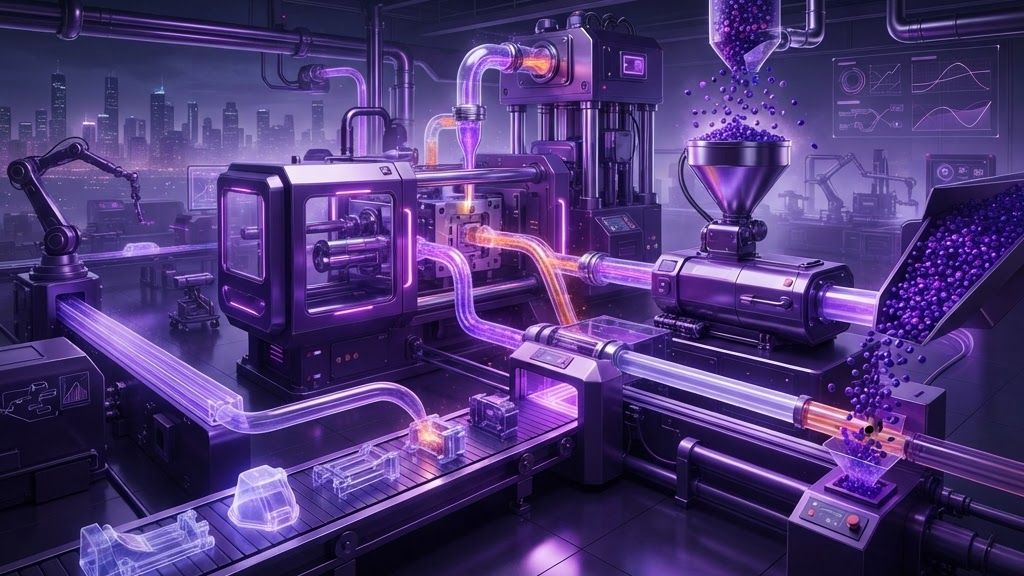
The Plastics Industry in Central Iowa
Plastics manufacturing in the Des Moines region grew alongside agricultural equipment, packaging, and consumer goods production. Today local processors run injection molding, thermoforming, rotational molding, extrusion, and blow molding operations serving customers who need durable components, protective packaging, fluid handling parts, and custom enclosures.
The metro's plastics companies tend to serve business customers rather than produce their own branded goods. That makes them contract manufacturers whose value lies in process control, tooling expertise, and material knowledge. A well-run molder can hold tolerances within a few thousandths of an inch across hundreds of thousands of parts, which requires disciplined process documentation and consistent material handling.
Ten Leading Plastic Manufacturers in the Des Moines Area
Iowa Injection Molding produces precision molded components for industrial and consumer customers. Its scientific molding approach, which characterizes the process rather than relying on operator adjustment, produces markedly more consistent output.
Heartland Thermoforming specializes in heavy gauge thermoformed panels and covers for equipment manufacturers. Thermoforming offers lower tooling costs than injection molding, making it economical for larger parts at moderate volumes.
Capital Rotational Molding manufactures tanks, containers, and large hollow parts. Rotational molding excels at seamless, stress-free hollow products such as agricultural tanks and material handling bins.
Prairie Plastics Extrusion produces profiles, tubing, and sheet through extrusion. Die design and cooling control determine dimensional consistency in extruded products.
Des Moines Custom Molders serves low to medium volume customers with flexible tooling options including aluminum molds that reduce upfront cost for shorter runs.
Midwest Medical Plastics manufactures components under controlled conditions for medical device customers. Cleanroom molding, validated processes, and full lot traceability distinguish this segment.
Ankeny Blow Molding produces bottles, containers, and hollow parts for packaging customers. Wall thickness distribution is the critical quality parameter, affecting both strength and material cost.
Urbandale Plastic Fabrication handles machining, bonding, and forming of plastic sheet and stock shapes for guards, fixtures, and enclosures where tooling investment is not justified.
Clive Tool and Mold builds and maintains injection molds. Access to local toolmaking dramatically shortens repair turnaround, which protects production schedules when a mold requires attention.
Grimes Recycled Polymers processes and compounds recycled resin for manufacturers seeking to incorporate post-industrial material into products without compromising performance.
Understanding Plastics Processes and Their Trade-Offs
Process selection drives cost, geometry, and volume economics. Injection molding delivers excellent precision and surface finish with high tooling cost, making it suitable for volume production. Thermoforming handles large parts with modest tooling investment but offers less geometric complexity. Rotational molding produces seamless hollow parts with very low tooling cost and long cycle times. Extrusion produces continuous profiles efficiently but only in constant cross sections.
Choosing correctly at the outset saves substantial money. A part quoted for injection molding at low annual volume may cost far less as a thermoformed or fabricated component, and experienced local manufacturers will say so during quoting.
Material Selection and Performance
Resin selection determines nearly everything about how a part performs. Polypropylene offers chemical resistance and living hinge capability at low cost. Polyethylene provides toughness and impact resistance, particularly at low temperatures. Acrylonitrile butadiene styrene delivers rigidity and good surface finish for enclosures. Polycarbonate offers exceptional impact strength and optical clarity. Glass-filled grades increase stiffness at the expense of toughness and surface appearance.
Ultraviolet stability matters greatly for outdoor agricultural applications common in Iowa. Unstabilized polymers chalk and embrittle after prolonged sun exposure, so specifying appropriate additives is essential for parts that live outside.
Tooling, Design, and Cost Control
Tooling is the largest fixed cost in molding, and part design drives it. Uniform wall thickness prevents sink and warp. Generous draft angles allow clean ejection. Avoiding undercuts eliminates side actions that add cost and maintenance. Consolidating multiple assembled components into one molded part often reduces total cost even if the tool is more complex.
Ask any prospective manufacturer for a design for manufacturability review before finalizing geometry. The recommendations typically pay for themselves many times over.
Sustainability and Regulatory Trends
Plastics manufacturers face growing pressure to demonstrate circularity. Post-industrial regrind is standard practice, and post-consumer recycled content is increasingly requested. Mono-material design, which avoids mixing incompatible polymers in a single product, improves recyclability meaningfully. Lightweighting reduces both material cost and environmental footprint simultaneously.
Regulatory attention on food contact materials and certain additives continues to evolve, so manufacturers serving packaging and food processing customers maintain documentation on compliance for the specific resins and colorants they use.
Selecting the Right Plastics Partner
Match volume to capability. High-volume programs need automation, secondary operations, and cost-per-part discipline. Prototype and low-volume work needs flexible tooling and engineering access. Ask about press tonnage range, material handling and drying practices, in-house inspection capability, and how process parameters are documented and locked.
Clarify tooling ownership, maintenance responsibility, and what happens to the mold at end of program. These commercial details matter as much as piece price over a product lifecycle.
Final Thoughts
Des Moines plastics manufacturers combine process breadth with genuine engineering support, serving agriculture, packaging, medical, and industrial customers. Buyers who involve processors during design, select processes based on realistic volumes, and specify materials with the operating environment in mind will achieve better parts at lower total cost.