
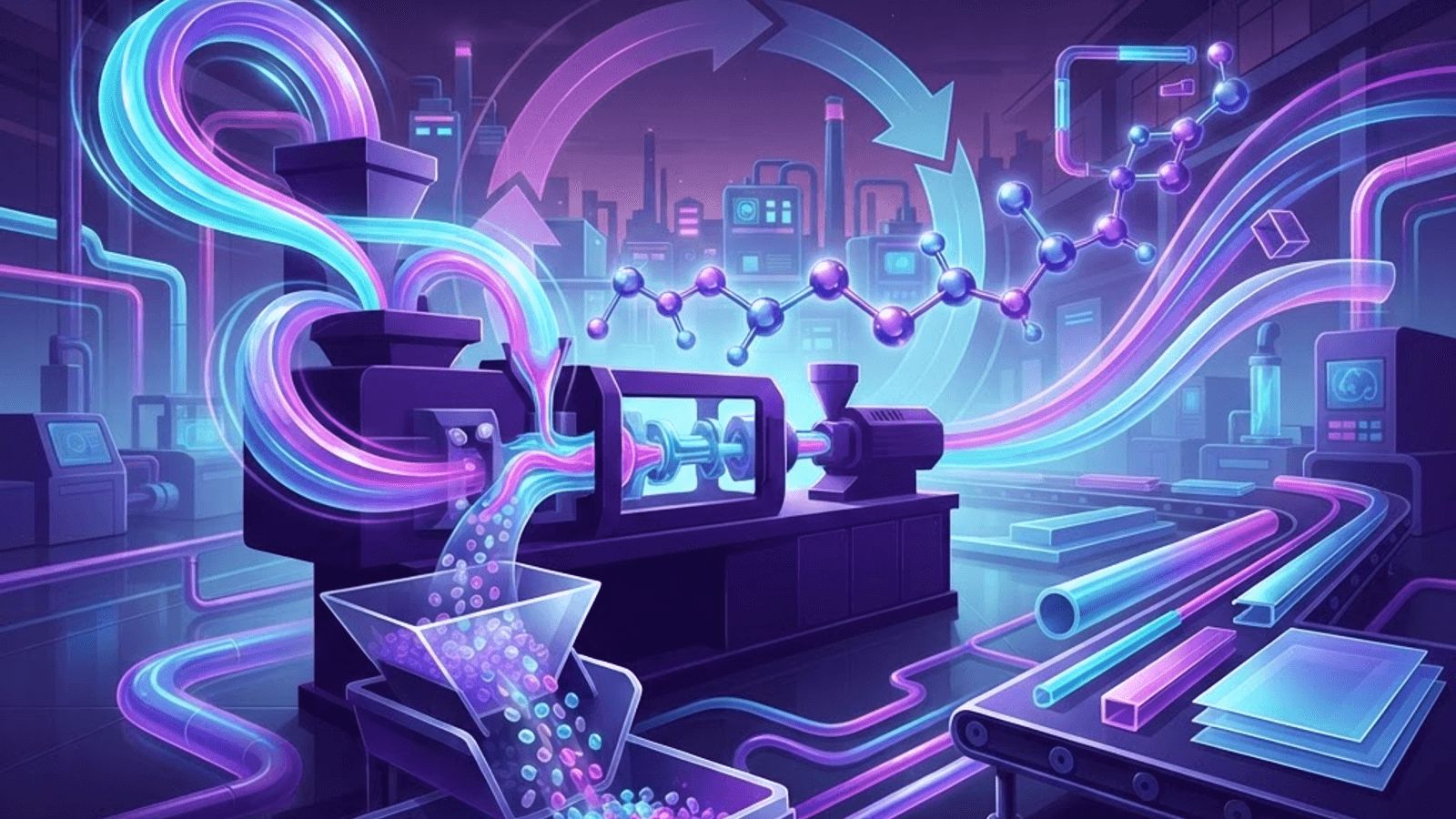
From Rubber to Polymers
The transition from rubber to plastics was natural for Akron. Both are polymer sciences, both depend on formulation and processing expertise, and both require the same analytical infrastructure to characterize and validate. As synthetic polymers expanded through the second half of the twentieth century, Akron's chemists, engineers, and machine builders followed the technology, and the city became a center for plastics processing as well as elastomers.
Today the regional plastics industry spans the entire value chain. Compounders formulate resin blends with specific mechanical, thermal, and aesthetic properties. Injection molders produce precision components in volumes ranging from hundreds to millions. Extruders make profiles, sheet, tubing, and film. Thermoformers produce packaging, trays, and large formed parts. Blow molders make containers and hollow components. Mold builders design and machine the tooling that makes all of it possible.
Which Process Fits Your Part
Choosing a process is the first engineering decision, and it drives everything downstream. Injection molding suits high-volume, dimensionally precise parts with complex geometry, but tooling is expensive and lead times for molds are long. Extrusion suits continuous profiles with a constant cross-section such as tubing, trim, and sheet. Thermoforming suits large, relatively shallow parts at moderate volume with much lower tooling cost. Blow molding suits hollow containers. Rotational molding suits large, seamless hollow parts in low volume. Machining from stock suits prototypes and very low quantities where tooling cannot be justified.
The Top 10 Plastic Manufacturers Serving Akron
1. Myers Industries
An Akron-headquartered manufacturer of polymer products including material handling containers, storage solutions, and specialty products serving agriculture, industrial, and automotive aftermarket customers across North America.
2. A. Schulman and Regional Compounding Operations
Plastics compounding operations with Akron roots produce engineered thermoplastic formulations, masterbatches, and specialty compounds tailored to customer performance requirements in automotive, packaging, and consumer markets.
3. Davis-Standard
A global supplier of extrusion and converting equipment with strong Ohio ties, providing extruders, dies, and complete processing lines used by plastics processors worldwide.
4. Summit Polymers and Regional Injection Molders
Precision injection molding operations across the Akron region produce automotive interior components, industrial parts, and consumer products, typically operating under automotive quality certification with in-house tooling support.
5. Kent Displays and Advanced Polymer Product Makers
Technology-driven manufacturers in the Akron-Kent corridor produce advanced polymer-based products, combining materials science with proprietary processing to create differentiated products rather than commodity parts.
6. Lubrizol Advanced Materials
With major Northeast Ohio operations, the company produces thermoplastic polyurethanes and specialty polymers used in medical devices, wire and cable, footwear, and industrial applications requiring specific elastic and chemical resistance properties.
7. Akron Rubber Development Laboratory
An independent testing organization providing physical, analytical, and failure analysis services for plastics and elastomers, supporting product development and qualification for processors throughout the region.
8. Regional Thermoforming and Packaging Producers
Northeast Ohio thermoformers produce custom trays, clamshells, protective packaging, and large formed components, serving food, medical, and industrial packaging customers with comparatively low tooling investment.
9. Northeast Ohio Mold and Die Builders
The regional tooling industry designs and machines injection molds, extrusion dies, and thermoforming tools, offering local access to mold trials, engineering changes, and maintenance that overseas tooling cannot match.
10. University of Akron Polymer Engineering Partners
Research partnerships and spin-off ventures connected to the university's polymer engineering programs develop new processing methods, sustainable materials, and recycling technologies with direct application to regional manufacturers.
Design for Manufacturability Matters
The largest cost savings in plastics happen at the design stage. Uniform wall thickness prevents sink marks and warpage. Generous draft angles allow parts to eject cleanly. Ribs reinforce more efficiently than thick sections. Consolidating multiple assembled components into a single molded part eliminates labor and fasteners. Selecting a resin that meets requirements without over-specifying avoids unnecessary material cost. Experienced Akron molders will review a design before quoting and typically identify changes that reduce tooling and piece price substantially.
Recycling and Circularity
Plastics manufacturers face genuine pressure on sustainability, and the region is responding on several fronts. Regrind of internal scrap is standard practice. Post-industrial recycled content is increasingly specified where mechanical properties permit. Design for recyclability favors single-polymer constructions over multi-material laminates that cannot be separated. Chemical recycling technologies that break polymers back to monomers are being researched in Akron laboratories, and the region's polymer science depth makes it a credible location for commercializing such processes.
Selecting a Plastics Partner
Evaluate engineering support before price, because a molder who improves your design saves more than a lower piece price. Confirm quality certifications appropriate to your industry, including medical or automotive standards if applicable. Ask about tooling ownership and where molds are stored, since this becomes critical if the relationship ends. Understand capacity and press tonnage range to ensure your part fits. Request sample parts and dimensional reports from comparable programs. And discuss resin procurement, since material price volatility should be addressed contractually rather than argued about later.
The Regional Outlook
Akron's plastics sector benefits from something few regions possess: fundamental materials knowledge co-located with processing capability and tooling. As applications grow more demanding, particularly in medical devices, electric vehicle components, and sustainable packaging, that combination becomes more valuable rather than less. The manufacturers that invest in automation, quality systems, and materials engineering are well positioned for a long run.