
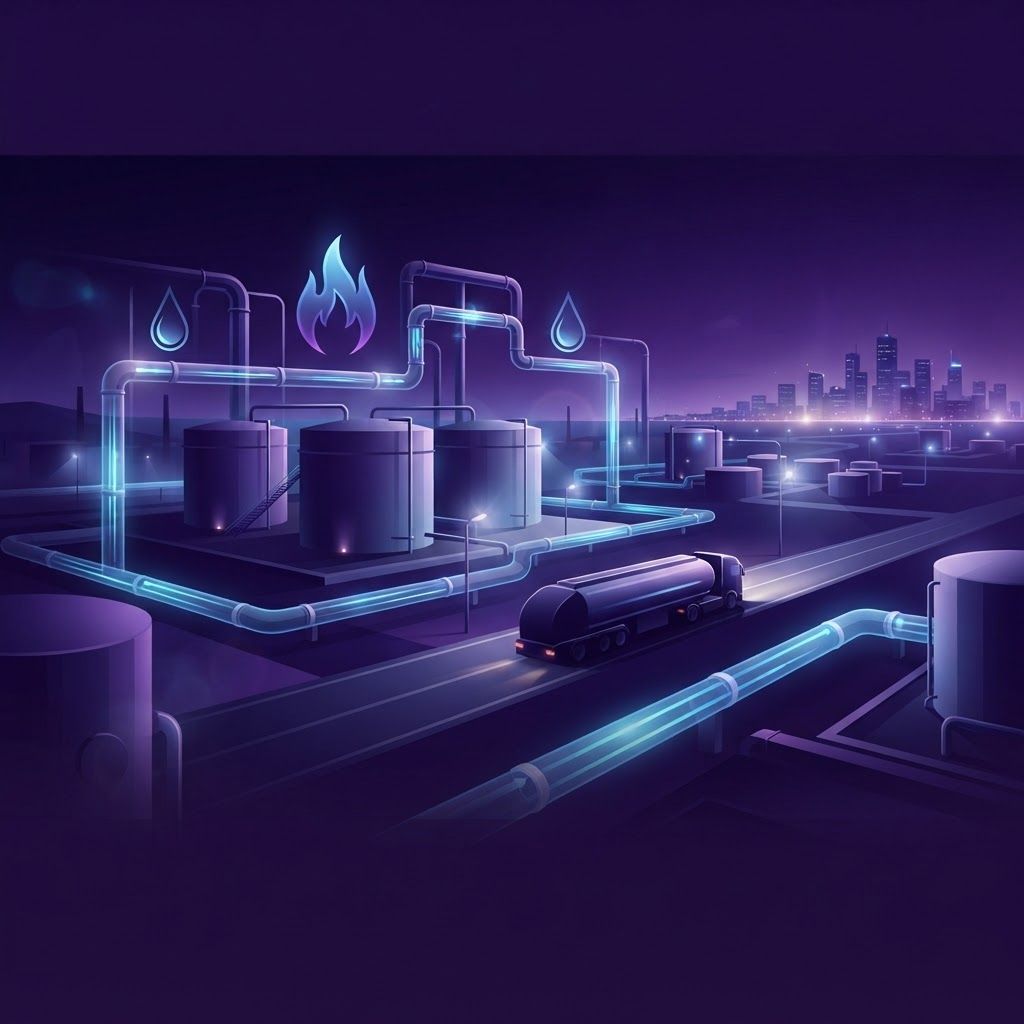
Understanding Oil and Gas in a Non-Producing State
Iowa has no commercial oil or natural gas production, which surprises people who assume energy companies exist only where extraction occurs. In practice, the downstream and midstream segments of the industry are enormous and geographically dispersed. Iowa consumes substantial volumes of diesel for agriculture and freight, gasoline for a highly automobile-dependent population, propane for grain drying and rural home heating, and natural gas for industrial processes and residential heating.
Des Moines sits at the center of that distribution network. Interstate highways, rail corridors and refined product pipelines converge in central Iowa, supporting terminals, wholesale distributors, retail fuel networks and pipeline operations. The sector also intersects heavily with Iowa's ethanol and biodiesel industries, which blend into conventional fuels.
The Segments of the Local Industry
The Iowa fuel economy divides into recognizable parts. Pipeline and terminal operators move and store refined products and natural gas. Wholesale fuel distributors supply retailers, farms and fleets. Propane marketers serve rural residential heating and agricultural drying. Retail fuel and convenience networks serve consumers. Natural gas utilities deliver to homes and businesses. Renewable fuel producers supply ethanol and biodiesel for blending. And energy services companies provide fleet fueling, lubricants, tank services and environmental compliance support.
The Ten Best Oil and Gas Companies Serving Des Moines
1. MidAmerican Energy Natural Gas Operations
Beyond electricity, MidAmerican Energy distributes natural gas to a large customer base across Iowa including the Des Moines metro. Its operations cover distribution infrastructure, system safety, capacity planning and customer programs. For residential and commercial gas customers in central Iowa, it is the primary utility relationship.
2. Black Hills Energy Iowa
Black Hills Energy provides natural gas service across numerous Iowa communities, managing distribution systems, pipeline integrity programs and energy efficiency offerings. Its service territory complements other utilities and covers many smaller cities surrounding the metro.
3. Magellan and Refined Product Pipeline Operators
Refined product pipeline systems deliver gasoline, diesel and other fuels into Iowa terminals from refineries outside the state. Operators in this segment manage batching, scheduling, terminal storage and truck loading racks. Their reliability determines whether central Iowa retailers and fleets have consistent supply, particularly during planting and harvest demand peaks.
4. NuStar Energy Terminal Operations
Terminal operators maintain the storage tanks and loading infrastructure where fuel transfers from pipeline to truck. These facilities also handle ethanol and biodiesel blending, additive injection and quality control. Terminal capacity in and around Des Moines is critical infrastructure that receives little public attention until disrupted.
5. Elder Corporation and Regional Fuel Distributors
Wholesale fuel distributors supply farms, construction companies, municipalities, school districts and trucking fleets with diesel, gasoline, lubricants and on-site tank services. Their value lies in delivery reliability, tank monitoring, fuel quality management and flexible credit terms during seasonal cash flow swings common in agriculture.
6. Kum and Go and Retail Fuel Networks
Kum and Go, founded and headquartered in the Des Moines area, grew into one of the most recognized convenience and fuel retail networks in the Midwest. Retail networks like it manage fuel procurement, pricing, site development and increasingly electric vehicle charging deployment alongside conventional fuel sales.
7. Casey's General Stores
Headquartered in Ankeny just north of Des Moines, Casey's is one of the largest convenience store chains in the United States and a major fuel retailer across the Midwest. Its distribution network, fuel supply operations and prepared food business make it one of central Iowa's most significant corporate employers in the broader energy retail category.
8. Propane Marketers and Rural Energy Cooperatives
Propane is essential in rural Iowa for home heating, livestock building heat and grain drying, and demand spikes sharply during wet harvests. Marketers and cooperatives manage supply contracts, storage, delivery scheduling and price protection programs. Their planning capability during high-demand autumns directly affects agricultural operations.
9. Ethanol and Biodiesel Producers Serving the Fuel Supply
Iowa leads the nation in ethanol production and is a major biodiesel producer, and these fuels blend directly into the conventional supply chain. Producers, marketers and blending operations around central Iowa connect agriculture to transportation fuel markets, and they have become central to how the state's fuel economy differs from other regions.
10. Energy Services, Environmental and Compliance Providers
Supporting the sector are companies handling tank installation and testing, spill prevention planning, environmental remediation, transportation compliance and fuel systems maintenance. Regulatory requirements covering underground storage tanks, hazardous materials transport and air permitting make this expertise a practical necessity rather than an optional service.
What Fuel Buyers Should Consider
Agricultural and fleet buyers benefit from a disciplined approach. Evaluate delivery reliability and emergency response capability, not just posted price, because a supply interruption during harvest costs far more than a small per-gallon difference. Understand contract structures including fixed price, indexed and capped arrangements, and match them to risk tolerance. Ask about tank monitoring and automatic delivery, which prevents run-outs. Confirm fuel quality management practices including additive programs and water control, particularly for equipment sitting idle seasonally. And review compliance support, since tank and reporting obligations carry real penalties.
Trends Affecting the Sector
Several forces are reshaping the industry in Iowa. Renewable fuel blending continues expanding, with higher ethanol blends gaining retail availability across the state. Electric vehicle charging deployment has begun changing retail site economics and design, with major Iowa retailers investing in charging infrastructure. Diesel demand remains structurally tied to agriculture and freight, insulating it somewhat from passenger vehicle electrification. Pipeline infrastructure debates, including carbon dioxide transport proposals connected to ethanol production, have become significant policy and landowner issues in Iowa. And workforce availability for drivers and technicians remains a persistent constraint across distribution.
Final Thoughts
Oil and gas in Des Moines is a logistics, distribution and retail story rather than an extraction one, and it is economically substantial. Central Iowa hosts nationally significant fuel retailers, major natural gas utilities, critical pipeline and terminal infrastructure and a deep agricultural fuel distribution network. For businesses depending on reliable fuel, the right partner is the one whose supply chain and service capability hold up during the weeks when everything else is stretched.