
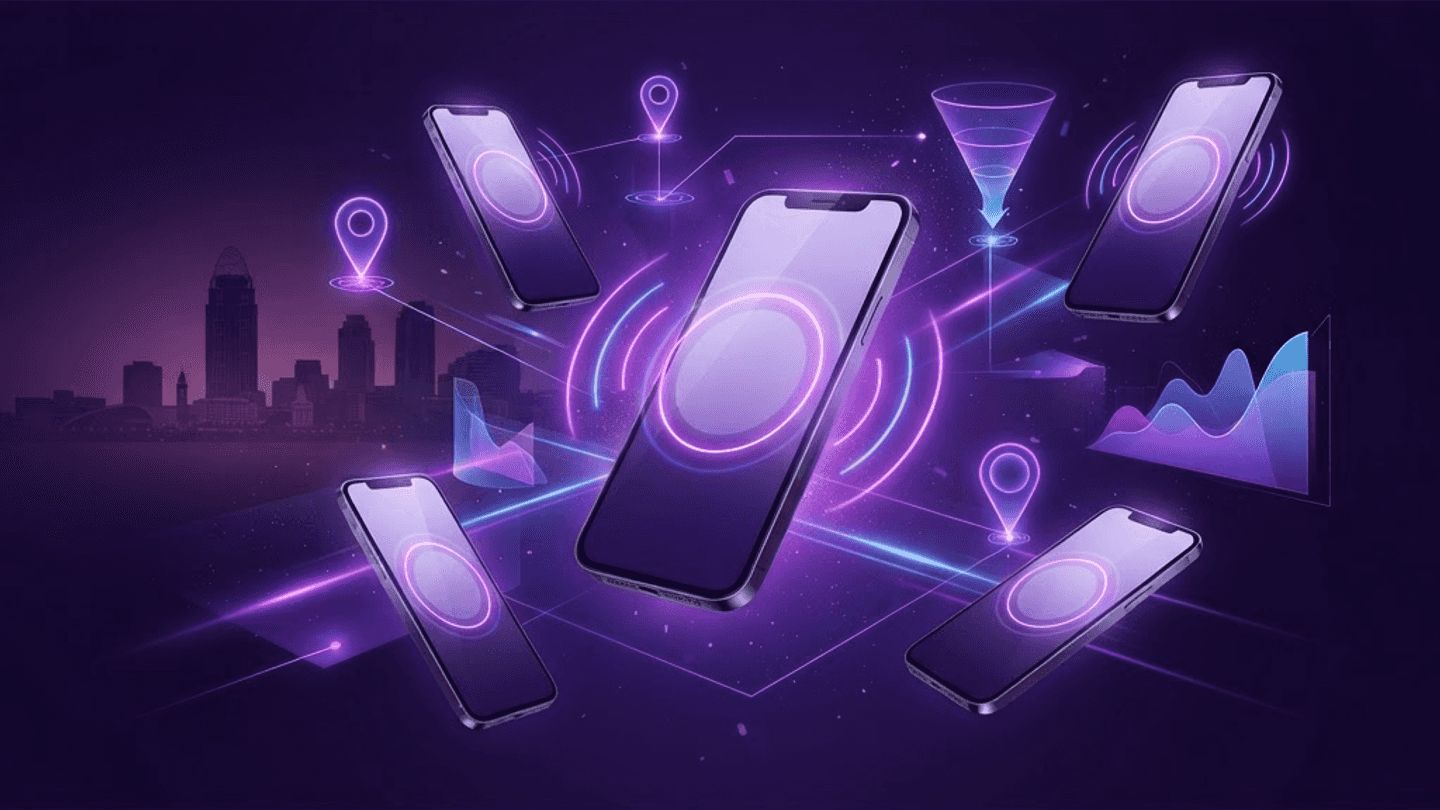
Why Mobile Marketing Matters in the Cincinnati Market
The majority of local search, social browsing, and increasingly checkout activity in the Cincinnati metro happens on phones. For restaurants, retailers, healthcare providers, and service businesses, the mobile experience is effectively the storefront. A slow mobile site, a broken map link, or an unclaimed local listing costs measurable revenue every day. Specialist firms exist because doing mobile well requires a combination of technical performance work, channel expertise, and creative built for small screens and short attention.
Cincinnati's geography adds a specific wrinkle. The metro spans three states, and consumers routinely cross state lines for work, shopping, and entertainment. Location-based targeting, radius bidding, and store-level attribution therefore require careful configuration to avoid wasted spend and confused messaging.
1. Empower Media Marketing
Empower is one of the region's larger independent media agencies, with substantial capability in mobile and cross-device planning. The team's strength is media strategy at scale: allocating budget across mobile video, in-app inventory, connected devices, and search while measuring incremental effect. For advertisers with meaningful budgets, this planning discipline typically produces better returns than optimizing individual channels in isolation.
2. Ahalogy Heritage Mobile Content Teams
Cincinnati produced notable expertise in mobile content discovery, particularly around visual platforms where users browse for ideas and inspiration. Practitioners from this lineage understand how mobile content earns distribution through platform algorithms rather than paid placement alone. Their work suits consumer brands in food, home, beauty, and family categories where inspiration precedes purchase.
3. SMS and Conversational Messaging Specialists
A distinct group of Cincinnati firms focuses on text messaging and conversational programs. Work includes list growth, compliance with consent regulations, segmentation, automated flows, and integration with point-of-sale and loyalty systems. Messaging delivers unusually high engagement, which makes discipline essential; over-messaging destroys a list quickly. Good specialists focus on frequency governance and value per message rather than volume.
4. App Marketing and User Acquisition Practices
Several local teams concentrate specifically on mobile app growth. Services include app store optimization, paid user acquisition across mobile ad networks, onboarding and retention analysis, push notification strategy, and lifetime value modeling by acquisition source. This is a quantitative discipline in which cohort analysis matters more than creative volume. Firms that report on retention curves and payback periods rather than install counts are the credible ones.
5. Local Search and Mobile Presence Agencies
For multi-location businesses, mobile marketing begins with accurate local presence. Cincinnati agencies in this space manage business listings across map and directory platforms, review generation and response, location page architecture, and structured data. The work is unglamorous but produces reliable returns, since a customer searching for a nearby provider on a phone converts at a high rate when the listing is accurate and the reviews are current.
6. Rockfish Style Digital Product and Commerce Teams
Cincinnati's digital commerce heritage produced firms that treat mobile as a product problem rather than a media problem. These teams optimize mobile checkout flows, implement progressive web app patterns, improve page performance, and reduce friction in the purchase path. Because a one-second improvement in mobile load time can move conversion measurably, this technical work often delivers more revenue than incremental ad spend.
7. Location Intelligence and Geofencing Providers
Firms specializing in location data build audiences from observed movement patterns, run geofenced campaigns around venues and competitors, and measure store visitation lift. In a tri-state metro with distinct suburban clusters, this precision is valuable for automotive dealers, healthcare systems, entertainment venues, and quick-service restaurants. Reputable providers are transparent about data sources and consent, an area where quality varies widely across the industry.
8. Mobile Creative and Motion Studios
Creative built for desktop rarely performs on mobile. Cincinnati supports studios that produce vertical video, sound-off-first editing, thumb-stopping opening frames, and platform-native formats at the volume modern testing requires. Their production models are built for iteration, generating many variants efficiently rather than one polished asset. Brands running continuous social and video campaigns depend on this throughput.
9. Retail Media and Shopper App Specialists
Given the region's retail concentration, several firms focus on advertising within retailer apps and mobile properties. This includes sponsored product placement, in-app coupon distribution, retailer loyalty audience targeting, and measurement against retailer sales data. For consumer goods manufacturers, retail media on mobile now represents a substantial share of trade and marketing investment, and it requires specific platform knowledge.
10. Full-Service Digital Agencies with Mobile Depth
Many Cincinnati digital agencies deliver mobile work as part of integrated programs. The advantage is coherence: the same team maintains the website, runs the paid media, manages the email and SMS programs, and reports on the combined effect. For mid-sized businesses without internal marketing staff, this consolidated model is usually more effective than assembling several specialists, provided the agency demonstrates genuine mobile competence rather than treating it as an afterthought.
How to Evaluate a Mobile Marketing Partner
Start with measurement. Ask precisely how the firm attributes mobile activity to outcomes and how it handles the well-known limitations of mobile tracking. Firms that acknowledge measurement constraints and use incrementality testing are more trustworthy than those promising perfect attribution.
Insist on a mobile performance audit before campaign work begins. Driving traffic to a slow or awkward mobile experience wastes budget regardless of targeting quality. For messaging programs, verify compliance practices around consent capture, opt-out handling, and record keeping, because penalties in this area are significant. Finally, review creative examples on an actual phone rather than in a desktop presentation.
Trends to Watch
Privacy changes across mobile operating systems continue to reduce third-party tracking, pushing sophisticated firms toward first-party data, server-side measurement, and modeled attribution. Short vertical video has become the default performance format across platforms. Messaging channels are consolidating into conversational commerce, where customers browse, ask questions, and purchase without leaving the thread. And on-device machine learning is enabling personalization that does not require sending behavioral data to servers, which will gradually change how targeting is built.
Final Thoughts
Mobile is no longer a channel to be added onto a marketing plan; in the Cincinnati market it is where most customer relationships begin. The firms worth hiring treat it as a full system spanning site performance, local presence, media, messaging, and measurement. Choose a partner who audits the experience before spending on traffic, and the results will compound.