
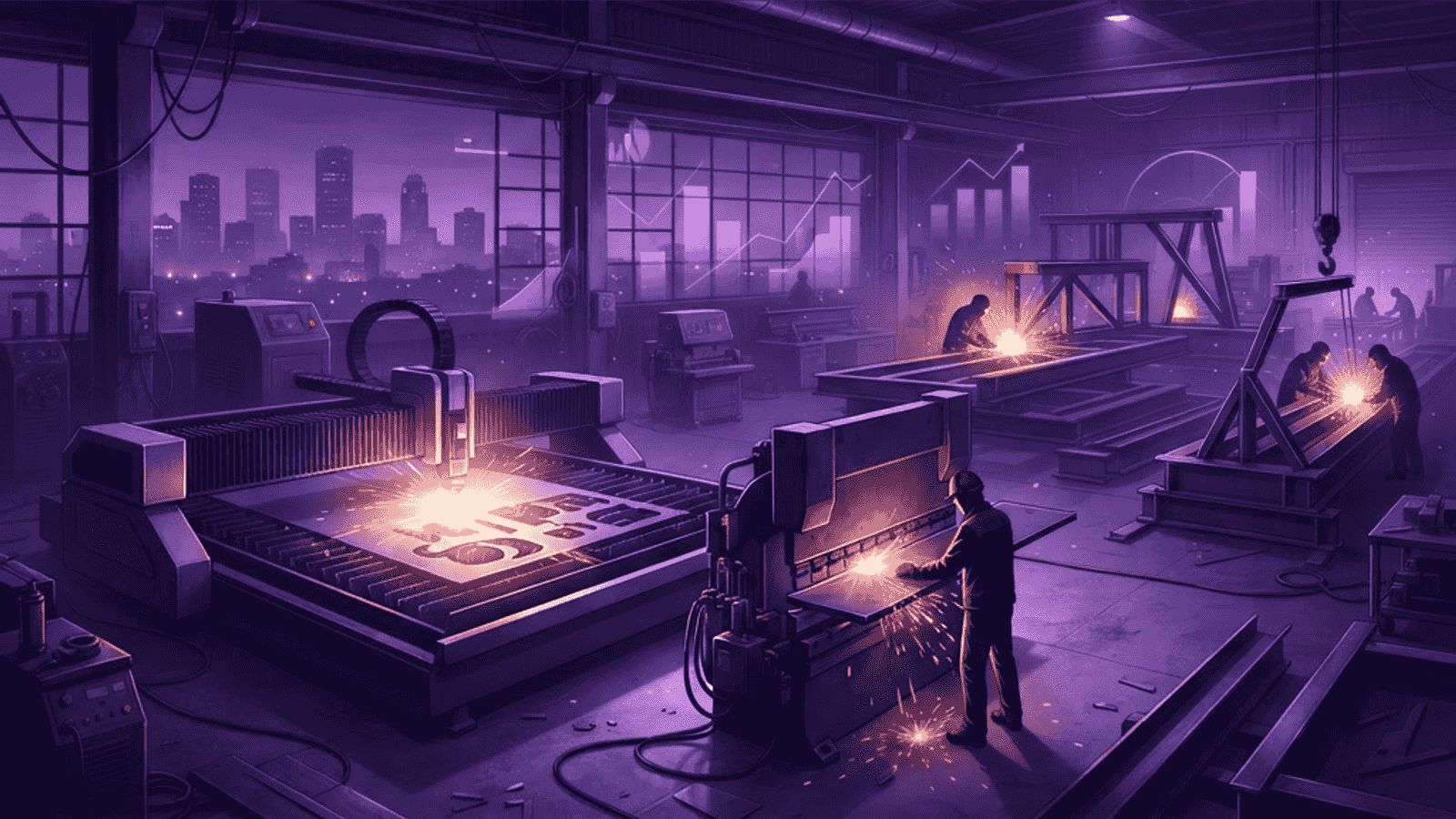
Metalworking Is Wichita's Industrial Backbone
Strip away the aircraft and what remains in Wichita is metal: machined fittings, formed skins, welded assemblies, stamped brackets, and finished components produced to tolerances most industries never require. The city's metalworking base developed under aerospace pressure, and that heritage shows in how local shops approach documentation, inspection, and process control.
Because aerospace demand fluctuates, Wichita metalworkers learned to diversify. The same shops now serve agriculture, energy, food processing, medical equipment, architectural construction, and general industry. That diversity benefits buyers, since a supplier accustomed to aerospace scrutiny brings unusual rigor to comparatively ordinary parts.
Capabilities Found in the Local Market
The metro offers computer-controlled milling and turning, multi-axis and large-envelope machining, laser and waterjet cutting, turret punching, press brake forming, roll forming, spinning, stamping with in-house die work, welding across steel, stainless, and aluminum, tube bending and fabrication, heat treating, plating and anodizing, powder coating, precision grinding, and assembly with functional testing.
Certifications matter here. AS9100 signals aerospace quality management maturity, Nadcap accreditation covers special processes such as heat treating and nondestructive testing, and welding certifications under recognized codes govern structural work. For pressure or structural applications, verifying the specific certification scope, not just the certificate's existence, is essential.
Top 10 Metalworks Companies in Wichita
1. Air Capital Precision Machining. A multi-axis machining house producing complex aerospace components from aluminum, titanium, and high-temperature alloys. Coordinate measuring machine inspection, tool path simulation, and disciplined first-article documentation support its work on tightly controlled programs.
2. Kansas Sheet Metal Fabrication. Combining laser cutting, turret punching, forming, and welding to build enclosures, panels, chassis, and brackets. Nesting efficiency and precise bend sequencing keep both material waste and lead times low.
3. Prairie Welding and Structural Fabrication. A heavy fabricator producing frames, platforms, tanks, and structural weldments under qualified welding procedures. Certified welders, fixture-based repeatability, and nondestructive testing capability serve demanding structural applications.
4. Sedgwick Stamping and Tool. Producing stamped components using progressive and compound dies, backed by an in-house tool and die shop. Fast die repair and design iteration reduce downtime that would otherwise stall a production line.
5. Cowtown Metal Finishing. Providing anodizing, plating, chemical conversion coating, passivation, and powder coating. Controlled bath chemistry, thickness verification, and corrosion testing make it a trusted final step in aerospace and industrial supply chains.
6. Midwest Waterjet and Laser Cutting. Specializing in precision cutting of thick plate, exotic alloys, composites, and heat-sensitive materials. No heat-affected zone on waterjet work and fast turnaround on flat parts serve both prototype and production needs.
7. Flint Hills Tube and Pipe Fabrication. Bending, forming, and welding tube and pipe assemblies for hydraulic, pneumatic, and structural applications. Mandrel bending, cleanliness control, and pressure testing produce assemblies that install correctly the first time.
8. Heartland Architectural Metals. Fabricating railings, canopies, storefronts, decorative panels, and ornamental metalwork for commercial construction. Field measurement, finish consistency across large installations, and coordination with general contractors define its strengths.
9. Wichita Grinding and Heat Treating. Offering precision surface and cylindrical grinding along with heat treating services. Furnace uniformity surveys, hardness verification, and tight geometric control support components requiring both hardness and accuracy.
10. Plains Assembly and Machining Group. A build-to-print supplier combining machining, fabrication, kitting, and mechanical assembly. Delivering complete assemblies rather than loose parts reduces the coordination burden on customer engineering teams.
Trends in Metal Manufacturing
Automation continues to spread through mid-sized shops. Robotic welding cells, automated bending, pallet-fed machining centers, and lights-out night shifts increase throughput without proportional labor increases, which matters in a tight labor market.
Digital thread adoption is accelerating. Model-based definition, in-process probing, automated inspection reporting, and digital traceability improve both quality and auditability. Buyers increasingly expect inspection data delivered electronically rather than as scanned paper.
Additive manufacturing has found practical footholds too, particularly for tooling, fixtures, and low-volume complex geometries. Rather than replacing machining, it complements it, reducing fixture lead times and enabling designs that would be impractical to cut.
How to Evaluate a Metalworks Supplier
Match capability to your part envelope precisely. Confirm machine travels, table capacities, press tonnages, brake lengths, cutting thicknesses, and crane capacity. A shop that must subcontract half your operations introduces schedule risk and margin stacking.
Scrutinize the quality system in action. Ask for a sample inspection report, learn how gauges are calibrated, review how nonconformances are handled, and check whether measurement uncertainty is understood. For critical parts, confirm the specific certification scope covers your processes.
Discuss material sourcing and traceability. Where does metal come from, how are heat numbers tracked, and can certifications be produced on demand? For aerospace and pressure work, that documentation is not optional.
Finally, test responsiveness during quoting. Shops that ask clarifying questions, suggest tolerance relaxations that cut cost, and flag manufacturability issues at quote stage generally behave the same way during production. That engineering partnership is where the real savings live.
Final Thoughts
Wichita's metalworks companies deliver aerospace-grade discipline across a wide range of industries, supported by dense local capability in machining, fabrication, finishing, and specialty processes. For buyers, that means a part can often move through every required operation within the same metro, cutting freight, lead time, and coordination overhead. Define tolerances and certifications clearly, visit the floor, and choose shops whose engineering instincts match the demands of your product.