
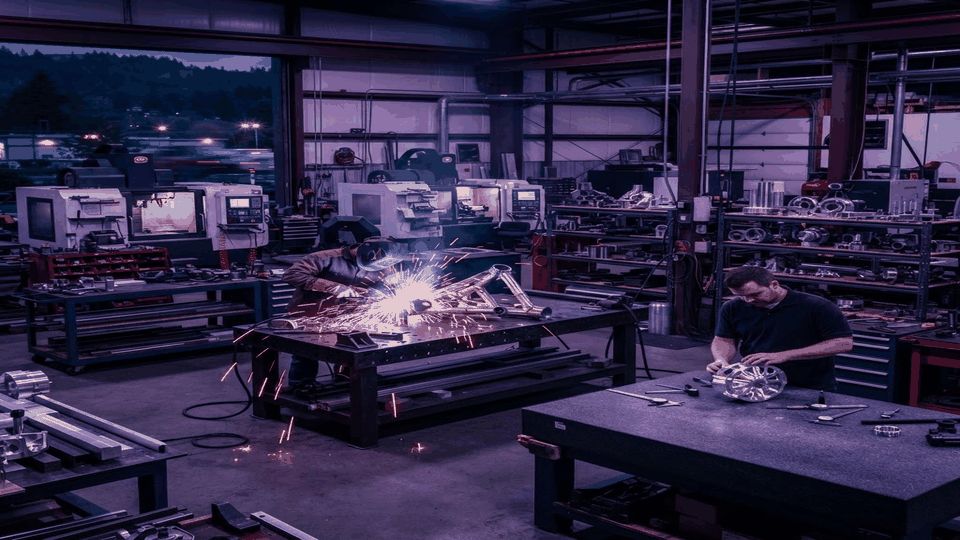
A State Built on Metalworking Skill
Few states offer Washington’s combination of aerospace production, shipyards, hydropower infrastructure, and architectural growth. These industries sustain a broad supplier base, from highly automated machining companies to artisan architectural fabricators. Quality certifications matter, but buyers should also assess equipment fit, engineering communication, inspection capacity, and delivery history.
1. Janicki Industries
Sedro-Woolley-based Janicki Industries provides large-scale tooling, precision machining, fabrication, and composite manufacturing. Its ability to produce very large, complex structures distinguishes it in aerospace, marine, defense, and energy markets. Advanced equipment, metrology, and multidisciplinary engineering allow Janicki to manage projects that exceed the capacity of typical machine shops.
2. Exotic Metals Forming Company
Exotic Metals Forming, a Parker Aerospace company in Kent, specializes in complex sheet-metal components and assemblies for aircraft and engines. Its work requires forming difficult alloys, precision welding, repeatable inspection, and rigorous traceability. Deep aerospace experience makes it a notable supplier for programs where process control is critical.
3. Skills Inc.
Skills Inc. in Auburn provides machining, sheet metal, fabrication, finishing coordination, and assembly for aerospace and other industries. The company is also recognized for an inclusive workforce mission. Its broad service mix can reduce handoffs, while established quality systems support customers with demanding documentation needs.
4. Machinists Inc.
Seattle-based Machinists Inc. handles large-part machining, welding, engineering, and industrial repair. Its equipment capacity is valuable for marine, energy, research, and heavy-industrial projects that cannot be accommodated by smaller shops. The ability to combine field understanding with in-house machining is a practical differentiator.
5. Vigor
Vigor operates major shipbuilding, repair, and fabrication facilities in the Pacific Northwest, including Harbor Island in Seattle. Its metalworking capabilities support ferries, commercial vessels, defense work, bridges, and infrastructure. Heavy lift capacity, waterfront access, and experience coordinating complex projects distinguish Vigor from general fabricators.
6. Seattle City Light Fabrication Partners
Specialized regional fabricators serving utilities produce gates, structural assemblies, platforms, and components for hydropower and electrical infrastructure. These shops must understand protective coatings, field installation, weld procedures, and public-project documentation. Their work is central to maintaining Washington’s extensive hydroelectric system.
7. Pacific Fishermen Shipyard
Pacific Fishermen Shipyard in Seattle provides vessel repair and metal fabrication for the North Pacific fishing fleet and other marine customers. Marine work demands fast problem solving, corrosion awareness, and the ability to complete repairs during limited vessel windows. Practical service and location near the working waterfront are significant advantages.
8. Western Integrated Technologies Fabrication
Kent-area industrial suppliers such as Western Integrated Technologies combine fabricated components with hydraulic and motion-control expertise. Integrating mechanical systems, controls, and metal assemblies can reduce coordination risk for custom machinery and industrial upgrades.
9. Architectural Elements
Washington’s architectural metal shops create stairs, railings, canopies, screens, and custom features for Seattle’s residential and commercial projects. The best firms coordinate shop drawings, finish samples, structural requirements, field measurements, and installation. Their value lies in translating design intent into code-compliant, buildable details.
10. Spokane Industries
Spokane Industries is known for foundry products, steel castings, and engineered components used in mining, construction, and industrial applications. Casting expertise is valuable when parts require complex geometry, wear resistance, or production at scale. Metallurgy, pattern development, heat treatment, and inspection are key selection factors.
How to Qualify a Metalworking Company
Send complete drawings, material specifications, tolerances, weld requirements, finish standards, quantities, and inspection expectations. Ask the shop to identify risks before quoting. Review calibration, material traceability, nonconformance procedures, and subcontractor control for heat treatment or coatings.
Capacity should match the job. A highly capable aerospace shop may be unnecessarily expensive for simple railing, while a general fabricator may not have the controls required for flight hardware. Site access also matters: Seattle waterfront work, Spokane industrial projects, and remote hydro facilities involve very different logistics. The best partner is the company whose processes, equipment, and communication align with the actual risk of the project.