
Metal Fabrication as a Regional Backbone
Metalworking is one of the quiet foundations of the St. Louis economy. The region's long history in aerospace, automotive assembly, brewing equipment, rail, barge traffic, and heavy agriculture created generations of tool and die makers, welders, machinists, and fabricators. That workforce did not disappear when individual plants closed; it dispersed into a dense network of independent job shops, custom fabricators, and precision machining businesses spread across the metro area and the surrounding counties on both sides of the river.
For buyers, this density matters. A company needing a weldment, a machined housing, a stainless enclosure, or a run of formed brackets can usually find several qualified shops within a short drive. Proximity shortens design iteration cycles, makes in-person first-article reviews practical, and removes the freight penalty that heavy steel parts otherwise carry.
The Core Disciplines
Metalworks is not a single trade. Understanding the distinctions helps buyers approach the right kind of shop.
Sheet metal fabrication covers laser or plasma cutting, punching, press brake forming, hardware insertion, and finishing. Typical output includes enclosures, panels, brackets, chassis, guards, and ductwork. Tolerances are governed largely by bend accuracy and material springback.
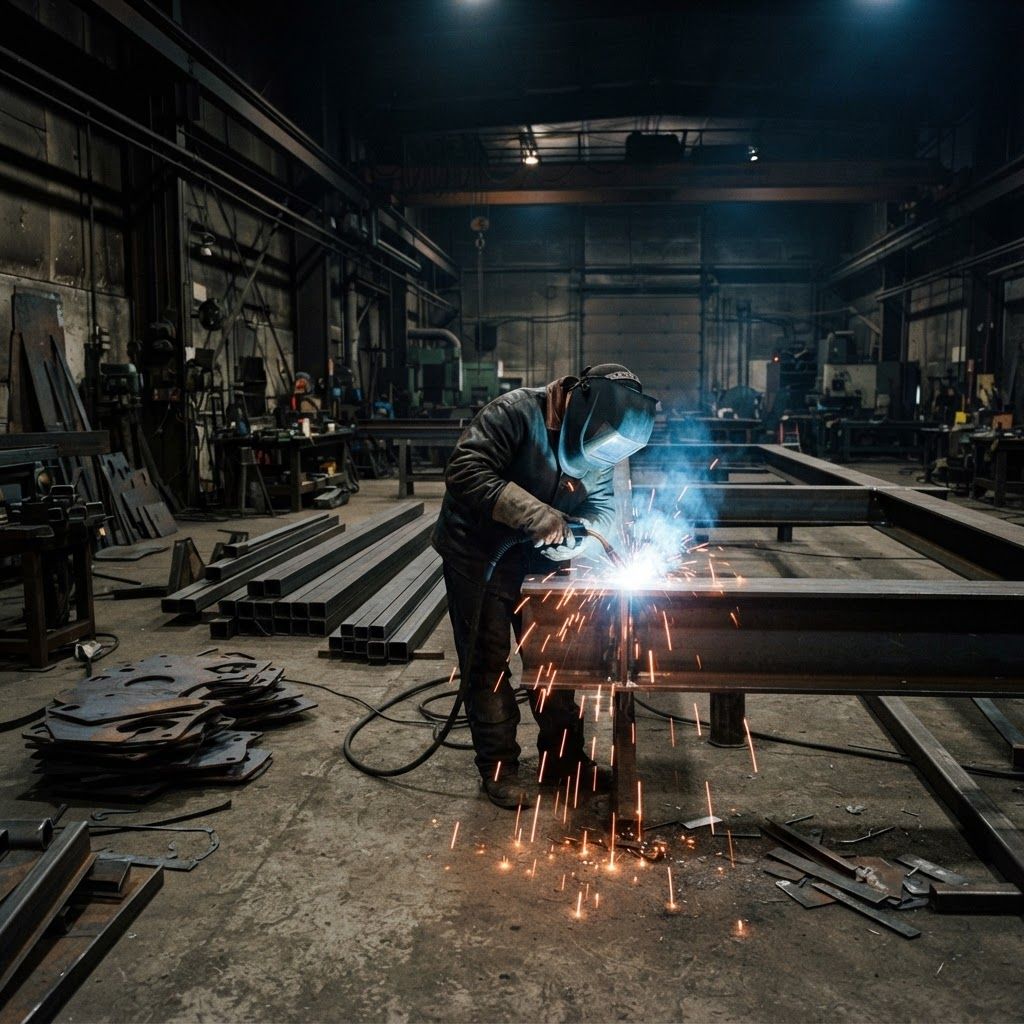
Structural and heavy fabrication handles beams, frames, skids, platforms, tanks, hoppers, and equipment bases. These shops need overhead crane capacity, large weld positioners, and the floor space to assemble oversized pieces.
Precision machining uses CNC mills, lathes, and multi-axis machining centers to hold tight tolerances on individual components. Shops serving aerospace and medical customers routinely work in thousandths of an inch with full inspection documentation.
Welding and joining specialists focus on MIG, TIG, stick, robotic welding, and sometimes exotic processes. Stainless and aluminum welding for food, pharmaceutical, and sanitary applications is a distinct skill set requiring specialized procedures and cleanliness discipline.
Architectural and ornamental metalwork produces railings, stairs, canopies, storefronts, decorative screens, and restoration pieces. Given the region's historic building stock, ornamental restoration is a meaningful niche.
Finishing and coating operations provide powder coating, wet paint, plating, anodizing, passivation, graining, and polishing, either in-house or through tightly managed partners.
Signals of a Genuinely Capable Shop
The gap between an average fabricator and an excellent one shows up in process discipline rather than equipment brochures.
Quality system maturity. A documented quality management system, controlled work instructions, calibrated inspection equipment, and a coordinate measuring machine for dimensional verification indicate a shop that can repeat results across production runs rather than heroically producing one good prototype.
Certified welding procedures. For structural or pressure-related work, ask about qualified welding procedure specifications, certified welder qualifications, and whether the shop's certifications are current. For critical joints, request nondestructive testing capability or a relationship with a testing lab.
Industry-specific credentials. Aerospace, defense, medical, and food equipment customers each impose their own requirements, from aerospace quality standards to sanitary design conventions. A shop already audited for your industry drastically shortens onboarding.
Engineering and design-for-manufacture input. The most valuable fabricators review a drawing and propose changes that cut cost: consolidating parts, adjusting a bend radius, changing a tolerance that adds machining time without adding function, or switching to a more available alloy. That feedback often saves more than a lower hourly rate.
Material sourcing strength. Established mill and service center relationships determine whether a shop can get plate, tube, or a specific stainless grade when supply tightens. Shops that stock common material for their repeat customers deliver noticeably faster.
Programming and nesting sophistication. Modern nesting software and offline programming reduce scrap and setup time. On sheet metal work, material utilization is a major cost lever, and a shop that tracks its yield is usually a shop that manages cost well.
Trends Reshaping Metalworking
Automation is the dominant story. Fiber lasers cut faster and cleaner than older CO2 systems, automated tower storage feeds machines with minimal handling, and robotic welding cells deliver consistency that manual welding cannot match on repetitive parts. Shops that invested in these systems can quote competitively on medium-volume work that previously moved offshore.
Reshoring has reinforced that trend. Supply chain disruptions taught many manufacturers that a distant low-cost supplier can be expensive when a line stops waiting for parts. Regional fabricators with responsive lead times have picked up programs that left the country years ago.
The skilled trades pipeline remains the sector's central constraint. Welders, machinists, and press brake operators with real judgment take years to develop. The strongest shops run apprenticeships, partner with regional technical colleges, and invest in retention because their capacity is ultimately limited by people, not machines.
Additive manufacturing has also found a practical role, not as a replacement for fabrication but for tooling, fixtures, jigs, and rapid prototypes that accelerate the path to production tooling.
Running an Effective Sourcing Process
Send complete information. A quote based on a dimensioned drawing, a 3D model, material and finish specification, tolerance callouts, quantity, and expected annual volume will be far more accurate than one based on a sketch. Ambiguity gets priced as risk.
Tour the floor before awarding significant work. Watch whether work-in-process is organized and labeled, whether inspection happens at the machine or only at final, and whether operators reference documented instructions. Ask how the shop handles a nonconformance and request an example of a corrective action.
Discuss capacity honestly. Ask what percentage of the shop's capacity your program would consume and what else is scheduled during your delivery window. A shop that admits it is tight in a given month is more trustworthy than one that promises everything.
Start with a first-article or pilot run, inspect it thoroughly against the drawing, and treat that exercise as the real interview. Then evaluate total cost including freight, finishing, packaging, tooling amortization, and the internal cost of any rework you would absorb.
Final Thoughts
The St. Louis metalworks community combines legacy craftsmanship with modern automation, and it serves everything from architectural restoration to precision aerospace components. Buyers who supply clear specifications, verify quality systems, and treat fabricators as engineering collaborators consistently get better parts at better prices. Judge shops on process control, certifications, engineering input, and delivery honesty, and the region's strongest fabricators become easy to identify.