
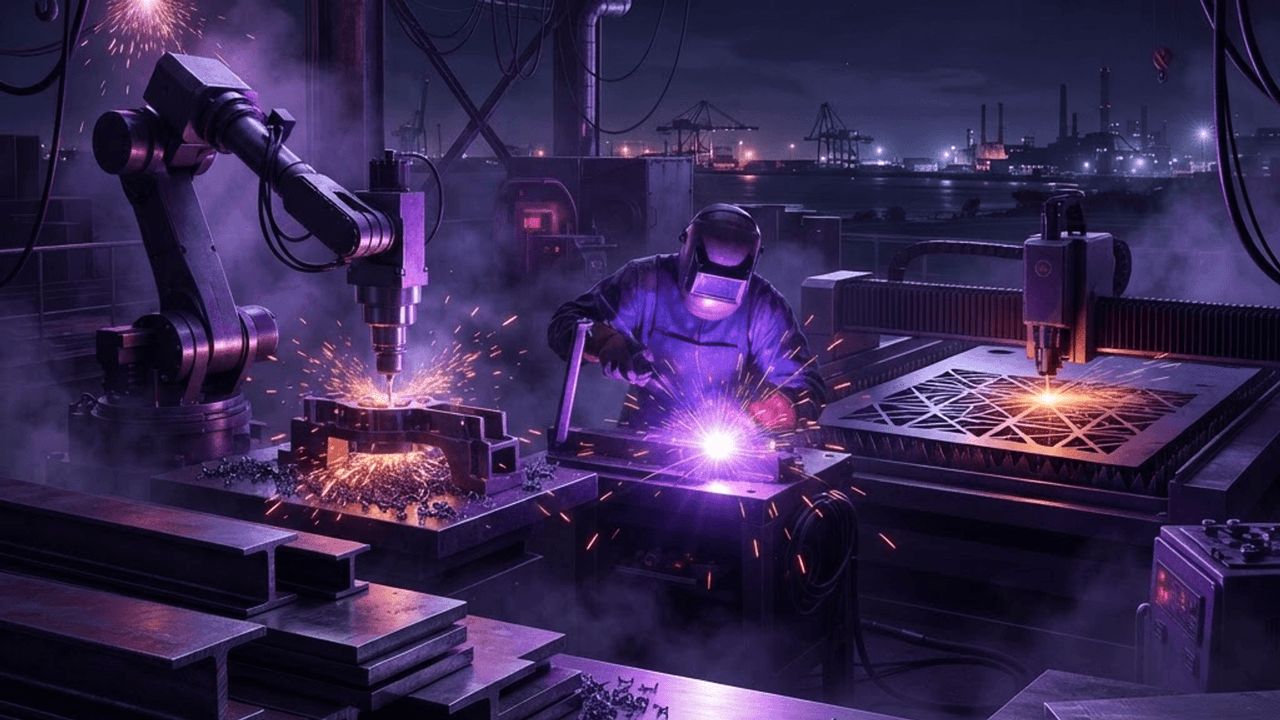
Metalworking as a Foundational Trade
Metal fabrication underpins construction, manufacturing, marine operations, and infrastructure maintenance. In Oceanside, the sector ranges from heavy structural shops producing building steel to precision machining operations holding tolerances measured in thousandths of an inch, with architectural metal studios and marine specialists occupying distinct niches in between.
Coastal conditions add a persistent variable. Salt exposure accelerates corrosion dramatically, which makes alloy selection, welding procedure, and protective finishing more consequential here than in dry inland environments. Shops that work regularly on marine and exterior projects build this into their standard practice.
The Core Capability Areas
Structural fabrication produces beams, columns, stairs, railings, platforms, and frames, typically working from engineered drawings with welding performed to established codes and verified by inspection.
Precision machining removes material from stock to produce components with defined tolerances, using CNC milling, turning, and increasingly multi-axis equipment that produces complex geometry in single setups.
Sheet metal fabrication cuts, bends, and assembles thinner material into enclosures, ducting, panels, and housings. Laser and plasma cutting have made complex profiles routine and inexpensive.
Welding and repair services address both new construction and the maintenance of existing equipment, frequently performed in the field rather than in a shop. Finishing operations including powder coating, galvanizing, anodizing, and polishing complete the process and determine service life in exposed applications.
Ten Metalworks Companies Serving Oceanside
Harbor Structural Steel fabricates and erects structural steel for commercial construction, including stairs, railings, and miscellaneous metals packages.
Pacific Precision Machining operates CNC milling and turning equipment for components requiring tight tolerances and documented inspection.
Coastline Marine Metalworks specializes in stainless and aluminum fabrication for vessels and dock structures, with welding procedures qualified for marine service.
Meridian Sheet Metal produces enclosures, panels, brackets, and ducting from laser-cut and formed sheet with in-house finishing.
Northgate Architectural Metals creates decorative and functional architectural elements including gates, screens, handrails, and feature stairs.
Blue Anchor Welding Services provides mobile welding and repair for equipment, structures, and vehicles at customer locations.
Tidewater Powder Coating offers surface preparation and powder coating with pretreatment processes suited to coastal corrosion exposure.
Summit Metal Supply and Cutting stocks bar, plate, tube, and sheet with cut-to-size service for fabricators and maintenance operations.
Vista Custom Fabrication handles one-off and small-batch fabrication projects, working from sketches through finished assemblies with design assistance.
Anchor Industrial Machining serves equipment repair needs with shaft work, bearing fits, keyway cutting, and replacement part reproduction from worn samples.
Trends in Metal Fabrication
Automation has reshaped shop economics. Fiber laser cutting, press brake automation, and robotic welding have improved consistency and reduced lead times, while raising the importance of accurate digital files. Shops that accept native CAD data and nest parts efficiently deliver better pricing than those working from printed drawings.
Multi-axis machining has consolidated operations that previously required multiple setups, improving accuracy while reducing handling and cost. This matters most for complex parts where each additional setup introduced positional error.
Material traceability has become standard for structural and regulated work, with mill certifications tracked through fabrication. Welder qualification documentation is likewise routinely requested rather than assumed.
Additive manufacturing in metal has entered the field for specific applications, particularly complex low-volume parts and tooling, though conventional processes remain more economical for the majority of work.
How to Select a Metalworking Partner
Match capability to requirement. A structural shop and a precision machining operation are different businesses with different equipment, tolerances, and inspection practices. Asking either to perform the other's work produces poor results.
Verify welding qualifications when structural or pressure-containing work is involved. Certified procedures and qualified welders are the difference between a compliant installation and a liability. Ask for documentation rather than assurances.
Discuss material selection for the environment. In coastal exposure, the choice between carbon steel with coating, galvanized steel, aluminum, and stainless alloys determines maintenance obligation for decades. Be wary of dissimilar metal contact, which causes galvanic corrosion that can destroy a well-built assembly.
Review tolerance expectations explicitly. Specifying tighter tolerances than the application requires increases cost substantially, while under-specifying produces parts that do not fit. State what actually matters functionally.
Evaluate finishing capability and process. Surface preparation quality determines coating adhesion far more than the coating product itself, and shops that shortcut preparation produce work that fails early in coastal conditions.
Practical Project Advice
Provide complete information up front, including drawings with dimensions and tolerances, material specification, finish requirement, quantity, and delivery need. Incomplete information produces padded quotes because shops price uncertainty.
For repair and reverse engineering work, provide the original part when possible. Measuring a worn component and inferring original dimensions is a skill, and having the physical sample makes it far more reliable than photographs.
Final Thoughts
Metalworks companies in Oceanside span structural fabrication, precision machining, marine work, sheet metal, architectural metal, mobile welding, finishing, and supply. Selecting well means matching shop capability to the specific work, verifying qualifications for safety-critical fabrication, and treating alloy and finish selection as a durability decision rather than a cosmetic one.