
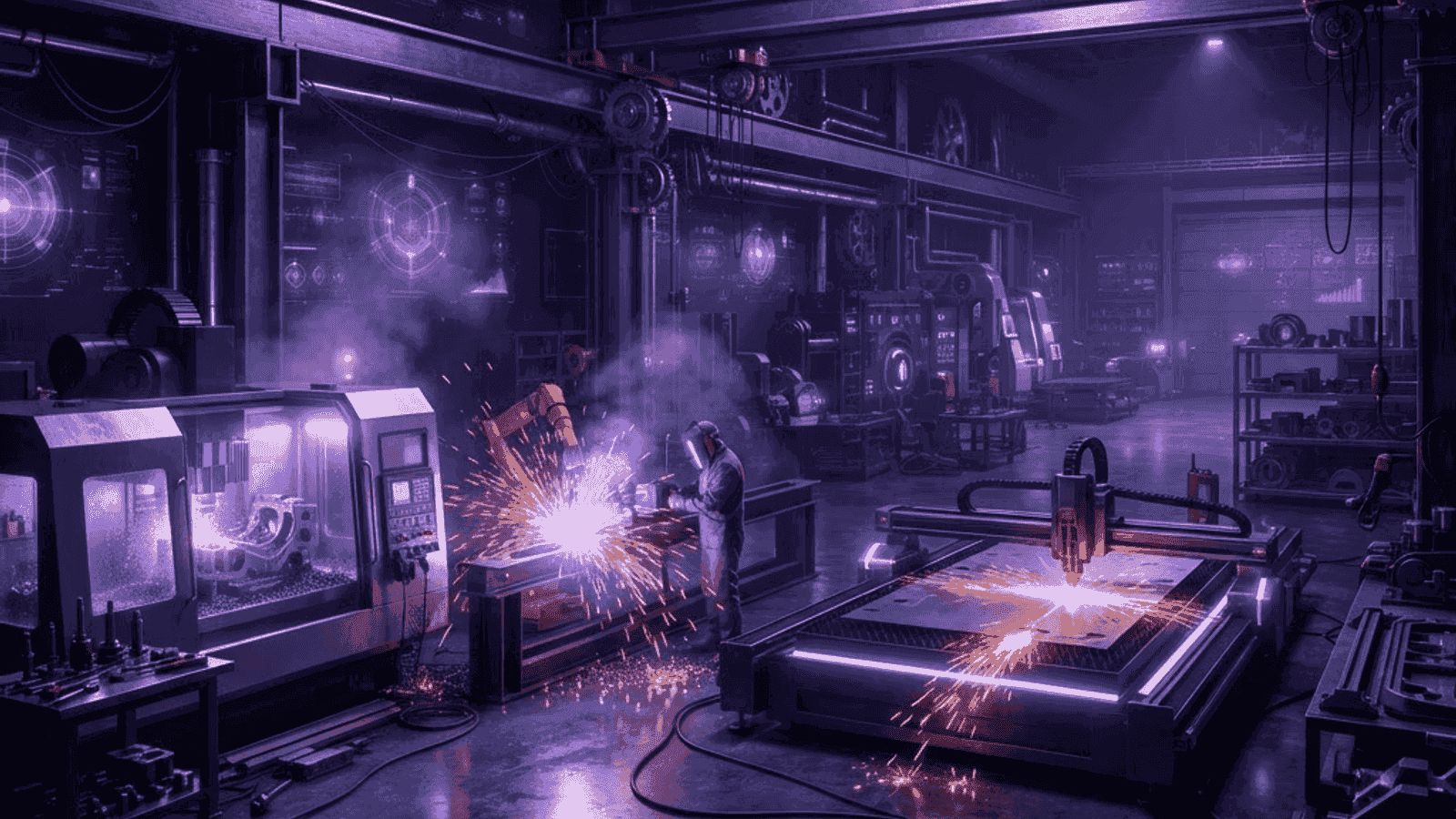
A City Built on Metal
Metalworking is among Oakland's oldest industries, and it never left. Shipbuilding, rail, and heavy manufacturing established a base of skilled fabricators, welders, and machinists whose knowledge passed down through generations and apprenticeships. Today that legacy supports a modern industry serving construction, transportation, laboratory equipment, art, and consumer hardware.
The city's metalworks companies benefit from proximity to a dense customer base. Architects designing steel stairs, researchers needing custom vacuum fixtures, breweries requiring stainless tanks and piping, and artists fabricating large-scale sculpture can all reach a capable shop within a short drive. That accessibility matters, because metal fabrication is an iterative process where in-person review of a fit-up or weld often saves days of email.
Understanding the Metalworking Disciplines
The term metalworks covers distinct capabilities that rarely all exist in one building. Structural fabrication produces beams, columns, and connections to engineered drawings, requiring welding certification and often special inspection. Architectural metalwork focuses on visible elements such as railings, canopies, gates, and stairs, where finish quality and aesthetic consistency dominate.
Sheet metal fabrication involves laser or plasma cutting, punching, forming on press brakes, and assembly, ideal for enclosures, brackets, panels, and ductwork. Precision machining removes material from solid stock on lathes and mills to achieve tight tolerances, essential for mechanical components and tooling. Specialty disciplines include stainless sanitary welding for food and pharmaceutical use, blacksmithing and hot forging, and casting.
The Top 10 Metalworks Companies in Oakland
1. Ironbark Fabrication Works. A structural and miscellaneous metals fabricator, Ironbark produces stairs, platforms, mezzanines, and structural connections for commercial construction. Its differentiator is coordinated shop drawings and field measurement, which dramatically reduces installation rework on renovation projects where nothing is quite square.
2. Estuary Precision Machining. This shop serves scientific instrument, semiconductor equipment, and medical clients with multi-axis CNC milling and turning. Documented inspection processes, material certifications, and repeatable tight tolerances make it a fit for regulated and research-driven customers.
3. Broadway Architectural Metals. Focused on visible metalwork, Broadway fabricates railings, gates, storefronts, screens, and decorative panels in steel, bronze, and aluminum. Its finishing knowledge, spanning patinas, powder coat, and hot-dip galvanizing, allows designers to specify with confidence about long-term appearance.
4. Bayline Sheet Metal Company. Bayline handles laser cutting, forming, and assembly for enclosures, chassis, brackets, and panels. Fast prototype turnaround paired with production capability makes it a practical partner for hardware companies moving from first article to volume.
5. Mandela Welding & Repair. A service-oriented shop, Mandela performs on-site and in-shop repair welding on equipment, trailers, structural members, and industrial machinery. Its ability to respond quickly to breakdowns has made it a dependable resource for local manufacturers and fleet operators.
6. Peralta Stainless & Sanitary Fabrication. Specializing in food-grade and pharmaceutical stainless work, Peralta builds tanks, tables, hoods, and process piping with sanitary welds and passivation. Breweries, commercial kitchens, and food producers rely on it for work that must be genuinely cleanable, not just clean-looking.
7. Jack London Forge. This shop preserves traditional blacksmithing and hot forging alongside modern methods, producing hardware, ornamental ironwork, and restoration components. It is frequently engaged for historic building projects requiring elements no catalog carries.
8. Foothill Waterjet & Laser Cutting. Offering cutting services across metals, composites, and stone, Foothill supports other fabricators, artists, and manufacturers who need parts cut accurately without investing in equipment. Waterjet's cold cutting avoids the heat-affected zone that matters for certain alloys.
9. Lakeside Metal Finishing. Providing powder coating, plating, anodizing coordination, polishing, and passivation, Lakeside completes the process chain. Consistent color and thickness control, plus proper surface preparation, determine whether a finish lasts years or fails within months.
10. Redwood Heights Metal Art Studio. Serving artists and designers, this studio fabricates large-scale sculpture, installations, and custom furniture in metal. Its engineering support around anchoring, wind loading, and weathering turns concepts into installations that survive public environments.
Technology and Workforce Trends
Automation has changed the economics of fabrication. Fiber laser cutters, automated press brakes with offline programming, and robotic welding cells reduce setup time and improve consistency, allowing shops to quote smaller batches profitably. For customers, this means custom parts are more affordable than a decade ago.
Digital workflows matter equally. Shops that accept 3D models directly, nest parts algorithmically, and simulate bend sequences catch problems before cutting metal. Ask any prospective supplier how it handles model-based data, because shops still working from paper drawings often carry higher error rates and longer lead times.
Workforce development remains the industry's central constraint. Experienced welders and machinists are retiring faster than replacements enter the trade, so shops with active apprenticeship programs and strong retention offer more reliable long-term partnership. Turnover shows up as inconsistent quality.
How to Choose a Metalworks Partner
Match capability to your actual requirement. A structural fabricator will struggle with tenth-of-a-thousandth machining, and a precision machine shop is not equipped to erect a steel stair. Ask directly what percentage of the shop's work resembles your project.
Verify certifications where they matter, including welder qualifications for structural work and quality system documentation for regulated components. Request examples of comparable work and, ideally, tour the shop. Look at material storage, fixture organization, and whether inspection tools appear to be in regular use.
Clarify who owns the engineering. Some shops build strictly to your drawings; others provide design assistance and will improve manufacturability. Both models work, but confusion about responsibility for a dimension is a common source of dispute.
Final Thoughts
Oakland's metalworks companies represent an unusually complete industrial capability, from heavy structural steel to micron-level machining and gallery-quality architectural work. Their value comes not only from equipment but from accumulated judgment about how metal behaves when cut, heated, formed, and loaded. Selecting the shop whose specialty genuinely aligns with your project produces better results, fewer surprises, and a relationship worth keeping for the next job.