
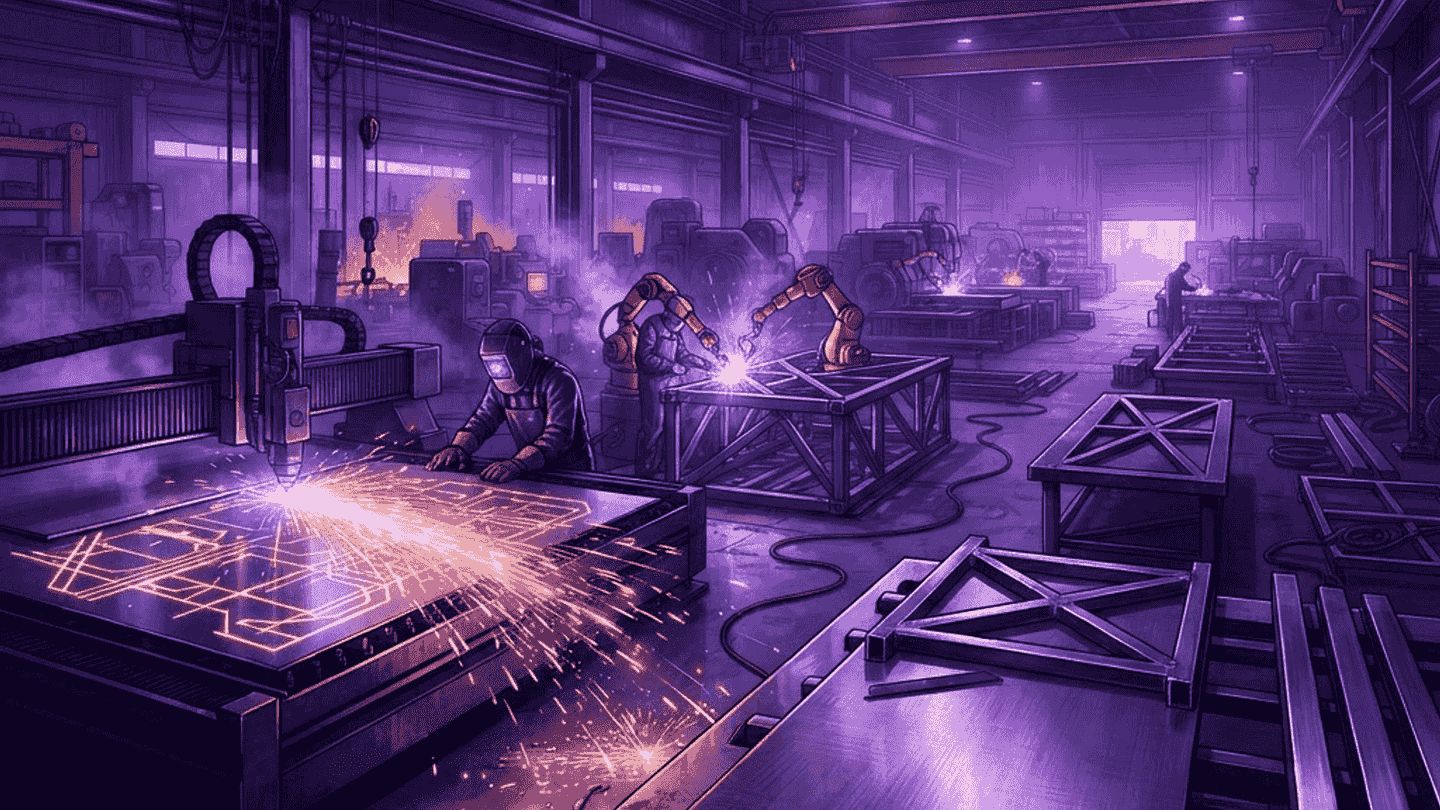
Metalworking Endures Where Other Industry Left
Much of Hudson County's heavy manufacturing base disappeared decades ago, but metalworking stayed. The reason is simple: metal fabrication is a service business as much as a production business. A stair railing, a custom bracket, a machine guard or a repaired conveyor frame cannot be efficiently ordered from another continent. It has to be measured on site, fabricated nearby and installed quickly. With thousands of residential units, commercial interiors and infrastructure projects under construction in and around Jersey City at any given time, local shops have steady demand for exactly the kind of work that cannot be commoditized.
The Range of Work Under One Label
Metalworks is a broad term covering distinct disciplines. Structural and miscellaneous metals fabrication produces stairs, ladders, embeds, lintels and support framing. Architectural metalwork covers railings, canopies, storefronts, cladding and decorative elements where finish quality is scrutinized at arm's length. Precision machining produces components to tolerances measured in thousandths of an inch. Sheet metal fabrication supports ductwork, enclosures and panels. Welding and repair services keep existing equipment and structures in service. Each requires different equipment, different skills and a different kind of quality control, and buyers save considerable frustration by identifying which category their project actually falls into.
Ten Metalworks Companies Serving Jersey City
Hudson Iron & Fabrication handles structural and miscellaneous metals for commercial construction, producing stairs, platforms and support steel. Field measurement accuracy and coordination with general contractors are the reasons it appears repeatedly on larger jobs.
Liberty Architectural Metals concentrates on visible work such as railings, canopies, feature stairs and metal cladding. Finish consistency across a large installation is difficult to achieve, and this is the shop's core competency.
Palisade Precision Machining operates CNC mills and lathes producing machined components for industrial, marine and equipment clients. Inspection documentation and repeatability define competitiveness in this niche.
Newport Laser & Waterjet provides cutting services in sheet and plate, including stainless and aluminum, serving other fabricators and manufacturers who need parts cut to file quickly.
Bergen Sheet Metal Works fabricates ductwork, enclosures, panels and custom sheet assemblies, supporting mechanical contractors and equipment manufacturers throughout the region.
Grove Street Welding Services specializes in mobile and shop welding repair, including structural repair, equipment restoration and stainless fabrication for food-service and laboratory environments.
Harborside Ornamental Ironworks serves the residential and restoration market with gates, fences, window guards and decorative ironwork, including matching historic profiles in the city's older neighborhoods.
Marion Metal Finishing supports the ecosystem with powder coating, polishing, passivation and galvanizing coordination, allowing fabricators to deliver completed finished assemblies rather than raw metal.
Journal Square Steel Supply functions as a service center, stocking bar, tube, angle, plate and sheet with cutting to length, which shortens lead times for shops that would otherwise wait on mill orders.
Hackensack Custom Fabrication completes the list as a general job shop taking on one-off and low-volume projects, the kind of work larger production shops decline but that keeps facilities and equipment operating.
Technology Has Raised the Baseline
Fiber laser cutting, CNC press brakes with automatic tooling, robotic welding cells and three-dimensional modeling have transformed what a mid-size shop can produce. Parts that once required manual layout and skilled hand-forming are now cut and formed from digital files with near-perfect repeatability. The practical implication for buyers is that a well-equipped shop can often deliver a more complex design at lower cost than a simplified one, because complexity in software is free while manual labor is not. It also means that providing accurate digital files rather than sketches materially reduces quoted price and lead time.
How to Assess Fabrication Quality
Look at welds first. Consistent bead profile, absence of undercut and spatter, and clean grinding where required indicate skilled welders and real supervision. Ask about welder certifications and whether procedures are qualified for the code governing your work. Check flatness and squareness on sample assemblies, since distortion from heat input is the most common defect in fabricated steel. For architectural work, inspect finishes under raking light rather than head-on, which is how the installation will actually be viewed. Ask how the shop handles field fit issues, because on renovation projects existing conditions are never exactly as drawn and the willingness to send a crew back is what separates a good vendor from a dispute.
Practical Advice on Scheduling and Cost
Fabrication cost is driven by labor hours, not material weight, which surprises many first-time buyers. Reducing the number of separate pieces, standardizing hole sizes, avoiding unnecessary tight tolerances and allowing standard mill finishes where appearance does not matter all reduce price substantially. On schedule, remember that finishing operations such as galvanizing and powder coating are often outsourced and add a week or more that is invisible in a fabrication-only quote. Confirm whether the quoted lead time includes finishing and delivery. For projects requiring site installation, verify that the shop carries its own installation crew or has a long-standing installer, since handoffs between separate fabrication and installation parties are where accountability tends to disappear.
Selecting the Right Shop
The best metalworks companies in Jersey City tend to be candid about what they do not do. A precision machining shop that declines an architectural railing job, or an ornamental shop that refers a structural project elsewhere, is demonstrating exactly the judgment you want. Match your project category to a shop's specialty, provide the best drawings you can, visit the facility before committing to a large order, and treat responsiveness during quoting as a preview of responsiveness during production. In fabrication, communication quality and delivered quality correlate closely.