
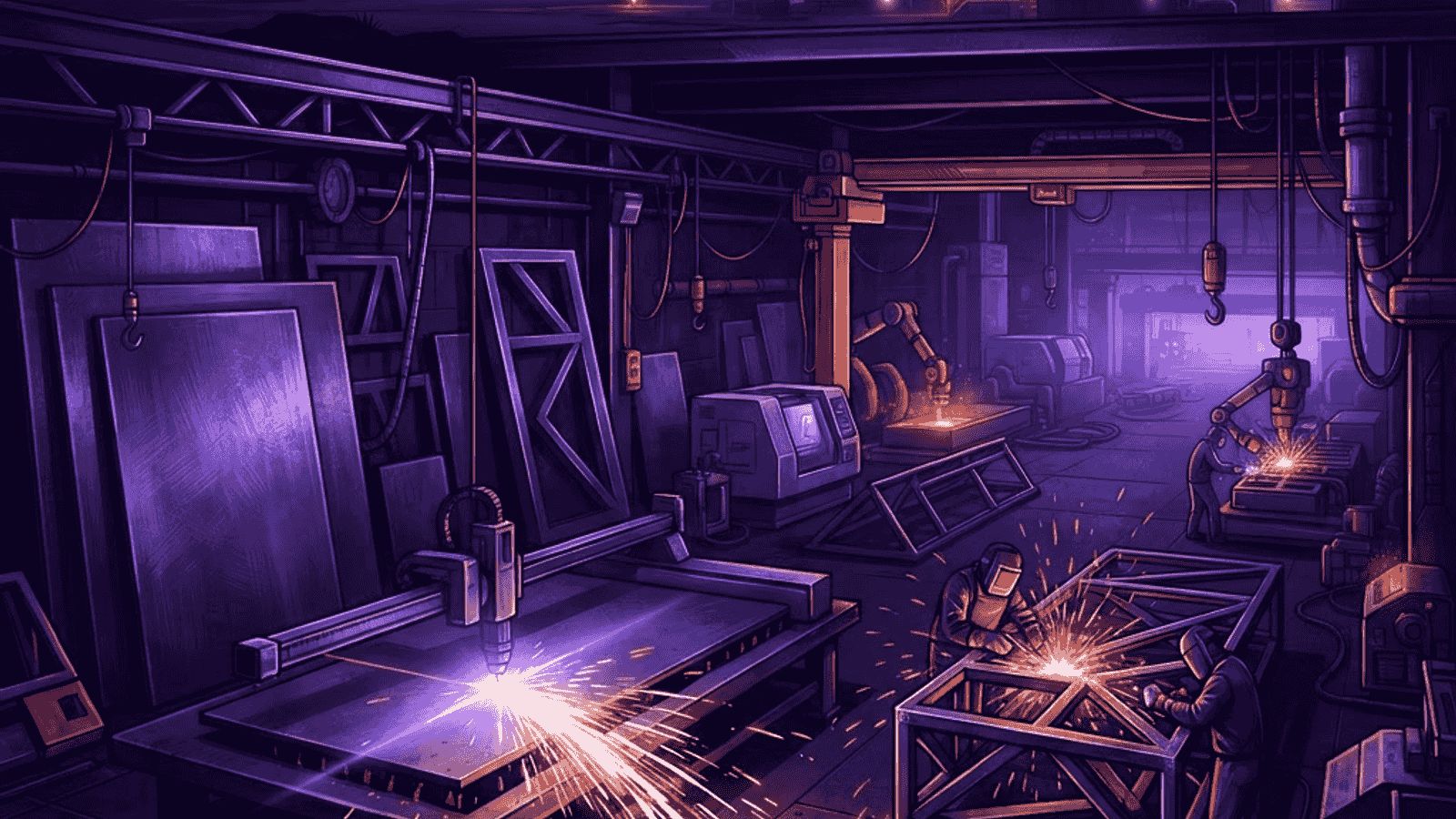
Metalworking in Gilbert's Industrial Landscape
Gilbert's economy is often described in terms of housing and healthcare, but a substantial metalworking sector operates in its industrial parks and along its commercial corridors. These companies cut, form, weld, machine and finish metal for construction, semiconductor support, aerospace suppliers, medical device manufacturers, agriculture equipment and countless small commercial customers. Their work is rarely visible in a finished product, yet almost nothing in the built environment exists without it.
The sector spans a wide range of capability. At one end sit structural and architectural fabricators working in heavy plate and beam. At the other are precision machine shops holding tolerances measured in thousandths of an inch for regulated industries. Understanding where a project sits on that spectrum is the first step to choosing an appropriate partner.
Ten Metalworks Companies Serving Gilbert
Ironwood Fabrication is a structural and miscellaneous metals fabricator handling stairs, railings, mezzanines, canopies and embed packages for commercial construction, with in-house detailing that shortens submittal cycles.
Sonoran Precision Machining operates multi-axis CNC milling and turning centers serving aerospace and medical device customers. Documented process control and first-article inspection reporting are central to its offering.
Copper State Sheet Metal focuses on laser cutting, press brake forming and welded enclosures, producing electrical cabinets, brackets, chassis and custom sheet assemblies in stainless, aluminum and cold-rolled steel.
Agave Welding & Steel provides mobile and shop welding services for repair, retrofit and light structural work, a practical resource for facility maintenance teams and equipment operators.
Desert Forge Metalcraft concentrates on architectural and ornamental metal, including gates, screens, custom furniture frames and decorative panels for residential and hospitality projects.
Mesa Alloy Works supplies plate processing, waterjet cutting and heavy machining for industrial and mining-adjacent customers who need large parts in exotic and abrasion-resistant materials.
Summit Tube & Bending specializes in tube laser cutting, mandrel bending and tubular assemblies, serving equipment builders, handrail contractors and material handling manufacturers.
Legacy Metal Finishing rounds out the supply chain with powder coating, anodizing, passivation and plating, allowing fabricators and OEMs to complete parts locally rather than shipping them out of state.
Vista Steel Supply & Service Center combines metal distribution with cutting, sawing and shearing, offering fabricators quick access to material in usable sizes without full-mill minimums.
Ridgeline Weldments completes the list with production welding of frames, skids and weldments, supported by certified welders and weld procedure documentation for customers with quality system requirements.
Capabilities That Actually Matter
Tolerance capability is the clearest technical differentiator. A shop that routinely works to plus or minus five thousandths of an inch is fundamentally different from one built for structural work, and asking for capability data rather than marketing claims prevents mismatched sourcing. Material expertise matters equally. Stainless, aluminum, titanium and abrasion-resistant steels each behave differently during cutting, forming and welding, and experience with a specific alloy reduces scrap and rework.
Certifications provide a useful proxy for process maturity. Quality management system registration, welding procedure qualification and industry-specific approvals indicate that a shop can document what it did and repeat it. For regulated customers in aerospace or medical devices, this is non-negotiable. For a commercial building project, structural welding certification and inspection support serve a similar function.
Finishing capability is frequently overlooked. Powder coating, anodizing and passivation affect corrosion resistance and appearance, and in Arizona's ultraviolet-intense environment, coating selection has a direct effect on service life. Shops that manage finishing in house or through tightly controlled partners reduce lead time and handling damage.
Technology and Industry Trends
Automation continues to change the economics of metalworking. Fiber laser cutting has largely displaced older technologies for sheet work, offering faster processing and better edge quality. Robotic welding cells make medium-volume weldments more consistent and less dependent on scarce skilled labor. Automated bending and tool changing reduce setup time, which improves competitiveness on smaller lot sizes.
Digital integration is advancing as well. Direct import of three-dimensional models, nesting software that improves material yield and in-process inspection data collection have all shortened the path from design to finished part. Customers increasingly expect a quote from a solid model rather than a paper drawing.
Workforce development remains the sector's central challenge. Experienced machinists, welders and fabricators are in short supply nationally, and Gilbert companies compete for the same talent as the broader Phoenix metropolitan industrial base. Firms that invest in apprenticeships and internal training have proven more capable of scaling with demand.
How to Select a Metalworks Partner
Provide complete information when requesting a quote. Material specification, tolerance requirements, finish, quantity, delivery expectation and any inspection documentation needs allow a shop to respond accurately instead of padding for uncertainty. Request a sample or first article for any part that will go into production, and confirm how the shop handles engineering changes once tooling exists.
Visit the facility when the project justifies it. Organization, equipment condition, work-in-process control and quality area setup reveal more about a shop's discipline than any capability statement. Ask about capacity utilization and typical lead time under normal conditions rather than best case.
Final Thoughts
Gilbert's metalworks companies range from architectural artisans to precision production shops, and matching the right capability to the right project is the entire task. Buyers who specify clearly, evaluate certifications honestly and consider finishing and logistics alongside machining cost consistently get better parts, fewer delays and more durable results.