
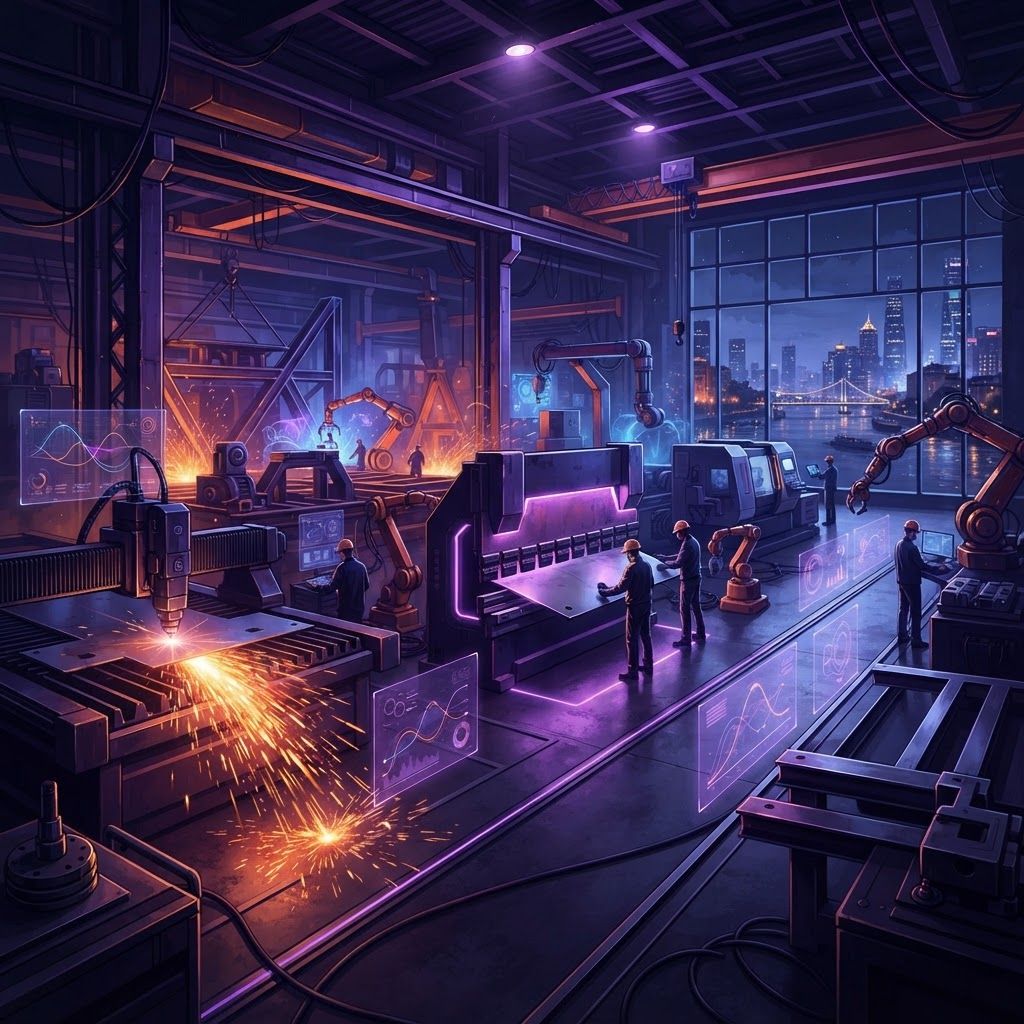
Metalworking as Cincinnati's Industrial Foundation
If any industry defines Cincinnati's manufacturing character, it is metalworking. The city's machine tool history built a workforce fluent in precision machining, and that capability compounded over generations into a dense network of job shops, fabricators, tool and die makers, foundries, and finishing operations. Aerospace demand from the region's jet engine industry pushed tolerance and documentation standards higher still, while automotive, food equipment, and industrial machinery customers provided volume and variety.
The result is a metalworking base capable of everything from single prototype parts to production runs, from thin gauge sheet metal enclosures to large weldments, and from general commercial tolerances to aerospace-grade precision with full material traceability.
Metalworks Companies in the Region
Meyer Tool is among the most recognized Cincinnati precision machining companies, serving aerospace and industrial gas turbine customers with complex machining, specialty processes, and rigorous quality systems.
Cincinnati Incorporated manufactures the fabrication equipment itself, including press brakes, shears, and laser cutting systems, while also representing decades of local metalworking engineering knowledge.
Sheet metal fabricators across Greater Cincinnati provide laser cutting, punching, forming, welding, and powder coating for enclosures, brackets, chassis, and architectural metal.
Tool and die shops in the tri-state area build stamping dies, progressive tooling, fixtures, and gauges, supporting automotive and appliance production throughout the Midwest.
Regional foundries and casting suppliers produce iron and aluminum castings for pumps, valves, machinery, and municipal products, often paired with machining services.
Structural steel fabricators and miscellaneous metals shops supply beams, columns, stairs, railings, and platforms for commercial construction and industrial facilities.
Welding and heavy fabrication companies in the Ohio Valley build tanks, pressure vessels, frames, and large weldments, with certified welding procedures for code work.
Heat treatment and metal finishing providers offer hardening, annealing, stress relief, plating, anodizing, passivation, and coating services critical to final part performance.
Screw machine and turning specialists produce high-volume turned components with automated equipment, serving fastener, fitting, and hydraulic component markets.
Additive manufacturing and rapid prototyping shops in the region now produce metal parts directly, enabling complex geometries and rapid iteration alongside traditional machining.
Matching Process to Requirement
Choosing the right metalworking process depends on geometry, volume, tolerance, and material. Machining suits complex geometry, tight tolerances, and low to moderate volumes but generates material waste. Stamping delivers low unit cost at high volume with significant tooling investment. Laser cutting and forming excel for sheet metal parts and enclosures. Casting handles complex shapes economically at volume but requires pattern investment and typically follow-on machining. Additive manufacturing suits low volume, highly complex parts and consolidated assemblies.
Material selection interacts with process capability. Stainless alloys, titanium, high-nickel alloys, and hardened tool steels demand specific tooling, coolant strategies, and experience. A shop excellent in aluminum may struggle with nickel superalloys, so ask directly about experience with your specific material rather than general capability.
Qualification and Quality Diligence
Review certifications relevant to your industry, including general quality management standards and aerospace-specific certification for flight hardware, along with welding qualification for code fabrication. Ask about inspection capability: coordinate measuring machines, surface finish measurement, hardness testing, and nondestructive examination such as penetrant or radiographic inspection where required.
Material traceability is essential for critical applications. Confirm the shop retains mill certifications, controls material identification through processing, and can trace finished parts to heat lots. For parts requiring special processes, verify whether subcontracted heat treatment, plating, or nondestructive testing suppliers are appropriately approved.
Evaluate capacity and technology honestly. Machine list, spindle count, axis capability, work envelope, and automation determine both cost and lead time. Programming and engineering resources indicate how much design support you will receive. Ask about on-time delivery history and how the shop communicates schedule risk.
Cost Drivers and Practical Advice
Tolerances drive cost more than any other specification. Applying tight tolerances everywhere rather than only where function requires them can multiply price. Similarly, unnecessarily fine surface finishes, cosmetic requirements on non-visible surfaces, and elaborate documentation add cost without adding value.
Provide complete information: dimensioned drawings with tolerances and datums, material specification, finish requirements, quantity and expected repeat frequency, and inspection expectations. Three-dimensional models plus drawings reduce interpretation errors. Discuss design for manufacturability, since small geometry changes often unlock substantial savings.
For ongoing production, consider blanket orders with scheduled releases, which let shops batch efficiently while you hold less inventory. Build relationships with shops whose capabilities align with your recurring needs rather than rebidding every job to the lowest quote, as consistency and accumulated process knowledge reduce total cost over time.
Final Thoughts
Cincinnati's metalworks companies represent one of the region's most durable competitive advantages, offering precision machining, fabrication, tooling, casting, welding, and finishing under one regional roof. Buyers who match process to requirement, specify tolerances purposefully, verify quality systems and traceability, and invest in long-term shop relationships get better parts, faster, and at lower true cost.