
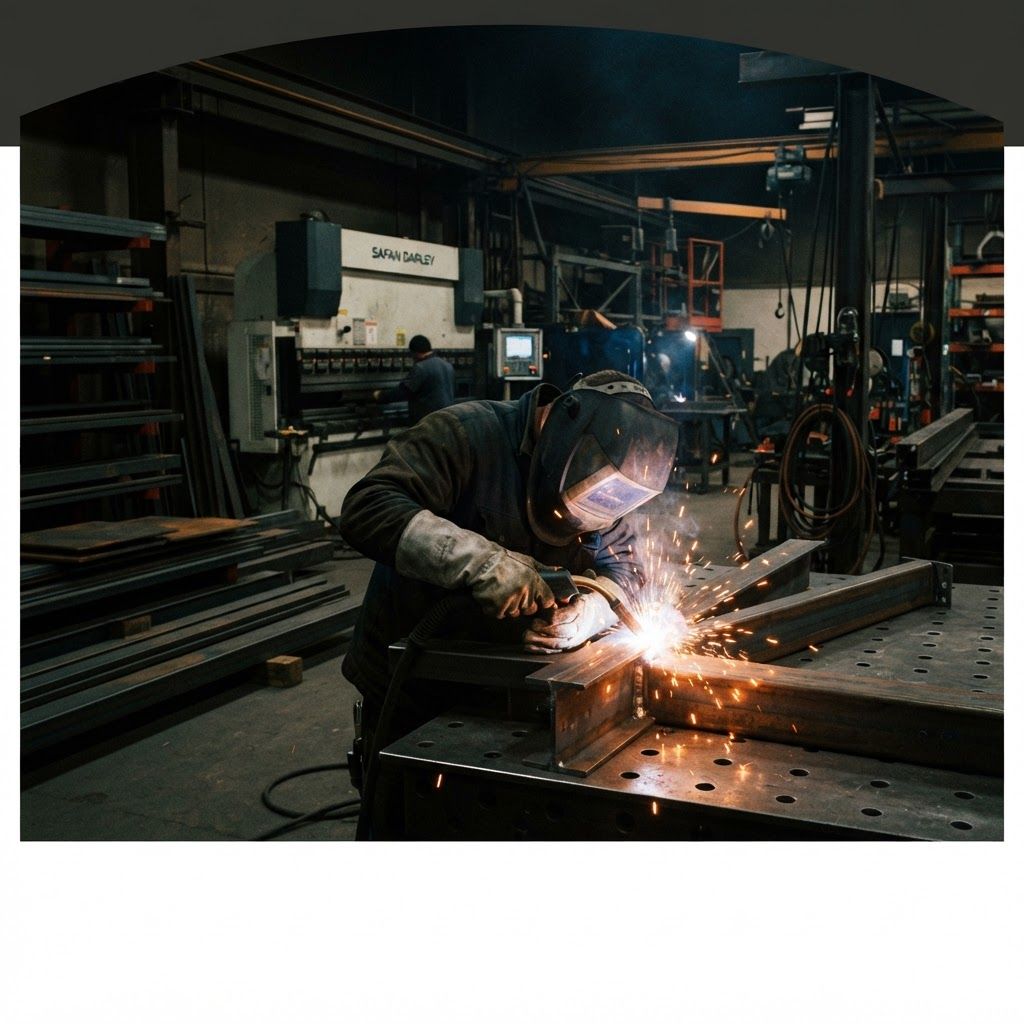
Buffalo's identity was forged in metal. For decades the Lackawanna steel complex south of the city ranked among the largest in the world, and although the blast furnaces went cold, the skills did not disappear. They dispersed into hundreds of fabrication shops, machine shops, foundries and finishing operations. That distributed capability is arguably more valuable to today's economy than a single large mill, because it lets manufacturers source almost any metal process within a short drive.
The Breadth of Regional Metalworking
Metalworking is not one trade but many. Fabrication cuts, forms and joins sheet and structural material. Machining removes metal to achieve precise geometry. Casting and forging shape metal through molten pouring or applied force. Finishing applies coatings, plating and heat treatment that determine corrosion resistance and hardness. Buffalo hosts substantial capacity in all of these, which means a complex assembly can move through several specialized suppliers without leaving Erie County.
Ten Metalworks Companies Worth Knowing
Lackawanna Steel Fabricators handles heavy structural fabrication for industrial, bridge and commercial construction. Certified welding procedures, large-capacity cranes and detailing services support projects where the steel package drives the entire schedule.
Queen City Sheet Metal concentrates on precision sheet metal work including enclosures, brackets, panels and chassis. Laser cutting, computer-controlled forming and welding come together with an emphasis on cosmetic quality, which matters for equipment where the enclosure is visible to end users.
Niagara Machine and Grinding provides precision machining and grinding for tight-tolerance components. Surface finish and dimensional stability are the specialties, supporting hydraulic, aerospace and tooling customers who work in the range where thermal expansion becomes a real consideration.
Erie Foundry Works pours iron and non-ferrous castings for pump, valve and machinery customers. Pattern making, in-house metallurgical testing and finish machining allow the foundry to deliver castings ready for assembly rather than requiring another vendor.
Buffalo Architectural Metals fabricates railings, stairs, canopies, storefronts and ornamental work. The city's renovation activity has generated steady demand for metalwork that satisfies modern code while matching historic aesthetics, and the shop handles both new fabrication and restoration.
Cataract Welding and Repair operates as both a fabrication shop and a mobile field service provider. Emergency repair capability keeps plants running when a critical weldment cracks, and the company maintains certifications for pressure and structural work.
Harborline Metal Finishing offers plating, anodizing, powder coating and passivation. Finishing determines how long a part survives in service, and the company's process control and testing support customers whose components face salt, chemicals or outdoor exposure.
Frontier Laser and Waterjet provides contract cutting services in a wide range of materials and thicknesses. Fast turnaround on cut blanks serves both prototype work and production, and waterjet capability handles materials that heat-based cutting would damage.
Steelbend Tube and Roll specializes in tube bending, roll forming and section rolling. Bending tube without kinking or excessive wall thinning is genuinely difficult, and the company's tooling library covers a wide range of radii and profiles.
Elmwood Heat Treating performs hardening, annealing, stress relieving and case hardening. Independent heat treaters are essential infrastructure for the machining community, and this operation's process documentation and hardness verification support customers with demanding quality requirements.
Forces Shaping the Metalworking Sector
Reshoring has been the most consequential development. As manufacturers restructure supply chains toward North America, regional fabricators and machinists have gained work that spent years offshore, and buyers increasingly value the ability to visit a supplier and resolve issues in person.
Automation is advancing steadily, with robotic welding cells, automated material handling and lights-out machining addressing the persistent shortage of skilled labor. Digital workflow has matured too, as shops accept three-dimensional models directly, program from them and use inspection data to close the loop on quality. Workforce development remains the sector's central challenge, and the strongest companies run structured apprenticeship programs rather than competing for a limited pool of experienced tradespeople.
How to Select a Metalworking Partner
Match the shop to the work honestly. A heavy structural fabricator and a precision machining house have different equipment, tolerances and cultures, and asking either to do the other's work produces disappointment. Verify certifications relevant to the application, including welding qualifications and quality management registrations.
Assess capacity realistically by asking about current backlog and how the shop handles schedule pressure. Discuss inspection expectations up front, including what gets measured and what documentation accompanies shipment. Finally, consider how many operations a supplier can perform internally, because every transfer between vendors adds cost, lead time and risk of miscommunication.
Designing Parts That Are Economical to Make
A significant share of metalworking cost is decided at the drawing stage rather than on the shop floor. Tolerances are the clearest example, because specifying precision tighter than the application requires can multiply machining time without improving function. Experienced shops routinely identify dimensions where loosening a tolerance would reduce cost substantially with no performance consequence.
Material selection carries similar weight, since an exotic alloy chosen for convenience may be difficult to source in the required form and slow to machine. Standard sizes and readily available grades keep both cost and lead time down. Weld access, bend radii and part consolidation matter too, and involving a fabricator during design rather than after drawings are frozen consistently produces a better result for both parties.
Final Thoughts
Buffalo's metalworks companies represent an unusually complete industrial ecosystem, covering fabrication, machining, casting, forming and finishing within a compact geography. For any organization that needs metal parts made correctly and supported by people who can be reached in person, that concentration of capability remains one of Western New York's most durable competitive advantages.