
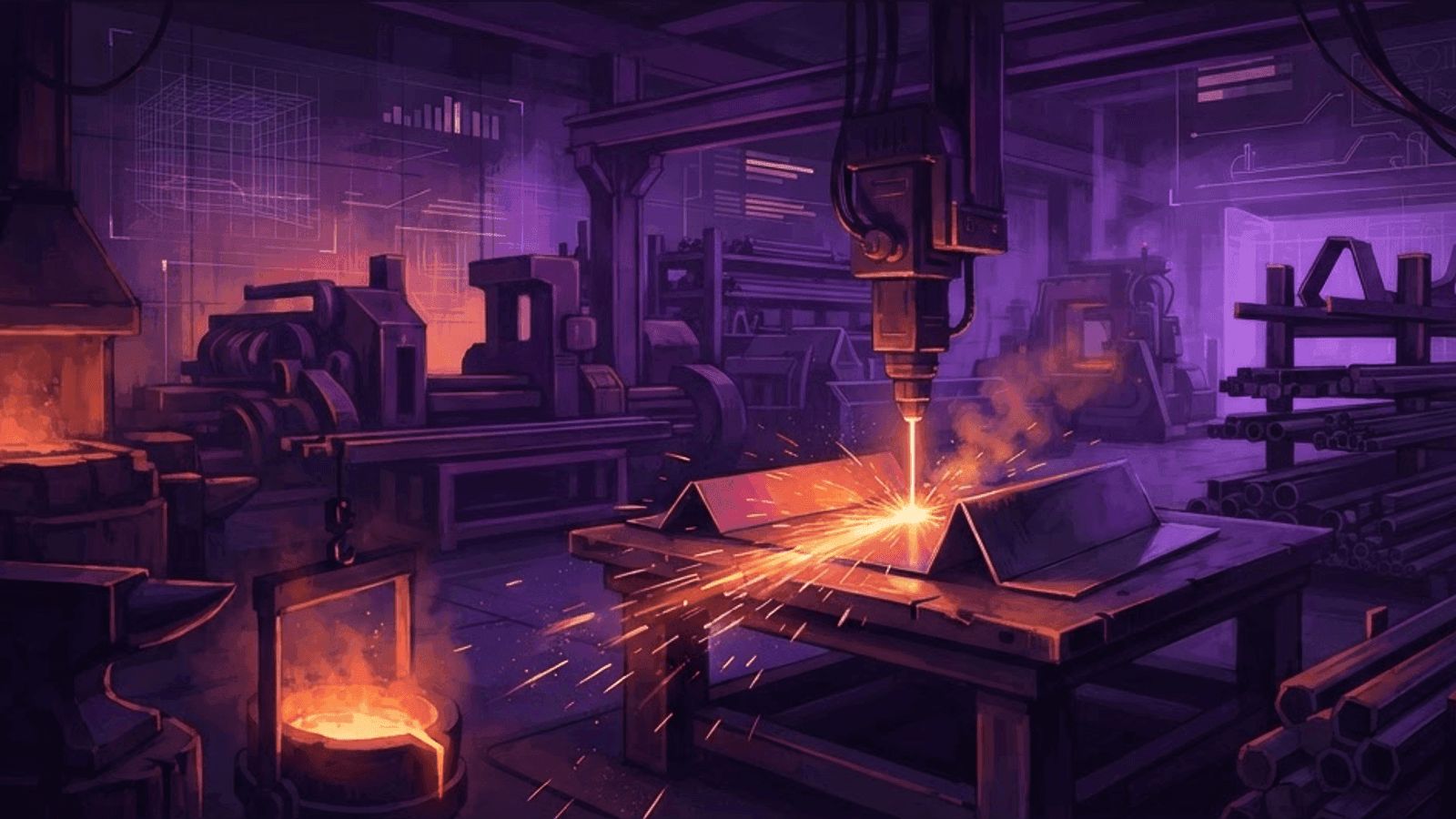
Metal and Birmingham Go Together
No industry is more closely bound to Birmingham's identity than metalworking. Brass founding, jewellery making, pressing, plating and fabrication built the city's wealth, and the skills involved never fully left. Today the sector spans laser cutting bureaux, architectural metalworkers, precision machinists, heavy fabricators and surface finishers, often operating within a few miles of one another.
This concentration creates practical advantages. A designer can have a part laser cut in one unit, folded in another, welded in a third and powder coated nearby, all within days. Few regions can match that combination of capability and proximity.
Ten Metalworks Companies Worth Knowing
1. Jewellery Quarter Metal Craft — Fine metalworkers producing precious and non-precious components, castings and finished pieces. Generations of accumulated skill show in the quality of hand finishing.
2. Aston Laser and Fabrication — A profiling bureau offering laser and plasma cutting, folding and welding. Fast quotation turnaround from customer drawings has made them popular with product designers and engineers.
3. Digbeth Architectural Metalwork — Makers of balustrades, staircases, gates, screens and feature metalwork for commercial and residential projects. Their installation teams handle complex city-centre sites routinely.
4. Saltley Heavy Fabrication — Specialists in structural steelwork, frames, platforms and large weldments, with coded welders and lifting capacity for substantial assemblies.
5. Midland Sheet Metal Company — Producers of enclosures, panels, brackets and chassis for electrical and equipment manufacturers, supported by punching, forming and assembly capability.
6. Tyseley Precision Machining — CNC turning and milling for engineering components in steel, aluminium and exotic alloys. Small batch and prototype work is handled with the same rigour as production.
7. Northfield Surface Finishing — Powder coating, wet spray, anodising and plating services. Their pretreatment discipline is the reason their finishes last, particularly on external architectural work.
8. Bordesley Pressings and Stampings — A press shop producing high-volume stampings and deep drawn components, with in-house tool making supporting long tool life.
9. Perry Barr Tube and Pipework — Tube bending, mandrel forming and pipework fabrication for handrails, frames, exhausts and process installations.
10. Erdington Castings and Foundry Services — Suppliers of aluminium and iron castings with pattern making and machining, serving industrial and heritage restoration customers alike.
Core Metalworking Processes Explained
Understanding the basic processes helps buyers specify better. Laser cutting produces accurate flat profiles quickly with minimal tooling cost. Press braking folds those profiles into three-dimensional parts. Welding joins assemblies, with method chosen according to material and cosmetic requirements. CNC machining removes material to achieve tight tolerances and complex geometry. Pressing forms parts at speed using dedicated tooling, which suits high volumes. Casting produces complex shapes that would be uneconomic to machine.
Most real components combine several processes, and a good fabricator will suggest the sequence that minimises cost while achieving the required result.
Finishes and Corrosion Protection
Finish selection determines both appearance and lifespan. Powder coating offers durable colour with good impact resistance. Galvanising provides excellent corrosion protection for external steel. Anodising hardens and protects aluminium while allowing colour. Electroplating adds conductivity, wear resistance or decorative brightness. Stainless steel avoids coating altogether but costs more in material.
Whatever the choice, preparation determines performance. Poor degreasing or inadequate pretreatment will cause any coating to fail, regardless of the quality of the coating itself. This is why the most respected finishers talk more about their pretreatment line than their spray booth.
Design for Fabrication
Cost in metalwork is driven by decisions made at drawing stage. Standardising material thickness across a project reduces setup changes. Generous bend radii avoid cracking. Avoiding unnecessarily tight tolerances on non-critical features saves inspection time. Designing for nesting efficiency reduces material waste. Minimising weld length and choosing accessible joint positions cuts labour significantly.
Sharing editable CAD files rather than flat drawings allows fabricators to suggest these improvements quickly, and most will do so without charge because it wins them the work.
Choosing a Metalworks Partner
Match the supplier to the job. A precision machinist is the wrong choice for a heavy structural frame, and a heavy fabricator will struggle with delicate architectural detailing. Visit the workshop, look at work in progress rather than showroom samples, and ask how they manage inspection and rework. For structural and safety-critical work, confirm welding qualifications and relevant certification.
Lead Times and Capacity Planning
Metalworking capacity in the region fluctuates with construction and manufacturing cycles, and lead times can change substantially within a few months. Buyers who plan ahead and book capacity early consistently receive better pricing and more reliable delivery than those issuing urgent enquiries.
Material availability also influences timing. Standard mild steel sheet and section are usually readily available, while specific stainless grades, thicker plate and non-ferrous alloys may require ordering from mill stock with associated lead times. Confirming material availability at quotation stage prevents unpleasant surprises after an order is placed.
For repeat work, consider a scheduled call-off arrangement. Agreeing annual volumes with phased delivery allows the fabricator to batch production efficiently, which reduces setup costs and typically produces better pricing than placing repeated one-off orders throughout the year.
Final Thoughts
Birmingham's metalworks companies represent a living industrial tradition that has adapted rather than declined. With capability ranging from microscopic jewellery detail to multi-tonne structures, the city offers a breadth of metalworking expertise that continues to attract customers from across the country.