
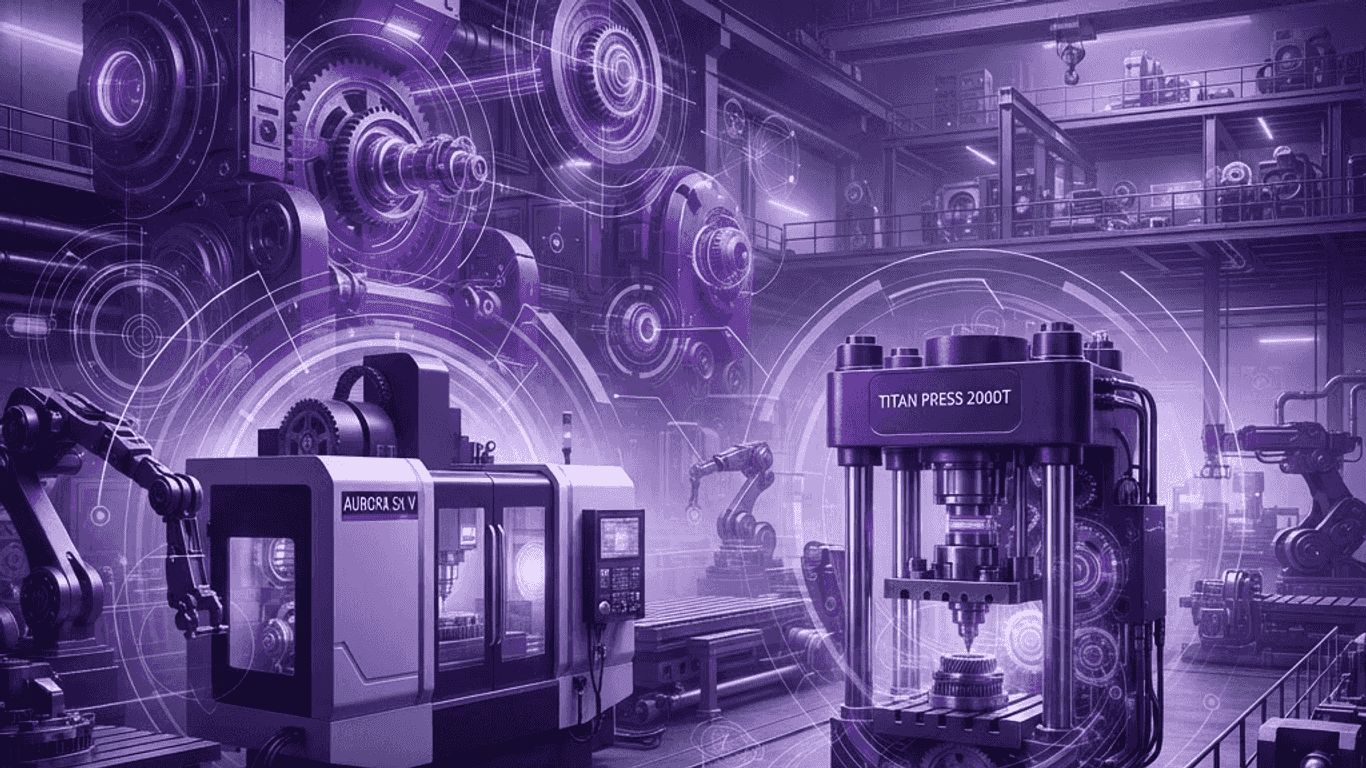
Tulsa's Machinery Manufacturing Heritage
Machinery is where Tulsa's industrial identity is most concentrated. Building drilling rigs, pumps, compressors, and process equipment for the energy industry required a workforce that could design, machine, weld, and assemble large, high-stress systems. That capability has since diversified into agriculture, mining, aerospace, water treatment, and general industrial machinery.
What distinguishes the region is scale of fabrication combined with engineering depth. Many Tulsa shops can take a mechanical concept, produce detailed designs, machine large components in house, assemble, test, and ship a complete system. Few metro areas of comparable size offer that breadth, and it is why global operators still source machinery from northeastern Oklahoma.
1. Helmerich & Payne Rig Technology
Tulsa-based Helmerich & Payne is renowned for designing and building highly capable land drilling rigs, integrating mechanical systems with sophisticated automation. Its differentiator is closed-loop performance: hardware and control software developed together to improve drilling precision. The engineering culture there has trained a generation of local machinery designers.
2. Zeeco
Zeeco, headquartered near Tulsa, engineers and manufactures combustion equipment including burners, flares, thermal oxidizers, and vapor recovery systems. Its testing facility allows full-scale flame verification before shipment, which is rare in the industry. Refiners and chemical plants worldwide specify Zeeco when emissions performance must be proven, not estimated.
3. Pump and Compression Equipment Manufacturers
Tulsa hosts manufacturers and packagers of pumps, compressors, and skid-mounted fluid handling systems. Their strengths are packaging engineering, vibration control, and field commissioning support. Buyers value suppliers who deliver complete, tested skids rather than loose components requiring site integration.
4. Pressure Vessel and Heat Transfer Equipment Builders
Fabricators in the metro build code-stamped pressure vessels, separators, heat exchangers, and storage systems. Certification, weld procedure qualification, and radiographic inspection define credibility in this segment. Long-standing relationships with inspection authorities help these firms deliver compliant equipment on predictable schedules.
5. Precision Machining and Large Component Shops
Heavy machining operations with large lathes, horizontal boring mills, and multi-axis machining centers serve equipment builders across industries. Their differentiator is envelope capacity: the ability to hold tolerances on components too large for typical job shops. Many also provide reverse engineering for obsolete parts.
6. Material Handling and Conveyor System Manufacturers
Manufacturers of conveyors, bulk handling systems, hoppers, and industrial automation platforms support agriculture, aggregates, and distribution operations. System integration is their strength, combining structural steel, drives, controls, and safety guarding into a coordinated installation. Uptime guarantees and spare-parts availability drive purchasing decisions.
7. Custom Machine Builders and Automation Integrators
Custom machine builders design purpose-built equipment when no catalog machine fits, such as specialized assembly cells, testing rigs, and packaging automation. Their value lies in problem definition as much as fabrication, translating a production bottleneck into a mechanical solution. Robotics integration has expanded this segment substantially.
8. Agricultural and Ground Engaging Equipment Producers
Given Oklahoma's agricultural base, manufacturers of tillage implements, livestock handling equipment, and trailers operate throughout the region. Durability and simple field serviceability are the differentiators, since downtime during planting or harvest is unacceptable. Direct dealer relationships keep feedback loops short.
9. Industrial Gearbox and Power Transmission Manufacturers
Firms specializing in gearboxes, couplings, drive shafts, and power transmission components serve energy, mining, and processing customers. Precision gear cutting, heat treatment control, and rebuild services define this segment. In-region repair capability often matters more than initial purchase price over an asset's life.
10. Machinery Rebuilders and Retrofit Specialists
Rebuilders restore machine tools and production equipment, frequently upgrading controls and drives during the process. A rebuild with modern automation can deliver near-new capability at a fraction of replacement cost and with a shorter lead time. For capital-constrained manufacturers, this is one of the highest-return options available.
Trends in Machinery Manufacturing
Digital integration leads the list. Machinery now ships with sensors, condition monitoring, and remote diagnostics as standard expectations, which requires mechanical builders to develop electronics and software competency. Predictive maintenance changes the commercial relationship as well, moving suppliers toward service contracts.
Energy efficiency and emissions performance are the second driver, particularly in combustion and fluid handling equipment. Regulations and operating costs both reward better efficiency. Meanwhile, skilled labor availability remains the sector's central constraint, prompting investment in automation, apprenticeships, and partnerships with local technical education programs.
How to Choose a Machinery Manufacturer
Define the functional requirement, not just the equipment specification. The best builders will challenge assumptions and propose better approaches, which is only possible if they understand the process outcome you need.
Verify engineering capability, in-house machining envelope, code certifications relevant to your application, and testing procedures. Ask what portion of the work is subcontracted and how that is managed. Review lead times realistically and confirm commissioning support, documentation, spare parts availability, and operator training. For capital equipment expected to run for decades, aftermarket support deserves as much scrutiny as the initial build.
Final Thoughts
Tulsa's machinery manufacturers combine heavy fabrication capacity with genuine engineering sophistication, a pairing that remains uncommon. Whether you need a code-stamped vessel, a custom automation cell, or a rebuilt machine tool, the region offers suppliers with the experience to deliver equipment that performs reliably for years.