
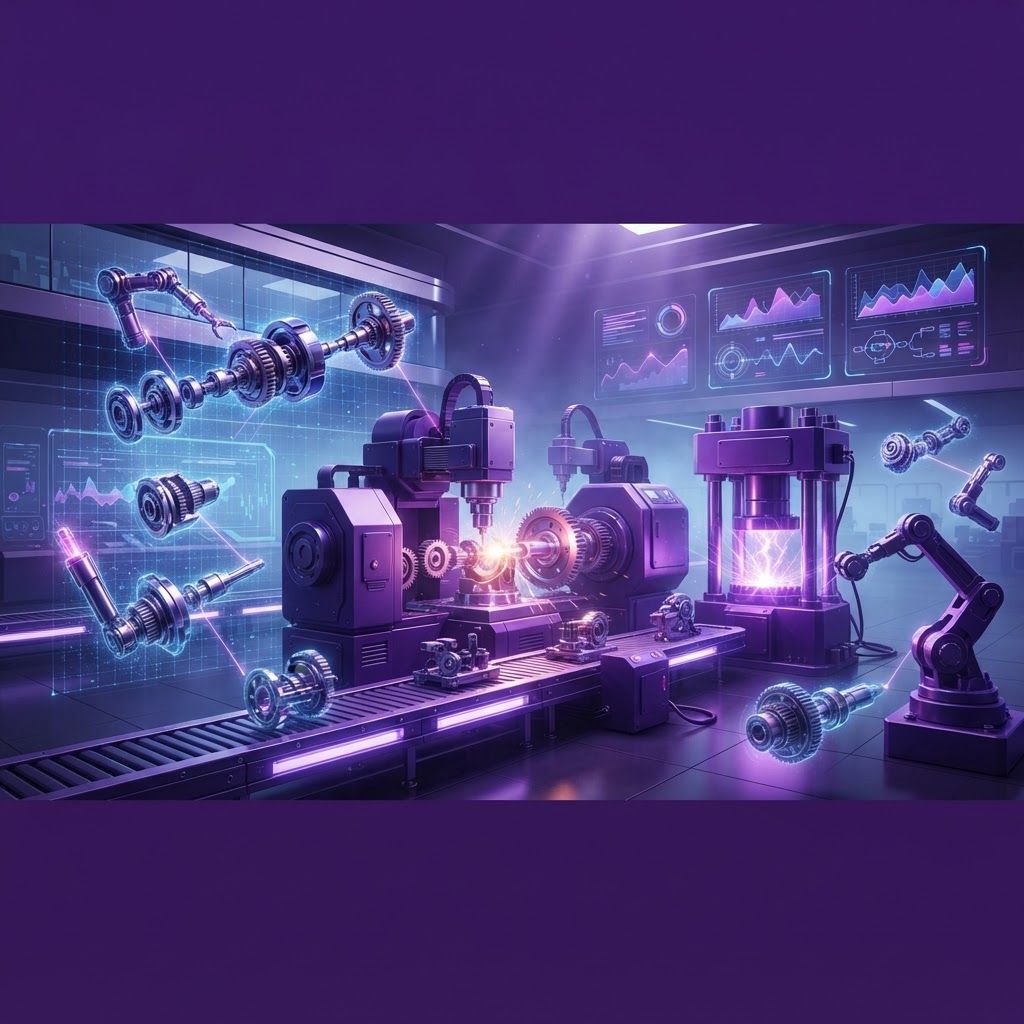
Machinery Manufacturing in the East Valley
Machinery manufacturing rarely attracts public attention, yet it underpins nearly every other industry. Semiconductor fabrication depends on handling equipment, food production depends on processing and packaging lines, and construction depends on heavy equipment kept running by parts suppliers. Tempe hosts a substantial cluster of companies serving these needs, ranging from small precision machine shops to firms that design and build complete automated production systems.
The local sector has been shaped by the industries surrounding it. Semiconductor investment created demand for ultra-precision components and cleanroom-compatible equipment. Aerospace operations in the region drove capability in exotic materials and tight tolerances. Agriculture and construction produced steady demand for rugged equipment and field-serviceable designs. Collectively, this gives Tempe machine builders unusual breadth.
Precision Machining and Component Manufacturers
Papago Precision Machining operates multi-axis CNC equipment producing close-tolerance components from aluminum, stainless steel, titanium, and engineered plastics. The shop is known for its inspection discipline and for handling first article documentation properly.
Rio Salado Machine Works combines machining with fabrication and welding, allowing it to produce larger assemblies that pure machine shops must outsource. Customers appreciate having fewer vendors to coordinate.
Desert Tolerance Manufacturing specializes in high-precision work for semiconductor and scientific instrumentation customers, maintaining environmental controls that keep dimensional accuracy stable across temperature swings.
Automation and Custom Equipment Builders
Sonoran Automation Systems designs and builds custom automated assembly and inspection machines. Its engineers handle mechanical design, controls programming, and integration, delivering turnkey systems for manufacturers automating manual processes.
Valley Robotics Integration focuses on robotic work cells, including material handling, palletizing, welding, and machine tending. The firm frequently retrofits robots into existing production lines rather than requiring wholesale replacement.
Tempe Controls and Machinery builds control panels and automation systems, programming controllers and human-machine interfaces for equipment builders and end users alike.
Industrial and Process Equipment
Copper State Industrial Equipment manufactures conveyors, material handling systems, and process machinery for food, packaging, and distribution operations.
Arizona Hydraulic Systems produces hydraulic power units, cylinders, and custom actuation systems, serving heavy equipment, industrial presses, and specialized machinery applications.
Heavy Equipment and Field Support
Broadway Heavy Machinery Services manufactures attachments, wear parts, and custom implements for construction and mining equipment, with a rebuilding operation that extends the life of expensive components.
Grand Canyon Machine Rebuilders specializes in remanufacturing industrial machinery, restoring older equipment to original specification with modern controls. For customers with proven machines and no appetite for capital replacement, the service is compelling.
Trends in the Machinery Sector
Automation demand continues to accelerate, driven less by cost reduction than by labor availability. Manufacturers who cannot fill positions increasingly automate tasks they would previously have staffed, which has expanded the customer base for automation builders considerably.
Connected machinery has become standard. Equipment now reports operating data continuously, enabling predictive maintenance that replaces components before failure rather than after. Machine builders who cannot deliver this capability find themselves excluded from serious consideration.
Additive manufacturing has found its place in the machine shop. Rather than replacing machining, it complements it, producing fixtures, prototypes, and complex low-volume parts faster and cheaper than subtractive methods allow.
Serviceability has regained importance. Buyers increasingly evaluate how easily a machine can be maintained, whether spare parts are standard or proprietary, and how quickly support responds. Total cost of ownership has displaced purchase price as the primary evaluation metric among sophisticated buyers.
How to Choose a Machinery Manufacturer
Begin with a clear specification. Vague requirements produce vague quotes and disappointing results. Define throughput, tolerance, material, duty cycle, footprint, and interface requirements before soliciting proposals.
Evaluate engineering depth, not just machine capacity. A shop with excellent equipment but thin engineering will build exactly what you specify, including your mistakes. A builder with strong engineering will question assumptions and improve the design.
Inspect quality infrastructure. Coordinate measuring machines, calibrated gauges, documented inspection procedures, and traceable material certifications distinguish serious manufacturers from general fabricators.
Discuss support explicitly. Who answers when the machine stops at two in the morning? What is the parts lead time? Is documentation provided, including electrical schematics and controls source code? Ownership of controls programming is a frequently overlooked contract term that causes real pain later.
Visit the shop and speak with the people who will do the work. Machining and machine building remain craft-intensive disciplines, and the experience level on the floor matters enormously.
Budgeting a Custom Machine Project
Custom machinery projects fail on budget more often than on capability, usually because the initial estimate covered only the machine itself. A realistic budget includes engineering and design time, the machine build, controls programming, factory acceptance testing, shipping and rigging, site preparation including utilities and foundations, installation, commissioning, operator training, and a spare parts package.
Contingency matters as well. Custom equipment is by definition unproven, and the debugging period after installation almost always reveals adjustments nobody anticipated. Experienced buyers reserve a meaningful percentage of the project budget for changes discovered during commissioning, and they negotiate a clear process for handling scope changes before work begins.
Payment structure deserves equal attention. Milestone-based payments tied to design approval, mechanical completion, factory acceptance, and site acceptance align incentives far better than large deposits with a small balance at the end. A builder confident in its work will accept a meaningful final payment contingent on the machine performing to specification in your facility rather than in theirs.
Final Thoughts
Tempe's machinery manufacturers combine precision capability, automation expertise, and practical field experience. Whether you need a hundred machined components, a custom automated cell, or a rebuilt production machine, the local market can deliver. Invest in a clear specification, choose partners with genuine engineering depth, and negotiate support terms as carefully as price. Machinery is a long-term relationship, not a transaction.