
The City Built on Machine Building
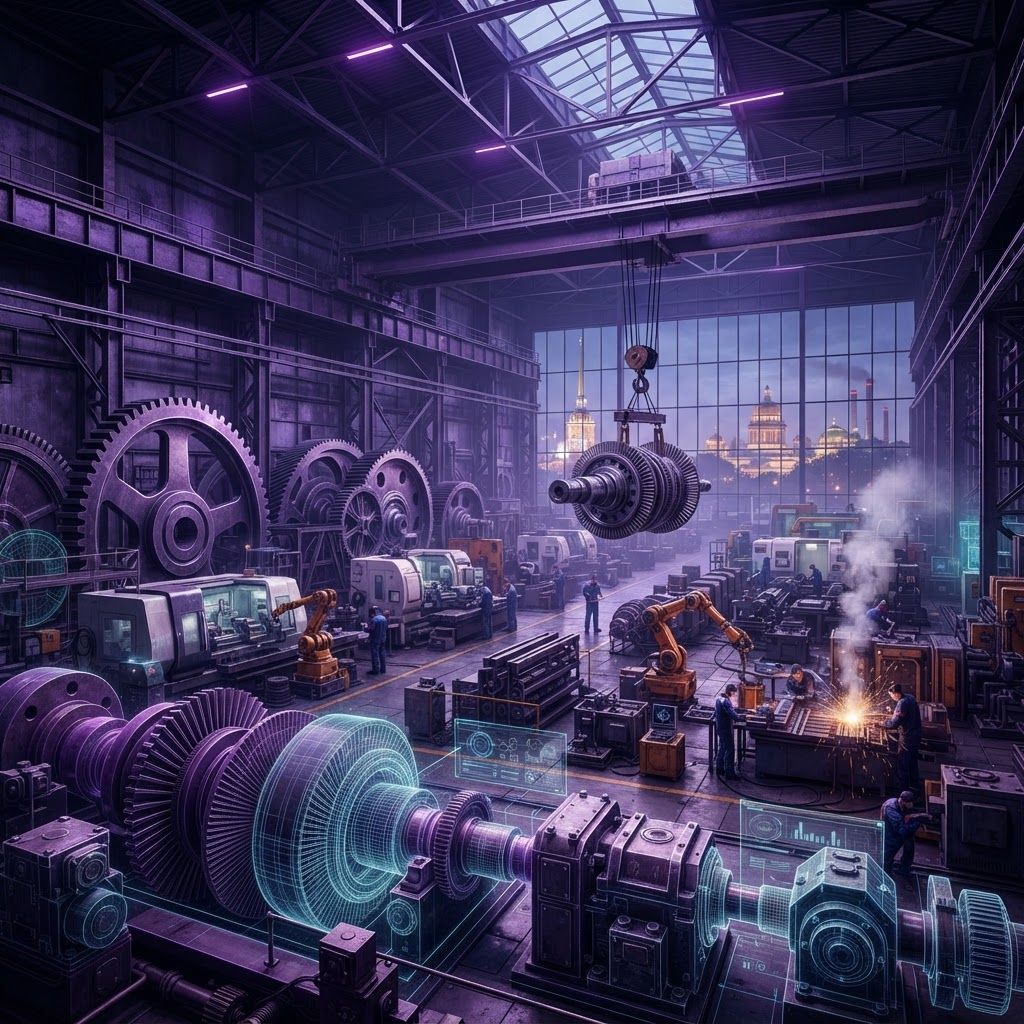
If any single industry defines St. Petersburg's industrial identity, it is machine building. The city's shipyards, turbine works and heavy engineering plants have operated for well over a century, and that continuity has produced something difficult to replicate quickly: a workforce that understands large, complex, low-volume fabrication. Welding a pressure vessel or aligning a multi-tonne rotor is not work that can be learned from a manual.
Modern machinery manufacturing in the city spans an enormous range. At one end sit heavy capital goods — power generation turbines, marine propulsion systems, port cranes and process equipment — built in single digits per year with lead times measured in months. At the other, precision machine tool and automation firms produce equipment for other factories, often in modest batches with high engineering content.
Understanding What You Are Actually Buying
Machinery procurement differs fundamentally from component sourcing. You are buying a long relationship, not a delivery. A production machine may operate for twenty years, during which you will need spare parts, technical support, software updates and eventually refurbishment. The manufacturer's stability and service capability therefore carry as much weight as the machine's specification sheet.
This is why total cost of ownership dominates serious evaluations. Energy consumption, tooling costs, expected uptime, maintenance intervals and the price of critical spares over a decade routinely dwarf the initial purchase difference between two candidate machines. Buyers who optimise only for capital cost frequently pay for it in unplanned downtime.
Ten Machinery Manufacturers Worth Considering
Neva Heavy Engineering operates at the largest scale, producing turbines, generators and heavy process equipment. Its capabilities in large-part machining and assembly make it a reference supplier for power and industrial infrastructure projects.
Baltic Shipyard Equipment builds marine machinery — winches, deck cranes, hatch systems and propulsion components — engineered for salt water and continuous duty. Marine classification experience is central to its offer.
Petrograd Machine Tools manufactures lathes, milling centres and grinding machines for other manufacturers. Rigidity, thermal stability and long-term accuracy retention are the qualities its customers emphasise.
Northern Hydraulics produces hydraulic cylinders, power packs and control systems for construction, mining and industrial applications, with strong in-house testing for pressure and cycle endurance.
Admiralty Lifting Systems specialises in cranes and material handling equipment for ports, warehouses and heavy plants, including custom configurations for constrained sites.
Fontanka Automation Engineering designs and builds automated production lines, robotic cells and bespoke assembly equipment. It suits manufacturers who need a process automated rather than a standard machine purchased.
Vyborg Pumps and Compressors manufactures rotating equipment for water treatment, chemical processing and energy applications, with a reputation for straightforward serviceability.
Ladoga Food Processing Machinery builds equipment for food and beverage production, where hygienic design, washdown resistance and compliance with food-contact standards govern every design decision.
Kolpino Metalforming Equipment produces presses, shears and bending machines for sheet metal work, supplying much of the region's fabrication sector.
Aurora Precision Systems works at the high-accuracy end, building measurement equipment, positioning stages and specialised machinery for research and semiconductor-adjacent applications.
Trends Transforming Machine Building
Digitalisation is the most visible change. Machines now ship with sensor packages and connectivity that allow condition monitoring, predictive maintenance and remote diagnostics. For operators, this converts unplanned failures into scheduled interventions — the single largest available gain in most plants. When evaluating suppliers, ask what data the machine exposes and whether you own it.
Energy efficiency has become a genuine selling point rather than a footnote. Variable-speed drives, regenerative braking on large motion axes and improved thermal management measurably reduce operating costs, and in energy-intensive processes those savings can justify replacing functional equipment.
Modularity is the third trend. Manufacturers increasingly design platforms that can be configured rather than engineered from scratch, shortening lead times while retaining flexibility. It is a pragmatic middle ground between off-the-shelf machines and fully bespoke builds.
How to Run a Machinery Procurement Process
Write a specification that describes the outcome you need, not the machine you imagine. Stating required throughput, tolerance, material range and cycle time lets experienced manufacturers propose approaches you may not have considered. Over-specifying the mechanism often locks you into a more expensive and less suitable solution.
Insist on a factory acceptance test before shipment, run with your own material and your own parts wherever possible. Define the acceptance criteria in the contract, along with the remedy if the machine fails to meet them. Then agree the commissioning plan, operator training scope and spare parts package as part of the same negotiation rather than as afterthoughts.
Finally, visit existing installations. A half-hour conversation with an operator who has run the machine for three years is worth more than any sales presentation, and reputable manufacturers are usually willing to arrange it.
Final Thoughts
St. Petersburg's machinery manufacturers combine deep heavy-engineering heritage with growing capability in automation and digital monitoring. Because machinery purchases are long-term commitments, evaluate service capacity, spare parts availability and total cost of ownership alongside the technical specification — that is where the real difference between suppliers appears.