
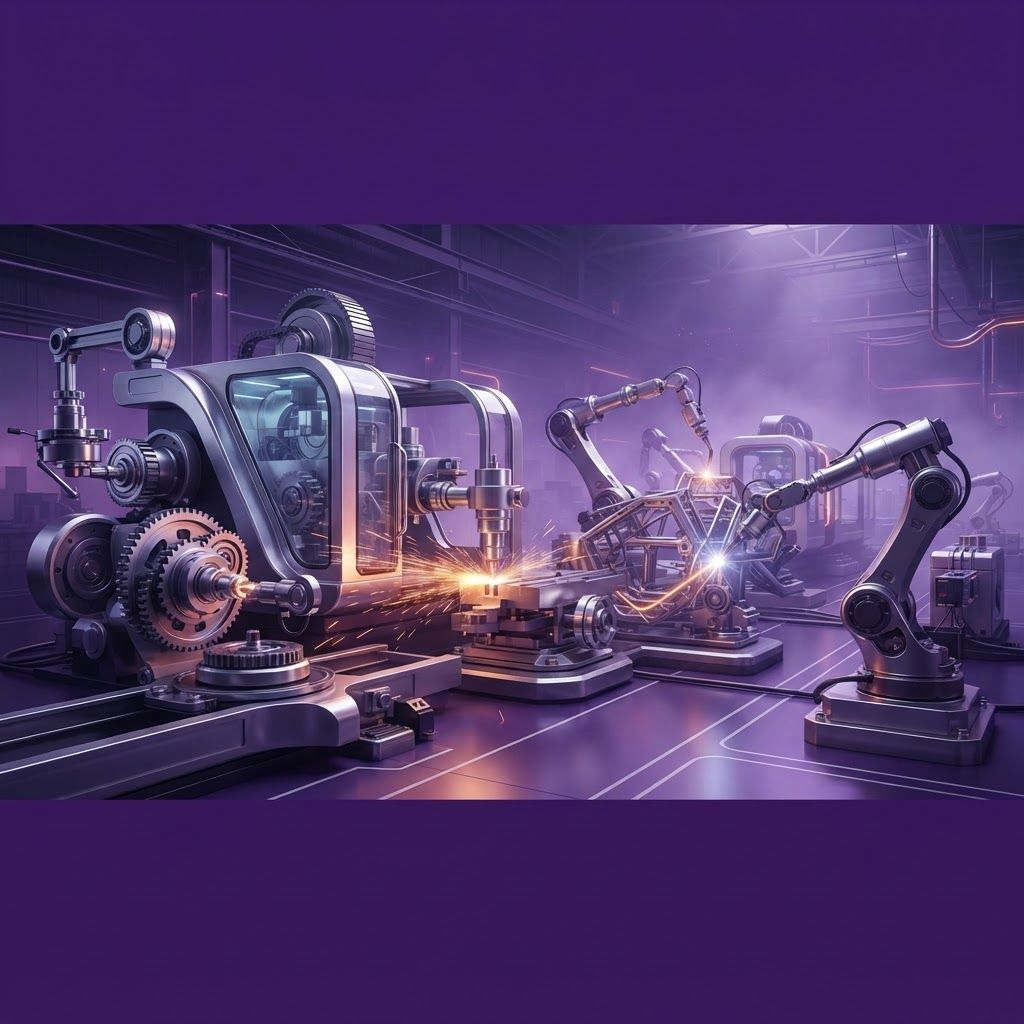
The Role of Machinery Manufacturing in Scottsdale
Machinery manufacturing rarely gets public attention, but it underpins nearly every other industry in the region. Semiconductor fabrication requires ultra-clean handling and process equipment. Arizona's mining sector needs crushing, conveying, and material handling machinery built to survive brutal duty cycles. Agriculture demands irrigation and harvesting equipment suited to arid conditions. Construction, which has expanded rapidly across the Scottsdale corridor, consumes concrete, lifting, and earthmoving equipment continuously.
Scottsdale contributes to this ecosystem primarily through engineering-intensive work: custom automation, precision equipment, controls integration, and specialty machinery designed for specific processes. Heavier fabrication typically happens in surrounding industrial areas, but design authority and project management often sit in the city.
What Buyers Should Understand About Capital Equipment
Buying machinery is fundamentally different from buying components. The purchase price is often a minority of lifetime cost once installation, training, spare parts, downtime, and energy consumption are included. Sophisticated buyers therefore evaluate total cost of ownership, parts availability, service response time, and documentation quality alongside capability specifications.
Safety and compliance also matter enormously. Machine guarding, lockout provisions, electrical standards compliance, and clear operating documentation protect both workers and the purchasing organization. Reputable manufacturers treat these as non-negotiable design inputs rather than afterthoughts.
Top 10 Best Machinery Manufacturers in Scottsdale
1. Axon Enterprise
Headquartered in Scottsdale, Axon Enterprise designs and manufactures advanced hardware systems for public safety, including devices, sensors, and connected equipment produced under rigorous quality controls. Its local manufacturing and engineering operations represent one of the city's most significant precision production capabilities.
2. Kinetic Automation Systems
Custom automation builders design and construct machines that perform assembly, inspection, packaging, and material handling tasks for regional manufacturers. Their differentiator is process engineering: understanding a client's throughput requirements and designing equipment that reliably meets cycle time targets.
3. Arizona Industrial Machine Works
Heavy fabrication and machine building operations produce conveyors, mixers, hoppers, and structural equipment for mining, aggregate, and processing customers. Capability in large-scale welding, machining, and assembly allows these firms to deliver equipment that lighter shops cannot handle.
4. Sonoran Semiconductor Equipment
Suppliers serving the semiconductor sector build wafer handling systems, cleanroom-compatible fixtures, gas delivery components, and precision subassemblies. Contamination control, tight tolerances, and comprehensive documentation are absolute requirements in this segment.
5. Desert Hydraulics and Machinery
Hydraulic systems manufacturers design and build power units, cylinders, and integrated hydraulic machinery for construction, agricultural, and industrial applications. Local rebuild and support services keep expensive equipment operating rather than idle awaiting parts.
6. Copper Valley Packaging Machinery
Packaging equipment manufacturers supply filling, capping, labeling, and case packing machines to food, beverage, nutraceutical, and consumer products companies across the Southwest. Changeover speed and sanitary design drive purchasing decisions in this category.
7. Cactus Conveyor Systems
Material handling specialists engineer belt, roller, and pallet conveyance systems for warehouses, distribution centers, and production plants. As regional logistics capacity expands, demand for integrated conveyance and sortation continues to grow.
8. Grand Canyon Water Equipment
Water treatment and pumping equipment manufacturers hold particular importance in Arizona. Products include filtration skids, reverse osmosis systems, pump stations, and reclamation equipment engineered for water-scarce operating conditions and stringent regulatory oversight.
9. Valley Precision Tooling
Tool and die manufacturers produce dies, molds, jigs, and fixtures that enable other manufacturers to produce parts accurately. Precision grinding, EDM capability, and metrology equipment define quality in this foundational trade.
10. Southwest Robotics Integration
Robotic integrators combine industrial robots, vision systems, end effectors, and safety architecture into working cells. For manufacturers facing labor constraints, well-executed robotic integration delivers consistent throughput without proportional headcount growth.
Trends in Machinery Manufacturing
Industrial automation and connectivity dominate current investment. Equipment increasingly ships with sensors and network connectivity that enable condition monitoring, predictive maintenance, and remote diagnostics, reducing unplanned downtime substantially.
Energy efficiency has become a purchasing criterion rather than a bonus feature. Variable frequency drives, servo actuation, and optimized hydraulic circuits cut operating costs meaningfully over a machine's decade-plus service life, which matters in a high-electricity-cost environment.
Modularity is another notable shift. Buyers want equipment that can be reconfigured as products change instead of purpose-built machines that become obsolete when a product line evolves. Manufacturers responding with modular platforms tend to win longer-term relationships.
How to Evaluate a Machinery Manufacturer
Request a factory acceptance test plan before ordering, and define performance criteria in measurable terms: throughput, uptime, scrap rate, and cycle time. Ambiguity at this stage produces disputes later.
Investigate service infrastructure carefully. Ask about typical parts lead times, whether critical spares are stocked domestically, how field service is dispatched, and what training is included. Also review documentation samples, since electrical schematics, maintenance manuals, and parts lists determine how maintainable a machine is years after installation.
Final Thoughts
Machinery manufacturers serving Scottsdale range from publicly traded technology hardware producers to specialized automation and heavy equipment builders. Because capital equipment decisions shape production capability for many years, the evaluation deserves proportional rigor. Focus on engineering depth, service commitment, and documented performance rather than initial quotation alone, and the resulting equipment will earn its cost repeatedly.