
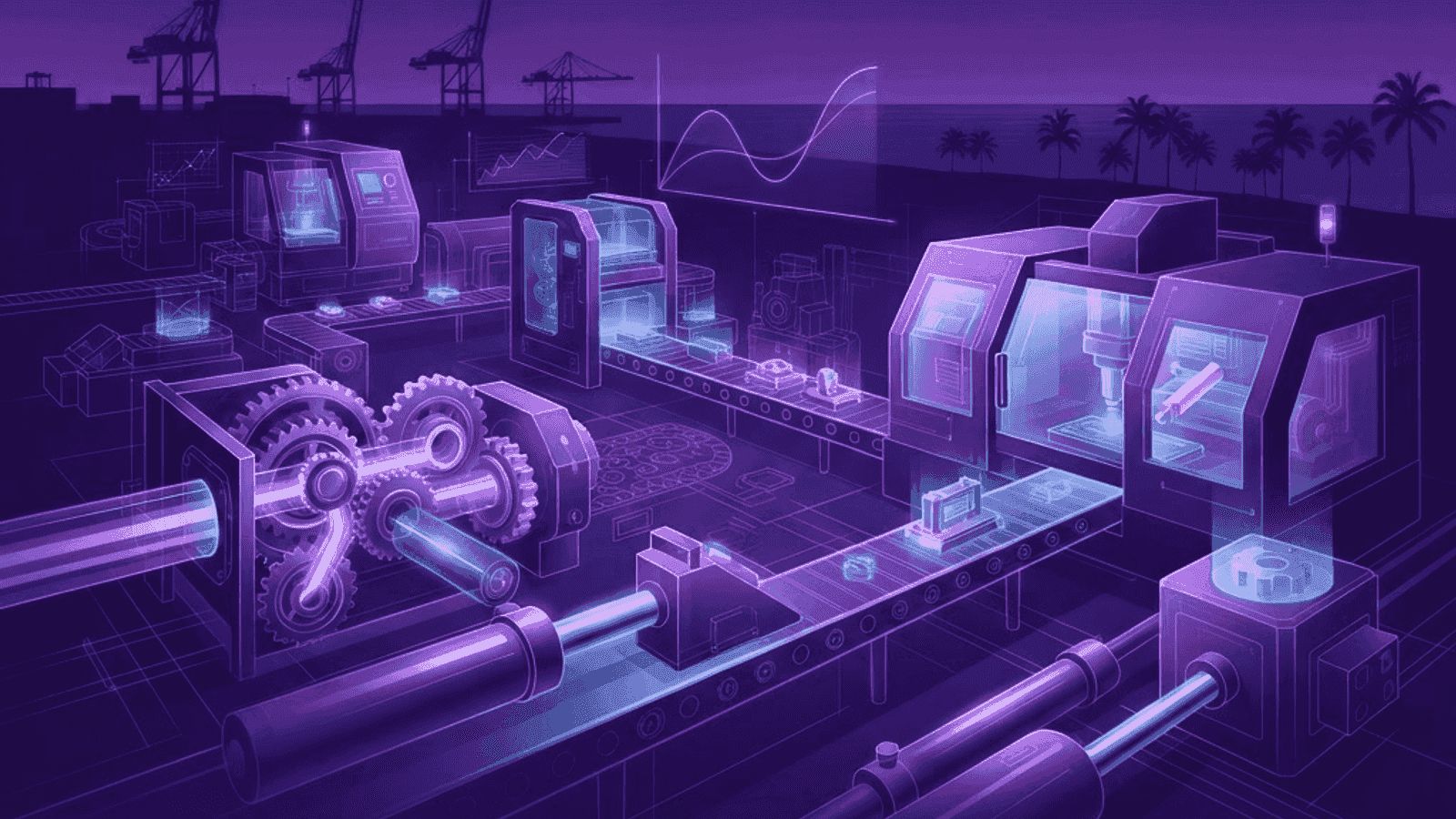
Machinery is the quiet backbone of Hawaii's economy. Harbor cranes move the containers that supply the islands, processing equipment handles agricultural output, pumps and filtration systems deliver water, and conveyors and mixers support construction across Oahu. When any of it stops, the cost of waiting for a mainland replacement is measured in days of lost production and freight charges that dwarf the original part price. That reality has made Honolulu's machinery manufacturers unusually resourceful.
These companies do more than build machines. They reverse-engineer discontinued components, retrofit aging equipment with modern controls, and design purpose-built systems for operations too specialized to buy off the shelf. This guide explains how the sector works and identifies ten manufacturers with strong reputations across the island.
Why Local Machinery Manufacturing Is Essential in Honolulu
The economics of isolation drive everything. A hydraulic cylinder, gearbox, or custom auger that could be next-day shipped on the mainland may take weeks to reach Oahu, and oversized items require special handling. Local machinery manufacturers compress that timeline by fabricating from raw stock, machining replacement parts to original specifications, and holding common material on hand.
Local builders also understand island operating conditions in a way distant suppliers cannot. Equipment here contends with salt-laden air, volcanic soil abrasiveness, high humidity, and limited space in dense urban and harbor environments. Machines designed with those constraints in mind last longer and require less unplanned maintenance, which is why so many operators favor locally built or locally modified equipment.
Trends Reshaping Machinery Manufacturing
Automation and controls modernization dominate current activity. Rather than replacing structurally sound machines, operators increasingly retrofit them with programmable logic controllers, variable frequency drives, servo actuation, and human-machine interfaces. The result is better throughput, energy savings, and data visibility at a fraction of replacement cost.
Predictive maintenance is close behind. Vibration sensors, thermal monitoring, and current signature analysis let operators schedule interventions before failures cascade, which is especially valuable when spare parts are far away. Additive manufacturing and advanced CNC capability have expanded what small shops can produce, letting them prototype tooling and produce complex geometries in-house. Energy efficiency requirements, driven by Hawaii's high electricity costs, push designers toward efficient motors, optimized hydraulics, and heat recovery. Finally, safety compliance and machine guarding standards continue to tighten, making documentation and risk assessment part of every serious build.
Top 10 Best Machinery Manufacturers in Honolulu
1. Pacific Machine Works
Pacific Machine Works is among the island's most comprehensive machinery builders, combining CNC machining, heavy welding, and mechanical assembly. The company is known for tackling large custom projects end to end, from concept drawings and stress analysis through commissioning and operator training, and it maintains a strong reputation with harbor and industrial clients.
2. Island Industrial Machinery
Island Industrial Machinery focuses on conveying, mixing, and material handling systems for construction and food processing operations. Its engineers design around real throughput data rather than catalog assumptions, and the shop's modular approach makes future capacity expansion straightforward.
3. Oahu Precision Machining
Oahu Precision Machining specializes in tight-tolerance components, shafts, bushings, gears, and replacement parts reverse-engineered from worn originals. With multi-axis machining and metrology capability, the company is a frequent lifeline for operators of legacy equipment whose manufacturers no longer supply parts.
4. Aloha Hydraulics & Systems
Aloha Hydraulics & Systems builds and rebuilds hydraulic power units, cylinders, and control manifolds for construction, marine, and utility equipment. The company's diagnostic depth in fluid power, combined with on-site service capability, minimizes downtime for customers with equipment spread across the island.
5. Diamond Head Equipment Manufacturing
Diamond Head Equipment Manufacturing designs purpose-built machines for niche applications, including agricultural processing lines and custom test rigs for research programs. Clients value its collaborative development process, in which prototypes are refined iteratively with operator feedback before final build.
6. Kalihi Fabrication & Machinery
Located in Honolulu's industrial district, Kalihi Fabrication & Machinery pairs structural fabrication with mechanical assembly, producing frames, skids, platforms, and integrated equipment packages. The company's practical, problem-solving culture makes it a common first call for urgent repairs and field modifications.
7. TradeWinds Automation
TradeWinds Automation concentrates on controls engineering, retrofitting existing machinery with modern programmable controllers, drives, sensors, and operator interfaces. Its documentation standards and remote diagnostic support are frequently cited as differentiators by utility and manufacturing clients.
8. Waipahu Heavy Equipment Works
Waipahu Heavy Equipment Works serves construction and quarry operations with custom attachments, wear-part fabrication, and structural rebuilds of heavy machinery. Its expertise in abrasion-resistant materials and hardfacing significantly extends component life in demanding island conditions.
9. Hawaii Pump & Process Systems
Hawaii Pump & Process Systems builds and integrates pumping, filtration, and process skids for water treatment, irrigation, and industrial fluid handling. The company's systems approach, covering piping, instrumentation, and controls, appeals to municipal and agricultural clients who need turnkey delivery.
10. Coral Reef Machine & Tool
Coral Reef Machine & Tool completes the list with tooling, jigs, fixtures, and small-batch machined assemblies. For manufacturers and repair shops that need production aids quickly, its fast turnaround and tooling design expertise make it a valuable local resource.
How to Choose the Right Machinery Manufacturer
Match capability to the actual task. Precision machining shops, heavy fabricators, and controls integrators are different disciplines, and the strongest projects assign each portion to a company that genuinely specializes in it. When a single vendor claims all three, ask for specific examples and equipment lists.
Insist on engineering documentation. Fabrication drawings, weld procedure specifications, material certifications, bill of materials, electrical schematics, and an operations and maintenance manual are what make a machine supportable five years later. A builder reluctant to provide documentation is creating future dependency.
Evaluate service and spares. Ask how quickly a technician can reach your site, whether critical wear parts are stocked locally, and what the recommended spares package includes. In Hawaii, aftersales support often determines total cost of ownership more than build price. Also review safety compliance directly: guarding, emergency stops, lockout provisions, and a documented risk assessment should be standard, not optional extras.
Finally, discuss lifecycle planning. The best machinery partners will tell you honestly when retrofitting an existing asset makes more sense than buying new, and will design equipment so that future upgrades do not require starting over.
Final Thoughts
Honolulu's machinery manufacturers have turned geographic constraint into a competitive strength built on versatility, reverse engineering, and fast response. Whether you need a custom processing line, a hydraulic rebuild, a controls retrofit, or a machined part that no longer exists in any catalog, capable partners are available on the island. Define your throughput and duty requirements clearly, demand complete documentation, and weight aftersales support heavily in your decision. Equipment that is designed, built, and supported locally tends to run longer and cost less over its life.