
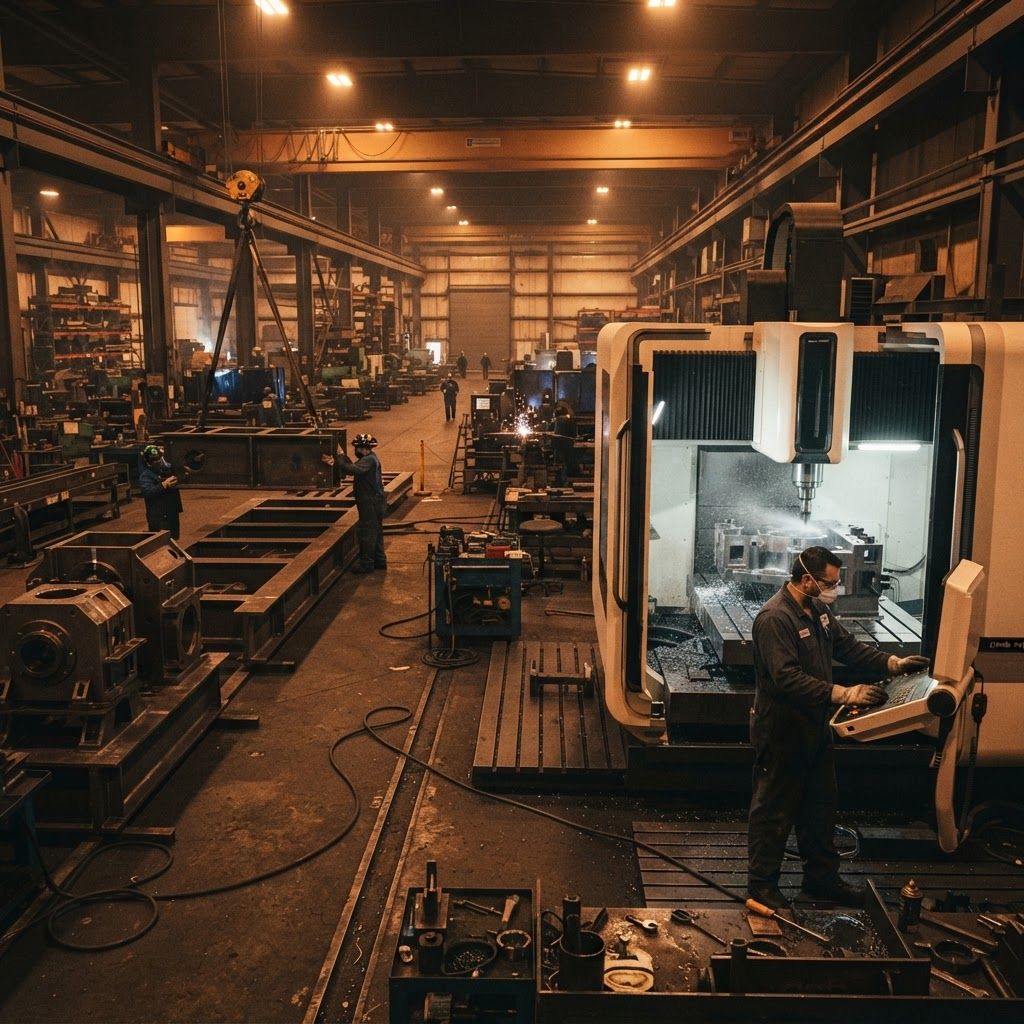
Machinery and Industrial Capability in North Texas
Frisco's visible economy is retail, sport, technology, and professional services, but underneath it sits a substantial industrial base. Every warehouse, data center, medical facility, and mixed-use development depends on machinery: cranes and earthmoving equipment during construction, conveyors and packaging lines in distribution, pumps and chillers in mechanical rooms, and custom automation on production floors.
North Texas hosts a dense cluster of machinery manufacturers, fabricators, and integrators serving those needs. Their proximity matters because industrial equipment requires installation, commissioning, spare parts, and rapid service response, all of which favor regional suppliers over distant ones.
Ten Machinery Manufacturers and Fabrication Specialists
Caterpillar supplies earthmoving, power generation, and industrial engines widely deployed on North Texas construction sites and in backup power installations.
Peterbilt Motors builds heavy-duty trucks in Denton, functioning as both a machinery manufacturer and a major regional industrial employer.
Bell Textron manufactures rotorcraft in North Texas, anchoring a precision machining and composites supply base that serves broader industrial markets.
Trinity Industries produces railcars and related industrial products, with engineering and manufacturing operations tied to Texas logistics infrastructure.
Chart Industries supplies cryogenic and process equipment used in industrial gas, energy, and specialty applications.
Flowserve manufactures pumps, valves, and seals for energy, water, and process industries, with substantial Texas engineering and service capability.
Elliott Machine Works and comparable regional fabricators provide custom machining, weldments, and structural assemblies for industrial customers.
Wagner Machine style precision shops in the metroplex deliver CNC machining, tooling, and fixtures supporting local manufacturers.
Rockwell Automation distributors and integrators serving North Texas design and build control panels, motion systems, and automated production cells.
Texas Industrial Conveyor Solutions completes the list with material handling systems for distribution centers and manufacturing plants across the region.
How to Specify Capital Equipment
Poor specification is the most common source of disappointing equipment purchases. A strong specification defines throughput requirements at realistic operating conditions, not peak laboratory rates. It documents utilities available, footprint constraints, ambient conditions, product variability, and required changeover times.
Include acceptance criteria. A factory acceptance test verifies the machine performs at the builder's facility, and a site acceptance test verifies performance after installation with actual materials. Tying a portion of payment to site acceptance aligns incentives strongly.
Specify spare parts and documentation as deliverables. Recommended spares lists, electrical schematics, programmable controller source files, and operator training should appear in the purchase order rather than becoming a later negotiation.
Industry Trends
Automation demand continues to rise as labor costs increase and skilled operators become harder to recruit. Collaborative robots, vision-guided picking, and modular conveyance let smaller operations automate incrementally rather than through a single large project.
Connected machinery has matured. Sensors monitoring vibration, temperature, and current draw feed analytics that predict bearing and motor failures before they cause downtime. The economic case is strong in continuous operations where an unplanned stoppage costs far more than the monitoring hardware.
Energy efficiency has become a purchasing criterion rather than an afterthought. Variable frequency drives, high-efficiency motors, and heat recovery reduce operating cost meaningfully across equipment lifetimes that often exceed fifteen years.
Lead times remain a planning constraint. Electrical components, controllers, and large castings can carry extended delivery schedules, so capital projects need procurement to begin well before installation windows.
Evaluating a Machinery Supplier
Visit the shop. Machine condition, organization, welding quality, and in-process inspection reveal more than a brochure. Ask to see a machine of similar complexity under construction and speak with the engineers who will actually execute the project.
Assess service depth. Confirm the number of field service technicians within driving distance, typical response times, and parts stocking practices. For critical equipment, negotiate a service agreement with defined response commitments rather than relying on best efforts.
Check references from customers who have operated the equipment for at least two years, since early performance rarely reveals durability issues.
Total Cost of Ownership
Purchase price typically represents a minority of lifetime cost. Energy consumption, consumables, maintenance labor, spare parts, and downtime dominate. A machine costing more upfront but running with higher availability and lower energy draw frequently wins over a decade. Building a simple model with conservative assumptions clarifies these tradeoffs quickly.
Final Thoughts
The machinery sector serving Frisco combines global manufacturers with capable regional fabricators and integrators. Buyers who invest effort in precise specification, meaningful acceptance testing, and realistic total cost analysis consistently achieve better outcomes than those selecting on price and delivery date alone. Proximity to service support remains one of the most undervalued factors in industrial procurement.