
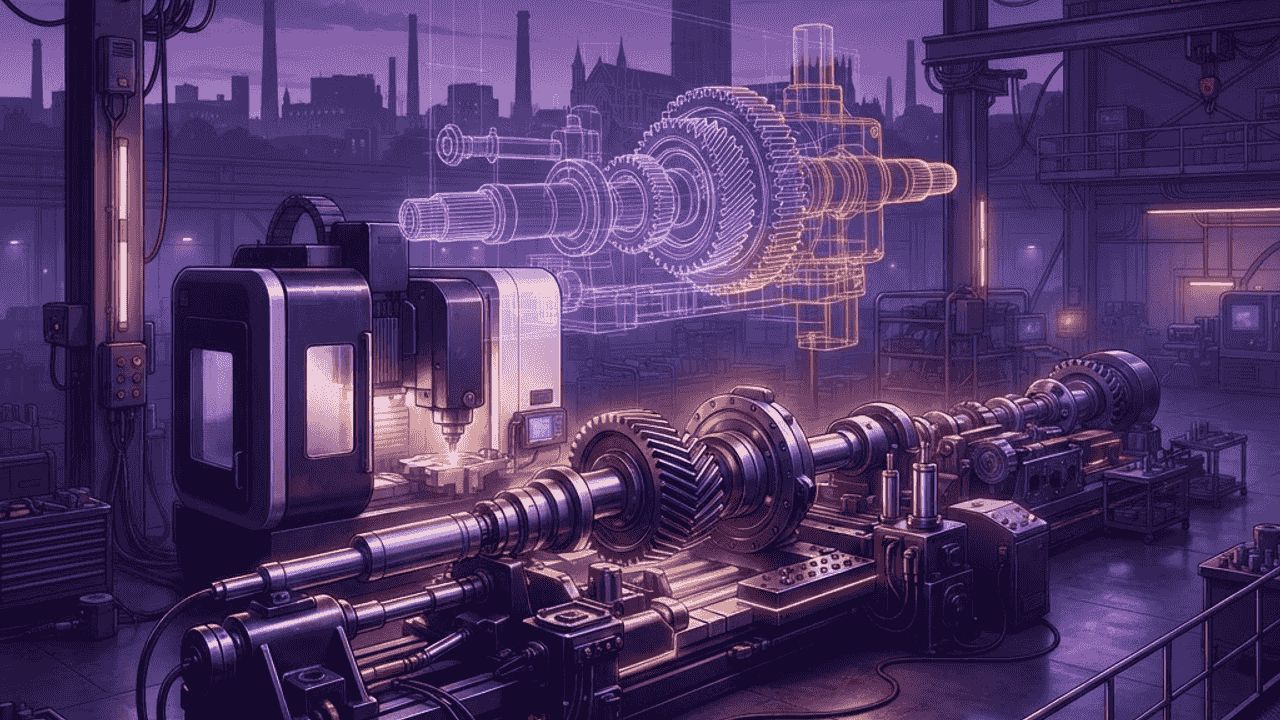
Heavy Engineering With Deep Roots
Machinery manufacturing in County Durham traces directly to the coalfield. Mines required winding gear, conveyors, cutting equipment, pumps and hydraulics, and the workshops that supplied them developed capabilities in heavy fabrication, precision machining, gear cutting and hydraulic systems. When deep mining ended, that engineering knowledge did not disappear. It redirected towards quarrying, materials handling, process equipment, rail, defence, offshore energy and general industrial machinery.
Today the county hosts a mix of original equipment manufacturers designing complete machines and subcontract engineering firms producing components and assemblies for others. Both benefit from an available skills base in welding, fitting, computer-controlled machining and mechanical design, and from industrial premises with the crane capacity and floor loading that heavy engineering requires.
Ten Machinery and Engineering Businesses
Ebac Group
Based in Newton Aycliffe, Ebac designs and manufactures dehumidifiers, water coolers and washing machines, and is notable as a manufacturer that retained UK production of consumer and commercial appliances rather than offshoring assembly.
Elddis Transport Engineering
County Durham engineering and vehicle bodybuilding operations of this type design and construct specialist bodies, trailers and handling equipment, combining fabrication with mechanical and hydraulic integration.
Thomas Swan Engineering Services
Industrial engineering divisions supporting process plants in the county provide bespoke equipment fabrication, pressure vessels and process machinery built to demanding certification standards.
Tharsus
Designing and manufacturing complex electromechanical machines and robotic systems, Tharsus works with clients commercialising automation products, and represents the higher-technology end of regional machine building.
Houghton International
Specialising in electromechanical engineering, motor and generator repair and rewinding, this North East business keeps heavy rotating machinery operating across energy, rail and industrial sectors.
Pearson Engineering
Designing and manufacturing specialist vehicle-mounted equipment and heavy engineering assemblies, this manufacturer illustrates how defence and specialist markets sustain high-value regional fabrication.
Reece Group
A North East engineering group encompassing precision machining, subsea equipment and specialist manufacturing, Reece supports offshore energy, defence and industrial customers requiring engineered-to-order machinery.
Express Engineering
Providing precision machining, subsea components and toolmaking for energy and industrial customers, this business operates at close tolerances on high-integrity components where material traceability is essential.
Nikken Kosakusho Europe
Manufacturing rotary tables, tooling systems and machine tool accessories in the North East, Nikken supplies precision engineering companies across the UK, supporting the wider machining sector.
Darchem Engineering
Producing thermal insulation systems, engineered enclosures and specialist fabrications for nuclear, aerospace and energy applications, Darchem operates in the most heavily qualified end of the engineering market.
Automation Is Reshaping Machine Building
The most significant change in machinery manufacturing is the integration of control, sensing and software into products that were once purely mechanical. A modern materials handling system includes programmable control, condition monitoring sensors, remote diagnostics and safety interlocking designed to recognised functional safety standards. Machine builders therefore need electrical, control and software competence alongside mechanical design, and firms that have added those skills have moved decisively up the value chain.
Condition monitoring in particular has changed customer expectations. Equipment that reports bearing temperature, vibration signature and duty cycle allows predictive maintenance rather than reactive repair, reducing downtime for the customer and creating recurring service revenue for the manufacturer. For County Durham firms supplying quarries, process plants and rail operators, this shift from selling machines to supporting availability is a substantial commercial opportunity.
Robotics and flexible automation also affect internal production. Machining cells with automated loading, in-process measurement and lights-out operation allow regional firms to compete on cost for complex parts despite higher labour rates.
Subcontract Machining Considerations
A large share of County Durham engineering capacity serves other manufacturers rather than end users. Buyers commissioning machined components should assess several factors carefully. Machine envelope and axis configuration determine what geometry is achievable in a single setup, and fewer setups mean better accuracy and lower cost. Metrology capability matters as much as machining, since verified tolerance requires calibrated measurement, ideally with coordinate measuring capability and documented gauge control.
Material sourcing and traceability are decisive for regulated applications. Nuclear, aerospace, offshore and rail customers require certified material with full documentation from mill to finished part, and suppliers without those systems cannot serve those markets regardless of machining skill.
How to Evaluate an Engineering Partner
Visit the workshop. Housekeeping, tool management, work-in-progress control and calibration records reveal process discipline immediately. Ask about lead time reliability and request performance data rather than assurances, since delivery failure in machinery supply usually cascades into customer downtime.
Discuss design involvement. Firms that review drawings critically, suggest manufacturable alternatives and identify tolerance conflicts before cutting metal save considerable cost. Confirm capacity for both prototype and repeat production if you need both, and clarify how tooling, fixtures and intellectual property are handled.
For complete machine purchases, examine aftersales support closely. Spare part availability, response times, remote diagnostic capability and training provision determine total cost of ownership far more than purchase price.
Final Thoughts
Machinery manufacturing in County Durham has evolved from colliery equipment to precision engineering, automation and highly qualified specialist fabrication. The companies above span appliance production, subsea components, robotics, electromechanical services and nuclear-grade engineering. For buyers, the reliable indicators remain verified process discipline, metrology capability, material traceability and genuine engineering engagement rather than simple price comparison.