
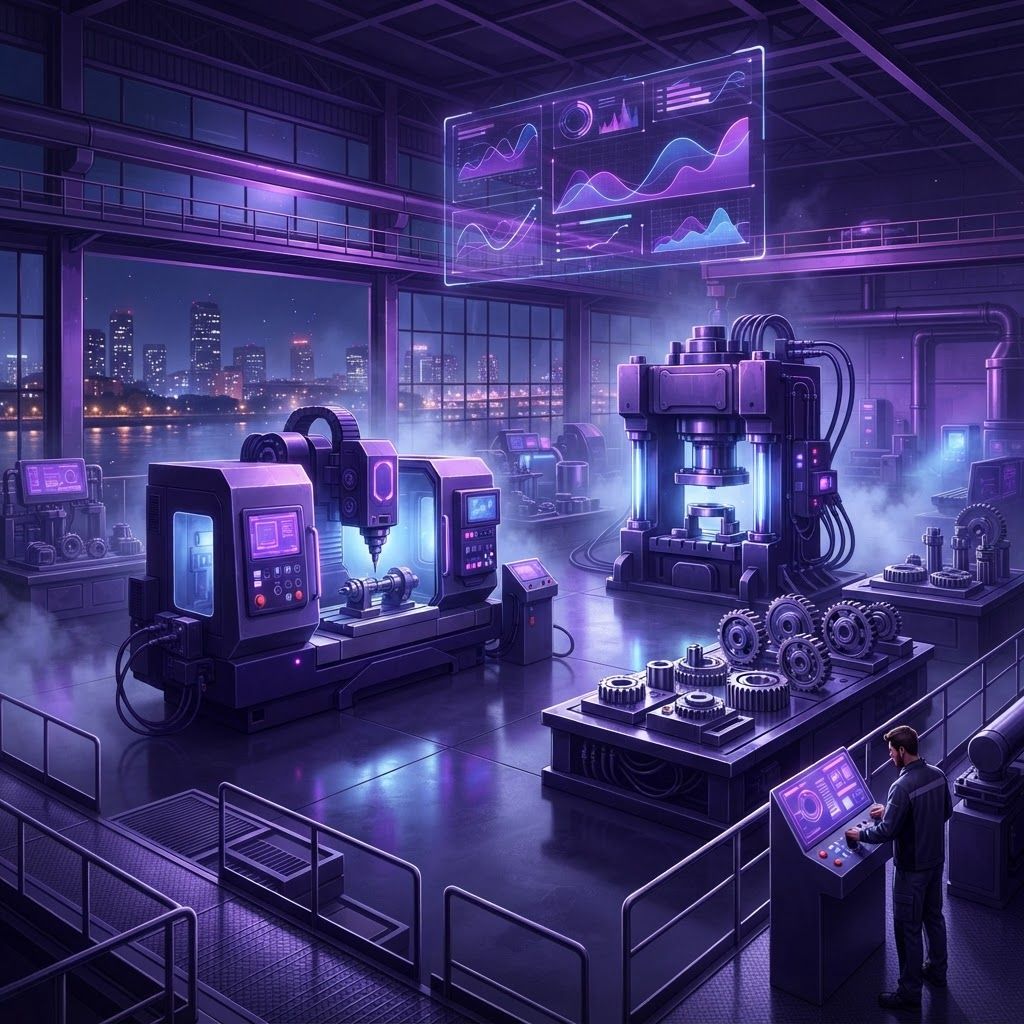
A Machine Tool Legacy That Still Matters
Few American cities are as historically tied to machinery manufacturing as Cincinnati. For much of the twentieth century the region was a global center for machine tools, producing milling machines, grinders, and metalworking equipment shipped worldwide. That industry consolidated and restructured significantly, but its legacy persists in the form of deep engineering talent, precision machining capacity, apprenticeship traditions, and a supplier network capable of building complex capital equipment.
Today the regional machinery sector spans plastics processing equipment, packaging and filling machinery, material handling and conveying systems, custom automation and robotic work cells, machine tool rebuilding and retrofits, food processing equipment, and specialized industrial machines built to order.
Machinery Manufacturers and Builders in the Region
Milacron remains one of the most recognizable Cincinnati area machinery names, producing injection molding machines, extrusion equipment, and hot runner systems for the global plastics processing industry.
Sunnen style precision honing and bore finishing equipment makers and comparable regional builders serve engine, hydraulic, and aerospace component manufacturers requiring exceptional bore geometry control.
Cincinnati Incorporated builds press brakes, shears, laser cutting systems, and additive manufacturing equipment, continuing a long lineage of metal fabrication machinery production in the region.
Meyer Tool and precision machining specialists support machinery builders with high-tolerance components, weldments, and complex assemblies.
Kendall style automation integrators and regional systems houses design robotic cells, vision inspection stations, and end-of-line automation tailored to specific production challenges.
ProMach affiliated packaging machinery operations serving the Ohio Valley supply filling, capping, labeling, case packing, and palletizing equipment to food, beverage, and consumer goods manufacturers.
Hydro Systems, based in the Cincinnati area, engineers chemical dispensing and dilution equipment used in commercial laundry, food service, and industrial cleaning applications.
Regional conveyor and material handling manufacturers build belt, roller, and overhead systems along with sortation equipment for distribution and manufacturing facilities.
Machine rebuilders and retrofit specialists in the region restore and modernize legacy machine tools, replacing controls and drives to extend useful life at a fraction of replacement cost.
Custom machine builders and job shops throughout the tri-state area design one-off equipment for unique processes, often the only practical option when no catalog machine fits the application.
Trends Driving Machinery Demand
Labor availability has become the strongest driver of automation investment. Manufacturers facing persistent difficulty staffing repetitive or physically demanding positions increasingly justify robotic cells and automated material handling on staffing grounds rather than pure labor cost arbitrage.
Connectivity and data collection are now standard expectations. Buyers want machines that report cycle counts, downtime reasons, energy consumption, and quality data to plant systems. This shifts differentiation toward controls architecture, cybersecurity practices, and data integration rather than mechanical design alone.
Flexibility increasingly outweighs peak throughput. Shorter product life cycles and higher product variety mean machines that changeover quickly and handle multiple part families deliver more value than dedicated high-speed equipment that becomes obsolete when the product changes.
Service and spare parts availability influence purchasing heavily. Domestic builders compete effectively against lower-cost imports by offering rapid technical support, local field service, and long-term parts availability, factors that dominate total cost of ownership over a machine's decades-long life.
How to Evaluate a Machinery Supplier
Begin with application fit and reference installations. Ask to see machines running similar parts at similar rates, ideally at a customer site rather than only in the builder's showroom. Request documented performance on comparable projects including achieved cycle times, uptime, and scrap rates.
Scrutinize the specification and acceptance criteria. A well-written purchase specification defines throughput at a stated quality level, changeover time, utility requirements, footprint, safety standards compliance, controls platform, spare parts list, and factory and site acceptance test procedures. Ambiguity here causes most capital equipment disputes.
Evaluate engineering depth, including mechanical, electrical, controls, and software resources, and whether design is performed in house. Confirm safety compliance with applicable machinery standards, risk assessment documentation, and guarding design. Discuss training, documentation quality, remote support capability, and typical response time for field service.
Finally, address commercial terms carefully: payment milestones tied to demonstrated progress, warranty scope and duration, liability for delayed delivery, and ownership of designs and controls source code, which matters greatly if you later need modifications.
Final Thoughts
Cincinnati's machinery manufacturers combine historical engineering depth with modern automation and controls capability. The region can supply everything from globally distributed plastics processing equipment to bespoke automation cells built for a single process. Buyers who write rigorous specifications, verify performance at reference sites, and weigh long-term service and parts support alongside purchase price consistently achieve better outcomes on capital equipment investments.